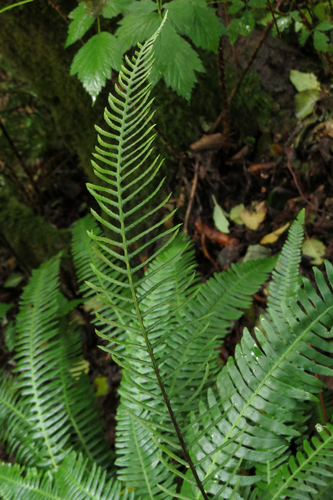
(c) Harsi S. Parker, some rights reserved (CC BY-NC), uploaded by Harsi S. Parker · cc-by-nc
Blechnum
Sign in to saveAlso known as Hard Fern
Blechnum, known as hard fern, is a genus of ferns in the family Blechnaceae, subfamily Blechnoideae, according to the Pteridophyte Phylogeny Group classification of 2016 (PPG I). Two very different circumscriptions of the genus are used by different authors. In the PPG I system, based on Gasper et al. (2016), Blechnum is one of 18 genera in the subfamily Blechnoideae, and has about 30 species. Other sources use a very broadly defined Blechnum s.l., including accepting only two other genera in the subfamily. The genus then has about 250 species. In the PPG I circumscription, the genus is mostly
Species
deer fern
GENUS
- KingdomPlantae
- PhylumTracheophyta
- ClassPolypodiopsida
- OrderPolypodiales
- FamilyBlechnaceae
Common Name: lemaru
via GBIF · Kew POWO
Museum specimens
- Specimen records
- 4,393
- With media
- 3,104
- Family
- Blechnaceae
- Collections
- UNIVERSITY OF ALBERTA MUSEUMS, BRIT, INECOL, DUKE, UNICACH, FC-UNAM
- Recorded in
- New Zealand, Peru, Mexico, Philippines, Costa Rica, Indonesia, Panama, Bolivia
Wikidata facts
- Instance of
- taxon
- Image
- Blechnum chilense 1.jpg
Show 6 more facts
- Commons category
- Blechnum
- taxon rank
- genus
- taxon name
- Blechnum
- topic's main category
- Category:Blechnum
- taxon common name
- 乌毛蕨属
Sources (3)
via Wikidata · CC0
~3 min read
Encyclopedic overview
6 sectionsContents
- Description
- Species
- Hybrids
- References
- Further reading
- External links
Blechnum, known as hard fern, is a genus of ferns in the family Blechnaceae, subfamily Blechnoideae, according to the Pteridophyte Phylogeny Group classification of 2016 (PPG I). Two very different circumscriptions of the genus are used by different authors. In the PPG I system, based on Gasper et al. (2016), Blechnum is one of 18 genera in the subfamily Blechnoideae, and has about 30 species. Other sources use a very broadly defined Blechnum s.l., including accepting only two other genera in the subfamily. The genus then has about 250 species. In the PPG I circumscription, the genus is mostly neotropical, with a few southern African species.
== Description == Plants in the genus Blechnum (as circumscribed in the PPG I classification) are mainly terrestrial or grow on rocks; few are epiphytes. Their rhizomes may be upright or creeping and have scales with entire margins or at most a few very small teeth. They generally form stolons, which is a characteristic of the genus. The sterile and fertile fronds are usually of the same form or at most slightly different. The blades of the fronds are of one colour and are usually pinnatisect or unipinnate, rarely entire. The leaf veins are usually free, dividing one to three times, each ending near the frond margin in an enlarged tip. The sori have indusia (scale-like coverings).
Excerpted from Wikipedia’s “Blechnum” article, available under the CC BY-SA 4.0 licence.