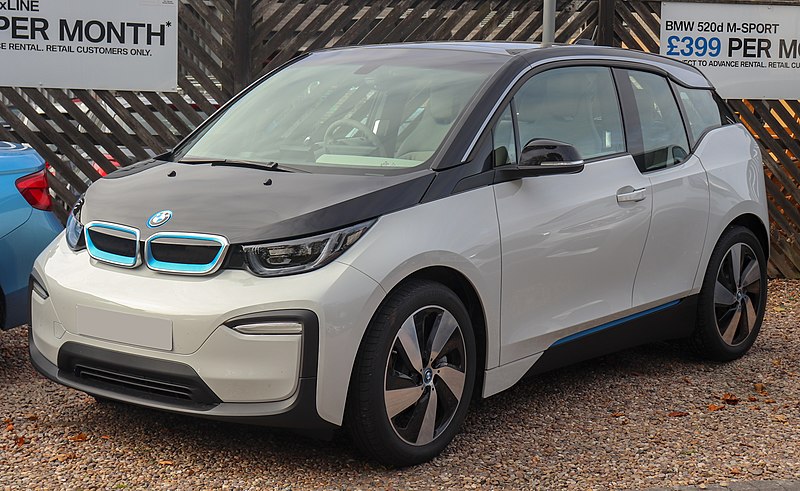
File:2018_BMW_i3_facelift_(1).jpg · Wikimedia Commons · See Wikimedia Commons
Key facts
- Manufacturer
- BMW
- Model code
- I01
- Production
- September 2013 – August 2022 (250,000 units)
- Model years
- 2014–2021 (North America)
- Assembly
- Germany: Leipzig (BMW Group Plant Leipzig)
- Designer
- Richard Kim
- Class
- Supermini / subcompact car ( B )
- Body style
- 5-door hatchback
- Layout
- Rear-motor, rear-wheel-drive
- Platform
- LifeDrive architecture
- Doors
- Conventional doors (front), Suicide doors (rear)
- Chassis
- Carbon-fiber body-on-frame
- Engine
- 647 cc W20K06U0 I2 range extender
- Electric motor
- BMW eDrive synchronous permanent magnet motor 125 kW 137 kW
- Transmission
- Single speed with fixed ratio
- Hybrid drivetrain
- Series plug-in hybrid , Extended-range electric vehicle (i3 REx)
- Battery
- i3 60 Ah : 18.2 kWh (22 gross) lithium-ion , i3 94 Ah : 27.2 kWh (33 gross) lithium-ion , i3 120 Ah : 37.9 kWh (42.2 gross) lithium-ion
- Plug in charging
- 7.4 kW on-board charger on IEC Combo AC , optional 50 kW Combo DC, DCFC standard on 2015+ models in the US market.
via Wikipedia infobox
Wikidata facts
- Instance of
- car model
- Subclass of
- electric car
- Manufacturer
- BMW
- Image
- 2018 BMW i3 facelift (1).jpg
- Height
- 1578
- Width
- 1775
- Length
- 3999
- Brand
- BMW
Show 5 more facts
- location of creation
- Leipzig
- powered by
- electric motor
- wheelbase
- 2570
- different from
- BMW 3 Series
- Commons category
- BMW I01
via Wikidata · CC0
~33 min read
Encyclopedic overview
The BMW i3 is an electric car that was manufactured by German marque BMW from 2013 to 2022. The i3 was BMW's first mass-produced zero emissions vehicle and was launched as part of BMW's electric vehicle BMW i sub-brand. It is a B-segment, high-roof hatchback with an electric powertrain. It uses rear-wheel drive via a single-speed transmission and an underfloor lithium-ion battery pack with an optional range-extending petrol engine.
Styled by Richard Kim, the i3 is a five-door with a passenger module of high strength, ultra-lightweight carbon fibre reinforced polymer adhered to an aluminium chassis, battery, drive system and powertrain. The body features two clamshell rear-hinged rear doors.
Excerpted from Wikipedia’s “BMW i3” article, available under the CC BY-SA 4.0 licence.