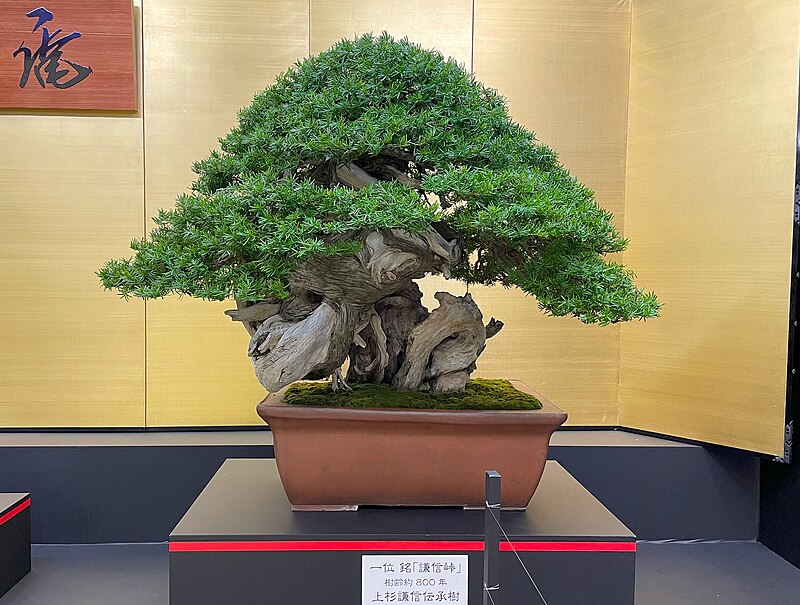
File:Bonsai,_Kenshin_Toge.jpg · Wikimedia Commons · See Wikimedia Commons
bonsai
Sign in to saveAlso known as bonsai tree
thumb|260px|Bonsai, named "Kenshin Tōge" (). Japanese yew (Taxus cuspidata) presented by [[Uesugi Kenshin to Nagao Masakage. The tree is estimated to be about 800 years old.]] thumb|Bonsai at the Omiya Bonsai Art Museum thumb|Bonsai at the National Bonsai & Penjing Museum at the United States National Arboretum
Bonsai is the art of cultivating and shaping miniature trees, a practice with roots in Japanese tradition that has been preserved in institutions like the Omiya Bonsai Art Museum and the National Bonsai & Penjing Museum. These carefully maintained trees can live for centuries—some specimens, like a Japanese yew presented by a historical figure, are estimated to be around 800 years old—making bonsai both an artistic practice and a form of living cultural heritage.
AI-generated from the Wikipedia summary — may contain errors.
Wikidata facts
- Instance of
- hobby
- Subclass of
- container gardening
- Country
- China
- Country of origin
- Japan
- Image
- BonsaiTridentMaple.jpg
Show 4 more facts
- Commons category
- Bonsai
- topic's main category
- Category:Bonsai
- Commons gallery
- 盆栽
- fabrication method
- bonsai cultivation and care
Sources (2)
via Wikidata · CC0
~37 min read
Encyclopedic overview
20 sectionsContents
- History
- Early versions
- {{nihongo|||Hachi no ki}}
- Classical period
- Modern bonsai
- Cultivation and care
- Material sources
- Techniques
- Bonsai styles
- Other styles
- Aesthetics
- Display
- Containers
- Bonsai artists
- Bonsai exhibitions
- Size classifications
- Indoor bonsai
- See also
- References
- External links
thumb|260px|Bonsai, named "Kenshin Tōge" (). Japanese yew (Taxus cuspidata) presented by [[Uesugi Kenshin to Nagao Masakage. The tree is estimated to be about 800 years old.]] thumb|Bonsai at the Omiya Bonsai Art Museum thumb|Bonsai at the National Bonsai & Penjing Museum at the United States National Arboretum
Bonsai (; , ) is the Japanese art of growing and shaping miniature trees in containers, with a long documented history of influences and native Japanese development over a thousand years, and with unique aesthetics, cultural history, and terminology derived from its evolution in Japan. Similar arts exist in other cultures, including Korea's bunjae, the Chinese art of penjing, and the miniature living landscapes of Vietnamese .
Excerpted from Wikipedia’s “bonsai” article, available under the CC BY-SA 4.0 licence.
Gallery (52)
Available in 86 languages
- Español
- Français
- Deutsch
- 中文
- 日本語
- Русский
- Português
- Italiano
- العربية
- हिन्दी
- Afrikaans
- Armenian
- Assamese
- azb
- Azerbaijani
- Bahasa Indonesia
- Balinese
- Bangla
Show 67 more
- Basque
- Belarusian
- Bosnian
- Breton
- Bulgarian
- Burmese
- Catalan
- Croatian
- Czech
- Danish
- Esperanto
- Estonian
- Filipino
- Finnish
- Galician
- Greek
- Hebrew
- Hungarian
- Icelandic
- Ido
- Interlingua
- Irish
- Javanese
- Kabyle
- Kannada
- Kurdish
- Kyrgyz
- Latin
- Latvian
- Lithuanian
- Luxembourgish
- Macedonian
- Malay
- Malayalam
- Marathi
- Nederlands
- Norwegian
- Occitan
- Polski
- Punjabi
- Romanian
- Scots
- Serbian
- Serbian (Latin)
- simple
- Sinhala
- Slovak
- Slovenian
- Sundanese
- Svenska
- Tajik
- Tamil
- Telugu
- Tiếng Việt
- Türkçe
- Ukrainian
- Urdu
- Uzbek
- Waray
- Welsh
- Western Frisian
- Western Panjabi
- Wu Chinese
- Xhosa
- zh_yue
- فارسی
- 한국어
via Wikidata sitelinks · CC0