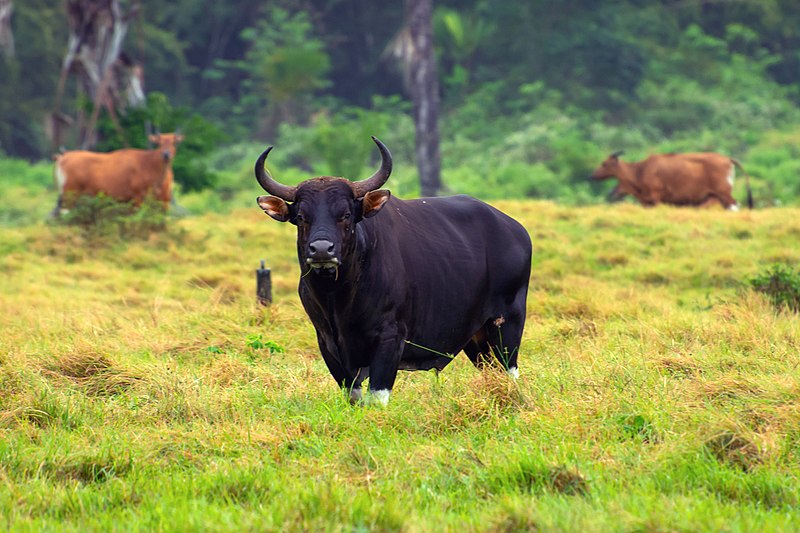
File:Banteng_Alas_Purwo.jpg · Wikimedia Commons · See Wikimedia Commons
Bos javanicus
Sign in to saveAlso known as Banteng, Tembadau
The banteng (Bos javanicus; ), also known as the tembadau, is a species of wild bovine found in Southeast Asia and parts of Northern Australia.
OverviewAI-generated
Bos javanicus, commonly known as the banteng, is a species of mammal in the family Bovidae. It belongs to the genus Bos and was described by D'Alton in 1823. The animal is classified within the order Artiodactyla, class Mammalia, phylum Chordata, and kingdom Animalia. It is diurnal and inhabits forest environments.
The species is listed as Critically Endangered by the IUCN Red List as of 2025. Its range includes South and Southeast Asia, with records from Indonesia, Vietnam, Burma, and Malaysia. In the United States, specimens are held by institutions such as the American Museum of Natural History and the California Academy of Sciences. The gestation period is 285 days, and the longest observed lifespan is 27.1 years.
Synthesized by Vinony from 34 facts across 7 sources: Wikidata, GBIF, IUCN Red List, Gbif Occ, Encyclopedia of Life, iDigBio, Vinony graph. Generated from structured data (not the Wikipedia text) and checked against those facts — may still contain errors.
Species
Critically EndangeredBos javanicus
SPECIES
- KingdomAnimalia
- PhylumChordata
- ClassMammalia
- OrderArtiodactyla
- FamilyBovidae
爪哇野牛(学名:Bos javanicus),别名白臀野牛,牛的一种,生活在南亚和东南亚。
via GBIF · IUCN
Museum specimens
- Specimen records
- 193
- With media
- 7
- Family
- Bovidae
- Collections
- MSB, CMN, AMNH, LACM, FMNH, MSU
- Recorded in
- United States, Vietnam, Indonesia, Burma, Malaysia
Wikidata facts
Show 13 more facts
- taxon rank
- species
- IUCN conservation status
- Critically Endangered
- taxon name
- Bos javanicus
- Commons category
- Bos javanicus
- Commons gallery
- Bos javanicus
- taxon common name
- banteng
- gestation period
- 285
- longest observed lifespan
- 27.1
- taxon author citation
- D'Alton, 1823
- habitat
- forest
- diel cycle
- diurnality
- described by source
- Encyclopædia Britannica 11th edition
- short name
- B. javanicus
Sources (3)
via Wikidata · CC0
~28 min read
Encyclopedic overview
18 sectionsContents
- Taxonomy and phylogeny
- Subspecies
- Characteristics
- Ecology and behaviour
- Diet and foraging
- Reproduction and life cycle
- Diseases and parasites
- Habitat and distribution
- Interaction with humans
- Domestication and uses
- In Australia
- Hybrids
- As symbol
- Threats and conservation
- Threats to domesticated banteng
- Cloning
- References
- External links
The banteng (Bos javanicus; ), also known as the tembadau, is a species of wild bovine found in Southeast Asia and parts of Northern Australia.
The head-and-body length is between . Wild banteng are typically larger and heavier than their domesticated counterparts, but are otherwise similar in appearance. The banteng shows extensive sexual dimorphism; adult bulls are generally dark brown to black, larger and more sturdily built than adult cows, which are thinner and usually pale brown or chestnut red. There is a big white patch on the rump. Horns are present on both sexes, and are typically long. Three subspecies are generally recognised.
Excerpted from Wikipedia’s “Bos javanicus” article, available under the CC BY-SA 4.0 licence.
Gallery (38)
Available in 63 languages
- Español
- Français
- Deutsch
- 中文
- 日本語
- Русский
- Português
- Italiano
- العربية
- Armenian
- Avaric
- Azerbaijani
- Bahasa Indonesia
- Balinese
- Basque
- Betawi
- Breton
- Bulgarian
Show 44 more
- Burmese
- Catalan
- Cebuano
- Croatian
- Czech
- Egyptian Arabic
- Esperanto
- Finnish
- Galician
- Georgian
- Hebrew
- Hungarian
- Interlingua
- Javanese
- Kazakh
- Khmer
- Kotava
- Kyrgyz
- Lithuanian
- Malay
- Malayalam
- Mari
- Minangkabau
- Navajo
- Nederlands
- Norwegian
- Piedmontese
- Polski
- Scots
- Serbian
- Serbian (Latin)
- Sundanese
- Svenska
- Tiếng Việt
- Udmurt
- Ukrainian
- Uzbek
- Waray
- Welsh
- Western Panjabi
- Wu Chinese
- فارسی
- ไทย
- 한국어
via Wikidata sitelinks · CC0