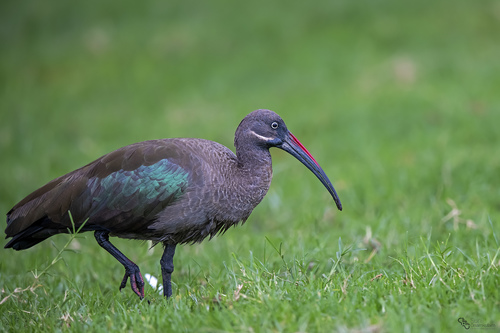
(c) Sunil Onamkulam, all rights reserved, uploaded by Sunil Onamkulam
Bostrychia
Sign in to saveBostrychia is a genus of ibises in the family Threskiornithidae. Member species are found in many countries throughout Africa. ==Species== It contains the following five species: {| class="wikitable" |- ! Image !! Scientific name !! Common name !! Distribution |- |120px || Bostrychia carunculata || Wattled ibis||Ethiopia |- |120px || Bostrychia hagedash || Hadada ibis||Sudan, Burundi, Ethiopia, Senegal, Uganda, Tanzania, Gabon, Democratic Republic of Congo, Cameroon, Gambia, Kenya, Somalia, Lesotho, Eswatini, Botswana, Mozambique, Zimbabwe and South Africa. |- |120px || Bostrychia olivacea ||
Species
Hadada Ibis
Genus
- PhylumChordata
- ClassAves
- OrderCiconiiformes
- FamilyThreskiornithidae
Bostrychia es un género de aves pelecaniformes de la familia Threskiornithidae; incluye cuatro o cinco especies de ibis.[1][2] Se distribuyen por el África subsahariana. Especies Los autores reconocen las siguientes especies:[3][2] Bostrychia bocagei - Ibis de Santo Tomé Bostrychia carunculata - Ibis carunculado Bostrychia hagedash - Ibis Hadada Bostrychia olivacea - Ibis oliváceo Bostrychia rara - Ibis moteado Referencias ↑ Clements, J. F., T. S. Schulenberg, M. J. Iliff, B.L. Sullivan, and C. L. Wood. 2010. The Clements checklist of birds of the world: Version 6.5. Cornell University Press. Downloadable from Cornell Lab of Ornithology ↑ a b Zoonomen Nomenclatural data (2014) Alan P. Peterson. Pelecaniformes. Acceso: 26 de noviembre de 2014 ↑ Gill, F.; Donsker, D. (Eds.) (2014). Storks, ibis & herons. IOC World Bird List (v.4.4). Wikimedia Commons alberga una categoría multimedia sobre Bostrychia. Datos: Q223302 Multimedia: Especies: Bostrychia G.R.Gray
via
Museum specimens
- Specimen records
- 740
- With media
- 490
- Family
- Rhodomelaceae
- Collections
- US, NY, BSNS, MICH
- Recorded in
- United States, Kenya, Australia
Wikidata facts
Show 6 more facts
- Commons category
- Bostrychia
- taxon rank
- genus
- taxon name
- Bostrychia
- topic's main category
- Category:Bostrychia
- Commons gallery
- Bostrychia
- homonymous taxon
- Bostrychia
Sources (1)
via Wikidata · CC0
~1 min read
Encyclopedic overview
3 sectionsContents
- Species
- Conservation
- References
Bostrychia is a genus of ibises in the family Threskiornithidae. Member species are found in many countries throughout Africa. ==Species== It contains the following five species: {| class="wikitable" |- ! Image !! Scientific name !! Common name !! Distribution |- |120px || Bostrychia carunculata || Wattled ibis||Ethiopia |- |120px || Bostrychia hagedash || Hadada ibis||Sudan, Burundi, Ethiopia, Senegal, Uganda, Tanzania, Gabon, Democratic Republic of Congo, Cameroon, Gambia, Kenya, Somalia, Lesotho, Eswatini, Botswana, Mozambique, Zimbabwe and South Africa. |- |120px || Bostrychia olivacea || Olive ibis|| Cameroon, Democratic Republic of the Congo, Republic of the Congo, Côte d'Ivoire, Gabon, Ghana, Kenya, Liberia, Nigeria, Sierra Leone, Zaire, Tanzania and São Tomé and Príncipe Island |- |120px || Bostrychia bocagei || São Tomé ibis|| São Tomé |- |120px|| Bostrychia rara || Spot-breasted ibis||Angola, Cameroon, Central African Republic, the Republic of the Congo, the Democratic Republic of the Congo, Ivory Coast, Equatorial Guinea, Gabon, Ghana, Guinea, Liberia, Nigeria, Sierra Leone, and Uganda |- |}
==Conservation== Four of these species are evaluated as Least Concern status, but the dwarf olive ibis is Critically Endangered according to the IUCN.
Excerpted from Wikipedia’s “Bostrychia” article, available under the CC BY-SA 4.0 licence.