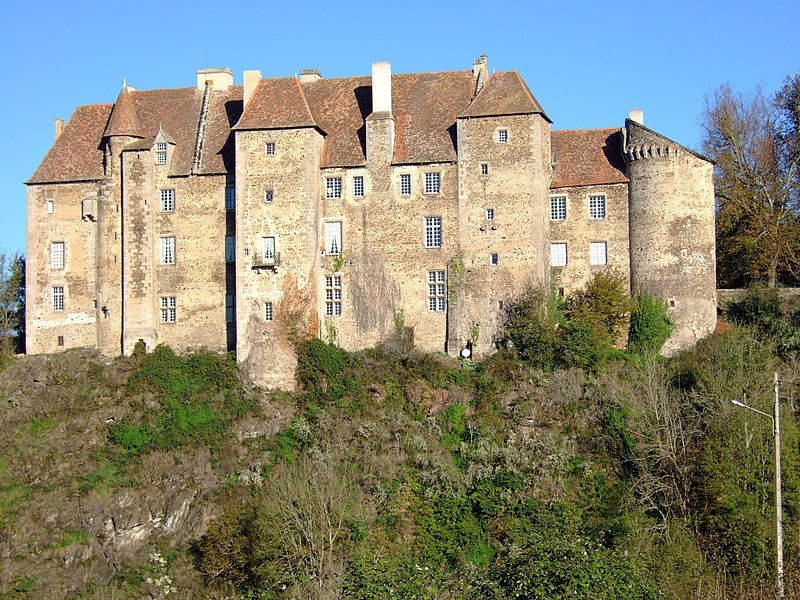
File:ChateauBoussacSurPetiteCreuse.jpg · Wikimedia Commons · See Wikimedia Commons
OverviewAI-generated
Boussac is a commune in France, situated within the Creuse department and the Nouvelle-Aquitaine region. It serves as the capital of the canton of Boussac. The municipality has an area of 1.48 square kilometers and an elevation of 395 meters above sea level. Its official names include Boussac and Boussac-la-Montagne.
The population of Boussac is 1,933, comprising 547 males and 710 females. The commune shares borders with Boussac-Bourg and Saint-Silvain-Bas-le-Roc. It is the owner of the artwork known as The Lady and the Unicorn. The postal code for the area is 23600.
Synthesized by Vinony from 37 facts across 6 sources: Wikidata, Openweathermap, OpenStreetMap, GeoNames, Vinony graph, Geo. Generated from structured data (not the Wikipedia text) and checked against those facts — may still contain errors.
Weather now
cached 5h agoPlace details
- Locality
- Boussac
- Region
- Nouvelle-Aquitaine
- Country
- France
- Population
- 0
via OpenStreetMap · GeoNames
Key facts
- Country
- France
- Region
- Nouvelle-Aquitaine
- Department
- Creuse
- Arrondissement
- Aubusson
- Canton
- Boussac
- Intercommunality
- CC Creuse Confluence
- Mayor 2020 2026
- Franck Foulon
- Area
- 1.48 km (0.57 sq mi)
- Population 2023
- 1,236
- Density
- 835/km (2,160/sq mi)
- Time zone
- UTC+01:00 ( CET )
- Summer dst
- UTC+02:00 ( CEST )
- Insee postal code
- 23031 /23600
- Elevation
- 335–395 m (1,099–1,296 ft) , (avg. 384 m or 1,260 ft)
via Wikipedia infobox
Wikidata facts
- Instance of
- commune of France
- Official name
- Boussac-la-Montagne
- Country
- France
- Located in
- arrondissement of Aubusson
- Population
- 1236
- Area
- 1.48
- Elevation
- 378
- Time zone
- UTC+02:00
- Shares border with
- Saint-Silvain-Bas-le-Roc
- Official website
- www.boussac.fr
- Image
- Boussac (Creuse) - Hôtel de ville.JPG
Show 10 more facts
- Commons category
- Boussac (Creuse)
- postal code
- 23600
- owner of
- The Lady and the Unicorn
- different from
- Boussac
- associated electoral district
- canton of Boussac
- male population
- 547
- female population
- 710
- email address
- mailto:[email protected]
- phone number
- +33-5-55-65-01-09
via Wikidata · CC0
~1 min read
Encyclopedic overview
Boussac ( French pronunciation: [busak]; Occitan: Boçac) is a commune in the Creuse department in the Nouvelle-Aquitaine region in central France. The famous Lady and the Unicorn Tapestries (c. 1500) were discovered in 1841 in Boussac castle. In 1844 the novelist George Sand saw them and brought public attention to the tapestries in her works at the time (most notably in her novel Jeanne), in which she correctly dated them to the end of the fifteenth century, using the ladies' costumes for reference. In 1863 they were bought by the Musée de Cluny in Paris where they are still on display.
Geography
Excerpted from Wikipedia’s “Boussac” article, available under the CC BY-SA 4.0 licence.