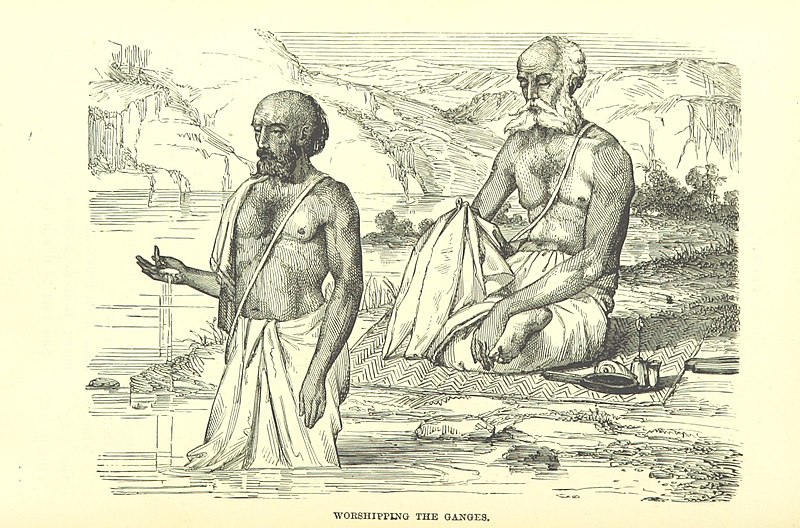
File:Image_taken_from_page_40_of_'The_Land_of_Temples_(India)'_(11151912296).jpg · Wikimedia Commons · See Wikimedia Commons
Brahmin
Sign in to saveAlso known as Brahmins, Brahman
thumb|Brahmins worshipping river Ganges, The Land of Temples (India), 1882 Brahmin (; ) is a varna (theoretical social classes) within Hindu society. The other three varnas are the Kshatriya (rulers and warriors), Vaishya (traders, merchants, and farmers), and Shudra (labourers). The traditional occupation of Brahmins is that of priesthood (purohit, pandit, or pujari) at Hindu temples or at socio-religious ceremonies, and the performing of rite of passage rituals, such as solemnising a wedding with hymns and prayers.
Brahmins are members of the highest varna (social class) in traditional Hindu society, traditionally serving as priests and religious specialists who perform temple worship and important life rituals like weddings. They are one of four varnas in the Hindu social hierarchy, alongside rulers and warriors, merchants and farmers, and laborers.
AI-generated from the Wikipedia summary — may contain errors.
Wikidata facts
Show 5 more facts
- described by source
- Pauly–Wissowa
- Commons category
- Brahmins
- topic's main category
- Category:Brahmins
- facet of
- caste system in India
- next lower rank
- kshatriya
Sources (1)
via Wikidata · CC0
~18 min read
Encyclopedic overview
16 sectionsContents
- Origin and history
- Generic meaning of the term "Brahmin"
- Purusha sukta
- Gupta era
- Role in the bhakti movement and involvement in social reform
- Role in the society
- Vedic duties
- Actual occupations
- Stratification among Brahmins
- Outside the Indian subcontinent
- Demographics
- See also
- References
- Sources
- Further reading
- External links
thumb|Brahmins worshipping river Ganges, The Land of Temples (India), 1882 Brahmin (; ) is a varna (theoretical social classes) within Hindu society. The other three varnas are the Kshatriya (rulers and warriors), Vaishya (traders, merchants, and farmers), and Shudra (labourers). The traditional occupation of Brahmins is that of priesthood (purohit, pandit, or pujari) at Hindu temples or at socio-religious ceremonies, and the performing of rite of passage rituals, such as solemnising a wedding with hymns and prayers.
Traditionally, Brahmins are accorded the supreme ritual status of the four social classes, and they also served as spiritual teachers (guru or acharya). In practice, Indian texts suggest that some Brahmins historically also became agriculturalists, warriors, traders, and had also held other occupations in the Indian subcontinent. Within the jati (caste) system, Brahmins similarly occupy the highest position, though that is complicated by strict stratification even among Brahmins and historical attempts by other castes and sub-castes to challenge Brahminical dominance. thumb|Vedic Brahmin Rishi worshipping Shakti
Excerpted from Wikipedia’s “Brahmin” article, available under the CC BY-SA 4.0 licence.
Gallery (30)
Available in 82 languages
- Español
- Français
- Deutsch
- 中文
- 日本語
- Русский
- Português
- Italiano
- العربية
- हिन्दी
- Afrikaans
- Albanian
- ami
- Armenian
- Assamese
- Azerbaijani
- Bahasa Indonesia
- Bangla
Show 63 more
- Basque
- Belarusian
- Bikol
- Burmese
- Catalan
- Croatian
- Czech
- Danish
- Egyptian Arabic
- Esperanto
- Estonian
- Finnish
- Galician
- Georgian
- Greek
- Gujarati
- Hungarian
- Icelandic
- Kannada
- Kazakh
- Khmer
- Kyrgyz
- Latin
- Latvian
- Lithuanian
- Maithili
- Malay
- Malayalam
- Marathi
- Mongolian
- Nederlands
- Nepali
- Newari
- Norwegian
- Norwegian Nynorsk
- Occitan
- Odia
- Pali
- Pashto
- Polski
- Punjabi
- Romanian
- Sanskrit
- Serbian
- Serbian (Latin)
- simple
- Sinhala
- Slovak
- Svenska
- Tamil
- Tatar
- Telugu
- Tiếng Việt
- Türkçe
- Ukrainian
- Urdu
- Uzbek
- Western Panjabi
- Wu Chinese
- zh_yue
- فارسی
- ไทย
- 한국어
via Wikidata sitelinks · CC0