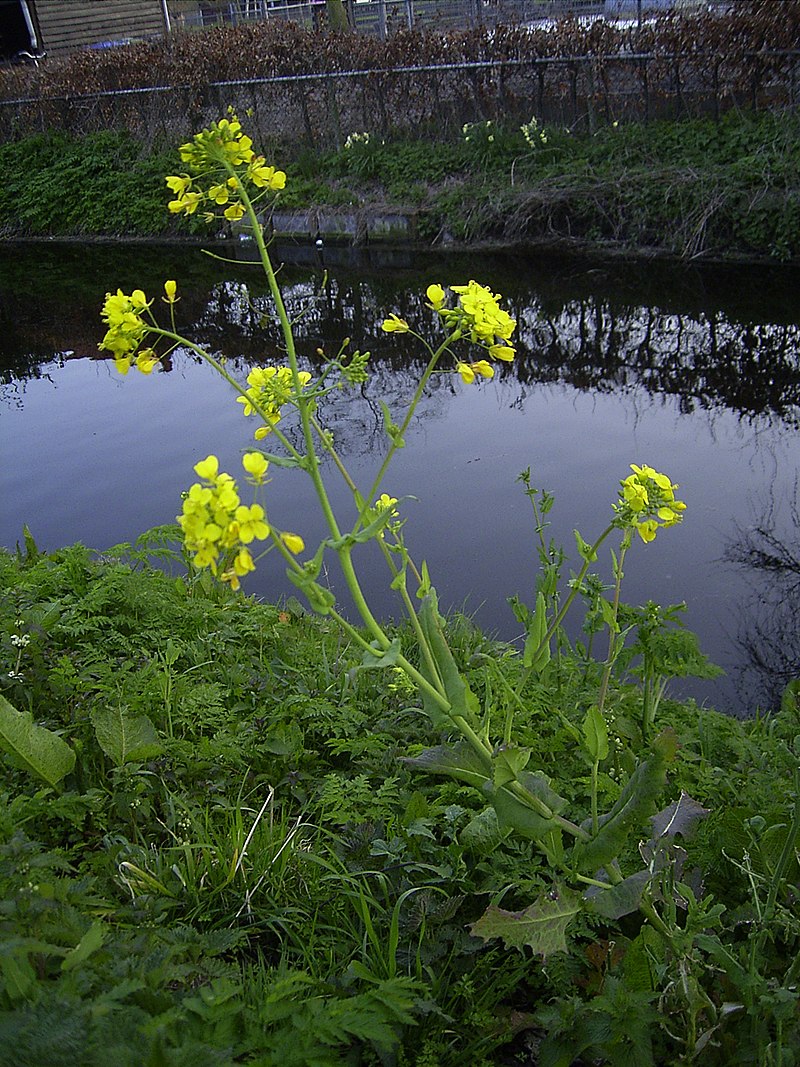
File:Brassica_rapa_plant.jpg · Wikimedia Commons · See Wikimedia Commons
Brassica
Sign in to saveAlso known as cabbage, mustard
Brassica () is a genus of plants in the cabbage and mustard family (Brassicaceae). The members of the genus are informally known as cruciferous vegetables, cabbages, mustard plants, or simply brassicas. Crops from this genus are sometimes called cole cropsderived from the Latin caulis, denoting the stem or stalk of a plant.
OverviewAI-generated
Brassica is a genus of plants within the family Brassicaceae, order Brassicales, and class Magnoliopsida. The scientific name is Brassica L., and its taxonomic type is Brassica oleracea. Common names for this group include mustard, Kool, cabbage, and kohl rabi. The genus produces fruit of the silique type and is used as a vegetable and food source.
Native to regions including Afghanistan, Albania, Algeria, Baleares, Bulgaria, the Canary Islands, Corse, Cyprus, the East Aegean Islands, Eritrea, Ethiopia, and France, Brassica species are also found in temperate Asia, the Mediterranean region, and Western Europe. Records from iDigBio indicate presence in Mexico, Canada, and the United States, with collections held by institutions such as IBUNAM, CICY, INECOL, FC-UNAM, and ECOSUR. The genus has an accepted taxonomic status.
Synthesized by Vinony from 45 facts across 9 sources: Wikidata, GBIF, PubMed, Gbif Occ, Encyclopedia of Life, Plants of the World, WoRMS, iDigBio, Vinony graph. Generated from structured data (not the Wikipedia text) and checked against those facts — may still contain errors.
Species
Brassica
GENUS
- KingdomPlantae
- PhylumTracheophyta
- ClassMagnoliopsida
- OrderBrassicales
- FamilyBrassicaceae
蕓薹屬(學名:Brassica)是一個十字花科下的屬。此屬的植物包括了多種重要的農業及園藝作物,包括了包心菜和芥菜等常見的蔬菜。 此屬物種原生於亞洲的溫帶地區、環地中海地區及西歐。
via GBIF · Kew POWO
Museum specimens
- Specimen records
- 1,555
- With media
- 1,222
- Family
- Brassicaceae
- Collections
- IBUNAM, CICY, INECOL, FC-UNAM, ECOSUR, UNIVERSITY OF ALBERTA MUSEUMS
- Recorded in
- Mexico, Canada, United States
Research
26,868 papers- Brassica Bioactives Could Ameliorate the Chronic Inflammatory Condition of Endometriosis.ReviewInternational journal of molecular sciences · 2020García-Ibañez P, Yepes-Molina L, Ruiz-Alcaraz AJ et al.DOI: 10.3390/ijms21249397
- Clubroot in Brassica: recent advances in genomics, breeding, and disease management.ReviewGenome · 2021Hasan J, Megha S, Rahman HDOI: 10.1139/gen-2020-0089
- Brassica vegetables and cancer prevention. Epidemiology and mechanisms.ReviewAdvances in experimental medicine and biology · 1999van Poppel G, Verhoeven DT, Verhagen H et al.DOI: 10.1007/978-1-4757-3230-6_14
- Exploration of the Sclerotinia sclerotiorum-Brassica pathosystem: advances and perspectives in omics studies.ReviewMolecular biology reports · 2024Singh J, Yadav P, Budhlakoti N et al.DOI: 10.1007/s11033-024-10043-4
- Brassica foods as a dietary source of vitamin C: a review.ReviewCritical reviews in food science and nutrition · 2014Domínguez-Perles R, Mena P, García-Viguera C et al.DOI: 10.1080/10408398.2011.626873
- Just how complex is the Brassica S-receptor complex?ReviewJournal of experimental botany · 2003Kemp BP, Doughty JDOI: 10.1093/jxb/erg033
- Comparison and evolutionary analysis of Brassica nucleotide binding site leucine rich repeat (NLR) genes and importance for disease resistance breeding.ReviewThe plant genome · 2021Zhang Y, Edwards D, Batley JDOI: 10.1002/tpg2.20060
- Key Advances in the New Era of Genomics-Assisted Disease Resistance Improvement of Brassica Species.ReviewPhytopathology · 2023Amas JC, Thomas WJW, Zhang Y et al.DOI: 10.1094/PHYTO-08-22-0289-FI
via PubMed
Wikidata facts
- Instance of
- taxon
- Parent taxon
- Brassiceae
- Image
- Brassica rapa plant.jpg
- Has use
- food
Show 10 more facts
- taxon rank
- genus
- taxon name
- Brassica
- Commons category
- Brassica
- topic's main category
- Category:Brassica
- Commons gallery
- Brassica
- taxon common name
- ogrščica
- has fruit type
- silique
- taxonomic type
- Brassica oleracea
- carbon footprint
- 0.6
via Wikidata · CC0
~5 min read
Encyclopedic overview
9 sectionsContents
- Uses
- Food
- Cooking
- Species
- Species formerly placed in ''Brassica''
- Genome sequencing and genetics
- Etymology
- References
- External links
Brassica () is a genus of plants in the cabbage and mustard family (Brassicaceae). The members of the genus are informally known as cruciferous vegetables, cabbages, mustard plants, or simply brassicas. Crops from this genus are sometimes called cole cropsderived from the Latin caulis, denoting the stem or stalk of a plant.
The genus Brassica is known for its important agricultural and horticultural crops and also includes a number of weeds, both of wild taxa and escapees from cultivation. Brassica species and varieties commonly used for food include bok choy, broccoli, Brussels sprouts, cauliflower, cabbage, collard greens, choy sum, kale, kohlrabi, napa cabbage, rutabaga, turnip and some seeds used in the production of canola oil and the condiment mustard. Over 30 wild species and hybrids are in cultivation, plus numerous cultivars and hybrids of cultivated origin. Most are seasonal plants (annuals or biennials), but some are small shrubs. Brassica plants have been the subject of much scientific interest for their agricultural importance. Six particular species (B. carinata, B. juncea, B. oleracea, B. napus, B. nigra, and B. rapa) evolved by the combining of chromosomes from three earlier species, as described by the triangle of U theory.
Excerpted from Wikipedia’s “Brassica” article, available under the CC BY-SA 4.0 licence.
Gallery (4)
Available in 71 languages
- Español
- Français
- Deutsch
- 中文
- 日本語
- Русский
- Português
- Italiano
- العربية
- Albanian
- azb
- Azerbaijani
- Bahasa Indonesia
- Basque
- Belarusian
- Bosnian
- Bulgarian
- Catalan
Show 52 more
- Cebuano
- Chuvash
- Croatian
- Czech
- Danish
- Egyptian Arabic
- Esperanto
- Estonian
- Finnish
- Galician
- Georgian
- Haitian Creole
- Hebrew
- Hungarian
- Icelandic
- Interlingua
- Irish
- Kazakh
- Latin
- Latvian
- Lithuanian
- Lombard
- Malagasy
- Malay
- Malayalam
- Manx
- Nederlands
- Northern Frisian
- Norwegian
- Norwegian Nynorsk
- Polski
- Quechua
- Sardinian
- Saterland Frisian
- Scots
- Serbian
- Sicilian
- simple
- Svenska
- Telugu
- Tiếng Việt
- Türkçe
- Ukrainian
- Upper Sorbian
- Uyghur
- Uzbek
- Waray
- West Flemish
- Wu Chinese
- zh_yue
- فارسی
- 한국어
via Wikidata sitelinks · CC0