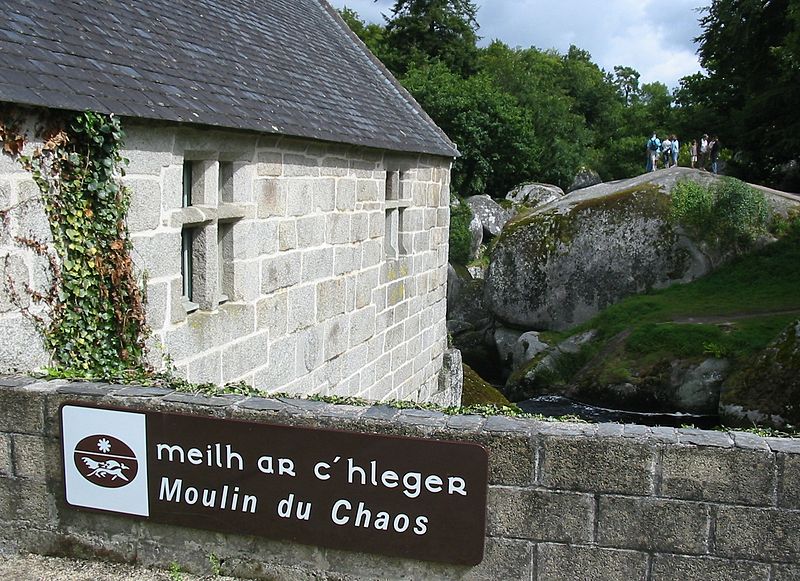
File:Huelgoat_Chaos_mill.jpg · Wikimedia Commons · See Wikimedia Commons
Breton is a Celtic language spoken in Brittany, a region in northwestern France, by a remaining community of native speakers. It matters as a significant example of Europe's endangered linguistic heritage and efforts to preserve languages distinct from dominant national languages like French.
AI-generated from the Wikipedia summary — may contain errors.
Wikidata facts
- Instance of
- modern language
- Subclass of
- Southwestern Brythonic
- Has part
- Trégorrois Breton
- Country
- France
- Image
- Huelgoat Chaos mill.jpg
Show 17 more facts
- has grammatical gender
- feminine
- female form of label
- la langue bretonne
- writing system
- Latin script
- Commons category
- Breton language
- Wikimedia language code
- br
- topic's main category
- Category:Breton language
- indigenous to
- Brittany
- native label
- brezhoneg
- number of speakers, writers, or signers
- 107000
- described by source
- Brockhaus and Efron Encyclopedic Dictionary
- start time
- 0450-00-00
- linguistic typology
- fusional language
- language regulatory body
- Ofis publik ar brezhoneg
- hashtag
- bzhg
- P10369
- rectangle
- P11012
- Misak Metsarents
Sources (12)
via Wikidata · CC0
~40 min read
Encyclopedic overview
Breton is a Southwestern Brittonic language of the Celtic language group spoken in Brittany, part of modern-day France. It is the only Celtic language still in use on the European mainland.
Breton is an Insular Celtic language that was brought from Great Britain to Brittany by migrating Britons during the Early Middle Ages, which makes Breton most closely related to Cornish, another Southwestern Brittonic language. Welsh and the extinct Cumbric, both Western Brittonic languages, are more distantly related, and the Goidelic languages (Irish, Manx, and Scottish Gaelic) have a slight connection due to their origins being from Insular Celtic.
Excerpted from Wikipedia’s “Breton” article, available under the CC BY-SA 4.0 licence.
Gallery (10)
Available in 131 languages
- Español
- Français
- Deutsch
- 中文
- 日本語
- Русский
- Português
- Italiano
- العربية
- abstract
- Afrikaans
- Albanian
- Albanian
- Amharic
- Aragonese
- Armenian
- Arpitan
- Asturian
Show 112 more
- Azerbaijani
- Bahasa Indonesia
- Basque
- Bavarian
- be_x_old
- Belarusian
- Breton
- Bulgarian
- Catalan
- Central Kurdish
- Chuvash
- Cornish
- Croatian
- Czech
- Danish
- Egyptian Arabic
- Esperanto
- Estonian
- Extremaduran
- Faroese
- Fiji Hindi
- Finnish
- fiu_vro
- Friulian
- Galician
- Georgian
- Greek
- Hakka Chinese
- Hebrew
- Hungarian
- Icelandic
- Ido
- Iloko
- Interlingua
- Irish
- kge
- Komi
- Komi-Permyak
- Kurdish
- Latin
- Latvian
- Ligurian
- Limburgish
- Lingua Franca Nova
- Lithuanian
- Lombard
- Low German
- Luxembourgish
- Macedonian
- Malagasy
- Malay
- Manx
- Māori
- Marathi
- Mazanderani
- nds_nl
- Nederlands
- Northern Frisian
- Northern Sami
- Norwegian
- Norwegian Nynorsk
- Novial
- nrm
- Occitan
- Ossetic
- Pampanga
- Pashto
- Pennsylvania German
- Picard
- Piedmontese
- Polski
- Quechua
- Romanian
- Romansh
- Santali
- Sardinian
- Saterland Frisian
- Scots
- Scottish Gaelic
- Serbian
- Serbian (Latin)
- Sicilian
- simple
- Slovak
- Slovenian
- Svenska
- Swahili
- Talysh
- Tamil
- Tatar
- Tiếng Việt
- Toki Pona
- Türkçe
- Ukrainian
- Upper Sorbian
- Urdu
- Uyghur
- Venetian
- Veps
- Walloon
- Welsh
- West Flemish
- Western Frisian
- Western Panjabi
- wikifunctions
- Wu Chinese
- Zaza
- zh_min_nan
- zh_yue
- فارسی
- ไทย
- 한국어
via Wikidata sitelinks · CC0