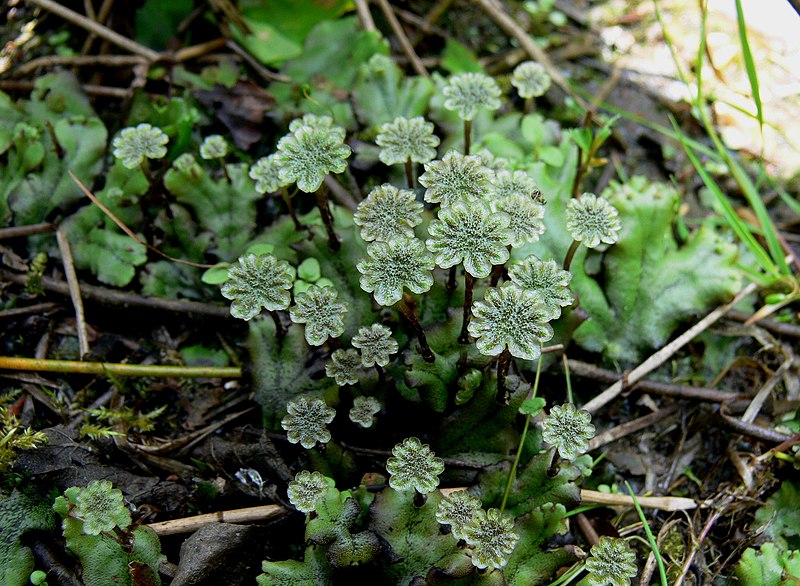
File:MarchantiophytaSp.NonDéterminéeFL3.jpg · Wikimedia Commons · See Wikimedia Commons
bryophyte
Sign in to saveAlso known as bryophytes, Bryophyta sensu lato
thumb|An example of moss (Bryophyta) on the forest floor in Broken Bow, Oklahoma
Bryophytes are small plants like mosses that grow close to the ground in moist environments such as forest floors. They matter because they help break down dead material, retain moisture in ecosystems, and serve as food and habitat for small creatures.
AI-generated from the Wikipedia summary — may contain errors.
Wikidata facts
Show 7 more facts
- taxon rank
- superphylum
- taxon name
- Bryophytes
- topic's main category
- Category:Bryophytes
- Commons category
- Bryophytes
- Commons gallery
- Bryophytes
- different from
- moss
- studied by
- bryology
Sources (3)
via Wikidata · CC0
~15 min read
Encyclopedic overview
18 sectionsContents
- Features
- Distribution
- Life cycle
- Sexuality
- Classification and phylogeny
- Monophyletic view
- Paraphyletic view
- Traditional morphology{{anchor|Taxonomy}}
- Evolution
- Similarities to algae and vascular plants
- Comparative morphology
- Uses
- Environmental
- Commercial
- See also
- References
- Bibliography
- External links
thumb|An example of moss (Bryophyta) on the forest floor in Broken Bow, Oklahoma
Bryophytes () are a group of land plants (embryophytes), sometimes treated as a taxonomic division referred to as 'Bryophyta sensu lato, that contains three groups of non-vascular land plants: the liverworts, hornworts, and mosses. In the strict sense, the division Bryophyta' consists of the mosses only. Bryophytes are characteristically limited in size and prefer moist habitats although some species can survive in drier environments. The bryophytes consist of about 20,000 plant species. Bryophytes produce enclosed reproductive structures (gametangia and sporangia), but they do not produce flowers or seeds. They reproduce sexually by spores and asexually by fragmentation or the production of gemmae.
Excerpted from Wikipedia’s “bryophyte” article, available under the CC BY-SA 4.0 licence.
Gallery (19)
Available in 69 languages
- Español
- Français
- Deutsch
- 中文
- 日本語
- Русский
- Português
- العربية
- हिन्दी
- Albanian
- Albanian
- Armenian
- Azerbaijani
- Bahasa Indonesia
- Bangla
- Belarusian
- Bosnian
- Bulgarian
Show 50 more
- Catalan
- Cebuano
- Central Kurdish
- Chuvash
- Croatian
- Czech
- Egyptian Arabic
- Esperanto
- Estonian
- Filipino
- Finnish
- Galician
- Georgian
- Hebrew
- Hungarian
- Icelandic
- Irish
- Javanese
- Kannada
- Kazakh
- Kurdish
- Latvian
- Lithuanian
- Luxembourgish
- Malagasy
- Malayalam
- Nederlands
- Northern Frisian
- Norwegian
- Norwegian Nynorsk
- Oromo
- Polski
- Punjabi
- Romanian
- Saterland Frisian
- simple
- Slovak
- Slovenian
- Svenska
- Tamil
- Tiếng Việt
- Türkçe
- Ukrainian
- Western Frisian
- Western Panjabi
- Wu Chinese
- Yakut
- فارسی
- ไทย
- 한국어
via Wikidata sitelinks · CC0