File:53-manasses-chronicle.jpg · Wikimedia Commons · See Wikimedia Commons
Bulgars
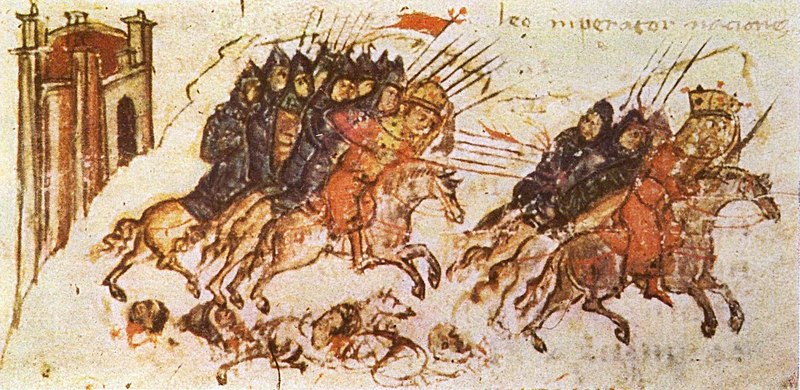
Sign in to savethumb|right|300px|Bulgars led by Khan (title)|Khan [[Krum pursue the Byzantines at the Battle of Versinikia (813)]]
The Bulgars were a nomadic people who, under leaders like Khan Krum, established a powerful state in southeastern Europe during the medieval period and clashed with the Byzantine Empire, as shown by their military victories such as the Battle of Versinikia in 813. They matter historically because they played a significant role in shaping the political landscape of Eastern Europe and the Balkans during the early medieval era.
AI-generated from the Wikipedia summary — may contain errors.
Wikidata facts
- Instance of
- people
- Part of
- Turkic peoples
Show 3 more facts
- Commons category
- Bulgars
- topic's main category
- Category:Bulgars
- on focus list of Wikimedia project
- Wikipedia:Vital articles/Level/4
Sources (2)
via Wikidata · CC0
~48 min read
Encyclopedic overview
17 sectionsContents
- Etymology and origin
- History
- Turkic migration
- Old Great Bulgaria
- Subsequent migrations
- Society
- Social structure
- Religion
- Language
- Ethnicity
- Anthropology and genetics
- Legacy
- See also
- Citations
- General and cited sources
- Further reading
- External links
thumb|right|300px|Bulgars led by Khan (title)|Khan [[Krum pursue the Byzantines at the Battle of Versinikia (813)]]
The Bulgars (also Bulghars, Bulgari, Bolgars, Bolghars, Bolgari, Proto-Bulgarians) were Turkic semi-nomadic warrior tribes that flourished in the Pontic–Caspian steppe and the Volga region between the 5th and 7th centuries. They became known as nomadic equestrians in the Volga-Ural region, but some researchers trace Bulgar ethnic roots to Central Asia.
Excerpted from Wikipedia’s “Bulgars” article, available under the CC BY-SA 4.0 licence.
Gallery (44)
Available in 63 languages
- Español
- Français
- Deutsch
- 中文
- 日本語
- Русский
- Português
- Italiano
- العربية
- Albanian
- Aragonese
- Asturian
- azb
- Azerbaijani
- Bahasa Indonesia
- Bangla
- Bashkir
- Basque
Show 44 more
- Belarusian
- Bulgarian
- Catalan
- Chuvash
- Croatian
- Czech
- Esperanto
- Estonian
- Finnish
- Galician
- Georgian
- Greek
- Hebrew
- Hungarian
- Kazakh
- Kurdish
- Latin
- Latvian
- Lingua Franca Nova
- Lithuanian
- Low German
- Macedonian
- Norwegian
- Polski
- Romanian
- Serbian
- Serbian (Latin)
- simple
- Sinhala
- Slovak
- Slovenian
- Svenska
- Tatar
- Tiếng Việt
- Türkçe
- Tuvinian
- Ukrainian
- Uzbek
- Western Panjabi
- Yakut
- zh_yue
- فارسی
- ไทย
- 한국어
via Wikidata sitelinks · CC0