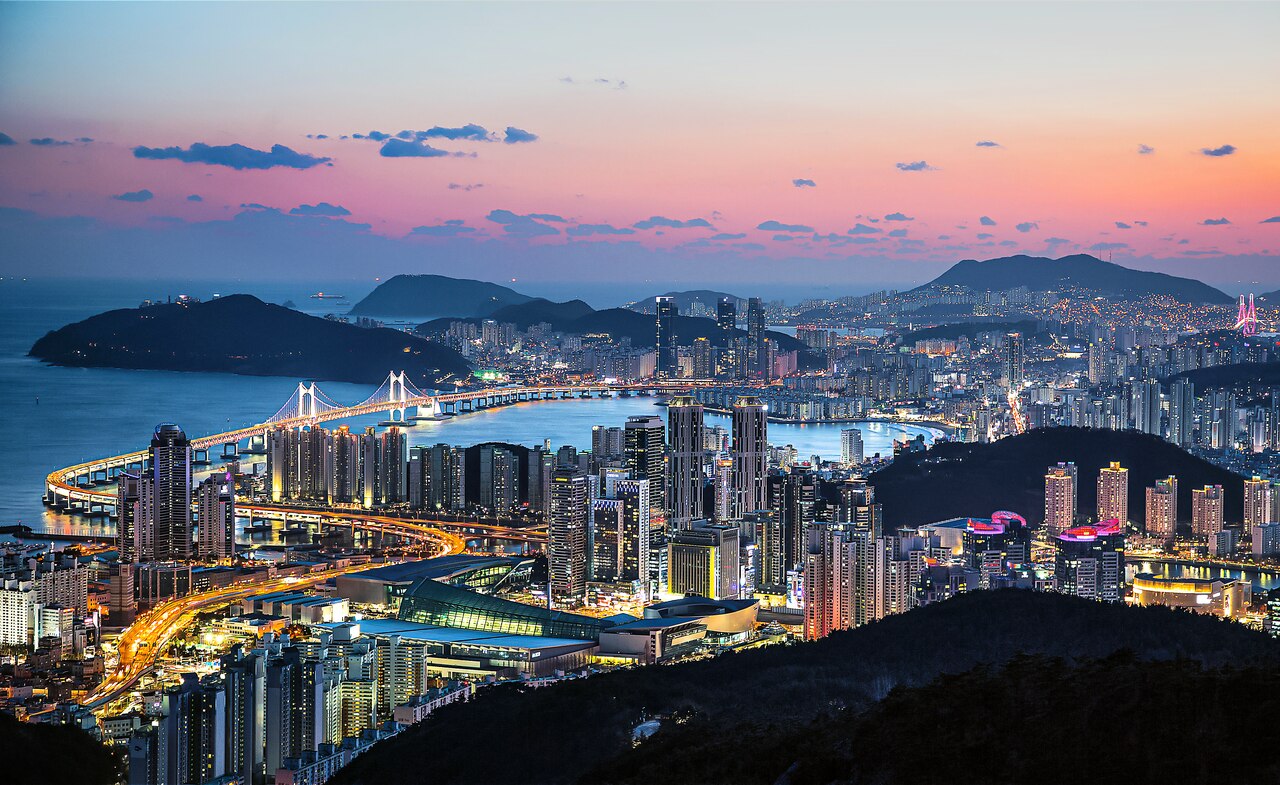
File:Gwangandaegyo_Bridge_in_Busan,_South_Korea_(iau2207b).tiff · Wikimedia Commons · See Wikimedia Commons
Busan
Sign in to saveAlso known as Pusan, Pusang, Busan Metropolitan City, Pusan Metropolitan City, Fuzan
Busan (), officially Busan Metropolitan City, is the second most populous city in South Korea, after Seoul, the nation's capital; it has a population of over 3.3 million as of 2024. Alternatively romanized as Pusan, it is the economic, cultural and educational center of southeastern South Korea, with its port being South Korea's busiest and the sixth-busiest in the world. The surrounding "Southeastern Maritime Industrial Region" (including Ulsan, South Gyeongsang, Daegu, and part of North Gyeongsang and South Jeolla) is South Korea's largest industrial area. The large volumes of port traffic a
Busan is South Korea's second-largest city with over 3.3 million people, serving as the economic, cultural, and educational hub of the southeastern region. Its port is the busiest in South Korea and the sixth-busiest in the world, making it a crucial center for the country's industrial activity and international trade.
AI-generated from the Wikipedia summary — may contain errors.
Key facts
- Settlement.name
- Busan
- Settlement.official_name
- Busan Metropolitan City
- Settlement.settlement_type
- Metropolitan city
- Settlement.image_size
- 250px
- Settlement.image_flag
- Flag of Busan (2023).svg
- Settlement.image_seal
- Symbol of Busan (2023–).svg
- Settlement.seal_type
- Logo
- Settlement.image_blank_emblem
- Slogan of Busan is good.svg
- Settlement.blank_emblem_type
- Wordmark
- Settlement.mapframe
- yes
- Settlement.mapframe point
- none
- Settlement.subdivision_type
- Country
- Settlement.subdivision_name
- South Korea
- Settlement.subdivision_type1
- Region
- Settlement.subdivision_name1
- Yeongnam
- Settlement.parts_type
- Districts
- Settlement.parts
- 16
- Settlement.government_type
- Mayor-Council
via Wikipedia infobox
Wikidata facts
- Demonym
- 부산시민
- Population
- 3453198
- Area
- 769.83
- Elevation
- 30
- Official website
- www.busan.go.kr
- Image
- Busan Tower 360 Degree Panorama 001.jpg
- Dialing code
- 51
Show 7 more facts
- Commons category
- Busan
- Commons gallery
- 부산광역시
- postal code
- 49599
- native label
- 부산
- social media followers
- 112100
- hashtag
- 부산
- P12749
- Dublin
Sources (8)
via Wikidata · CC0
~52 min read
Article
52 sectionsContents
- Names
- History
- Geography
- Climate
- Administrative divisions
- Economy
- Education
- Universities with graduate schools
- Other institutes of higher education
- Foreign schools
- High schools
- Culture and attractions
- Parks, beaches, and highlights
- Temples, religious and historical sites
- Arts
- Festivals
- Museums
- Traditional cuisine
- Hot spring resorts and spas
- Media
- In popular culture
- Demographics
- Religion
- Sports
- Baseball
- Football
- Basketball
- 2002 FIFA World Cup
- 2002 Asian Games
- Festivals and events
- Medical facilities
- Major medical centers
- Transportation
- Bus
- City buses
- Gimhae Airport Limousine Bus
- Intercity buses
- Sea
- Rail
- Metro
- Air
- International relations
- Sister cities
- Friendship cities
- Sister ports
- Notable people
- See also
- Notes
- References
- Citations
- Bibliography
- External links
Busan (), officially Busan Metropolitan City, is the second most populous city in South Korea, after Seoul, the nation's capital; it has a population of over 3.3 million as of 2024. Alternatively romanized as Pusan, it is the economic, cultural and educational center of southeastern South Korea, with its port being South Korea's busiest and the sixth-busiest in the world. The surrounding "Southeastern Maritime Industrial Region" (including Ulsan, South Gyeongsang, Daegu, and part of North Gyeongsang and South Jeolla) is South Korea's largest industrial area. The large volumes of port traffic and urban population in excess of 1 million makes Busan a Large-Port metropolis using the Southampton System of Port-City classification. As of 2025, Busan Port is the primary port in Korea and the world's sixth-largest container port.
Busan is divided into 15 major administrative districts and a single county, together housing a population of approximately 3.6 million. The entire metropolitan area, the Southeastern Maritime Industrial Region, has a population of approximately 8 million. The most densely built-up areas of the city are situated in a number of narrow valleys between the Nakdong and the Suyeong Rivers, with mountains separating most of the districts. The Nakdong River is Korea's longest river and Haeundae Beach is the country's largest beach.
Gallery (52)
On the map
3 mapped locations
Available in 125 languages
- Español
- Français
- Deutsch
- 中文
- 日本語
- Русский
- Português
- Italiano
- العربية
- हिन्दी
- Acehnese
- Afrikaans
- Albanian
- Amharic
- Armenian
- Asturian
- Azerbaijani
- Bahasa Indonesia
Show 106 more
- Balinese
- Bangla
- Bashkir
- Basque
- be_x_old
- Belarusian
- Bikol
- Bislama
- Breton
- Bulgarian
- Buriat
- Burmese
- Catalan
- cdo
- Cebuano
- Central Kurdish
- Chechen
- Croatian
- Czech
- Danish
- Egyptian Arabic
- Esperanto
- Estonian
- Filipino
- Finnish
- Galician
- Georgian
- Greek
- Hakka Chinese
- Hausa
- Hebrew
- Hungarian
- Iban
- Icelandic
- Ido
- igl
- Interlingue
- Irish
- Javanese
- kai
- Kanuri
- Kara-Kalpak
- Kashmiri
- Kazakh
- Khmer
- Kyrgyz
- Lao
- Latin
- Latvian
- Lingua Franca Nova
- Lithuanian
- Lombard
- Luxembourgish
- Macedonian
- Malagasy
- Malay
- Malayalam
- Maltese
- Māori
- Marathi
- Mari
- Mazanderani
- Mingrelian
- Mongolian
- Nederlands
- Northern Frisian
- Norwegian
- Norwegian Nynorsk
- Occitan
- Ossetic
- Polski
- Punjabi
- Quechua
- Romanian
- Scots
- Serbian
- Serbian (Latin)
- Silesian
- simple
- Sindhi
- Slovak
- Slovenian
- Sundanese
- Svenska
- Swahili
- Tajik
- Tamil
- Tatar
- Tiếng Việt
- Toki Pona
- Türkçe
- Ukrainian
- Urdu
- Uzbek
- Veps
- Waray
- Welsh
- Western Panjabi
- Wu Chinese
- Yakut
- zh_classical
- zh_min_nan
- zh_yue
- فارسی
- ไทย
- 한국어
via Wikidata sitelinks · CC0