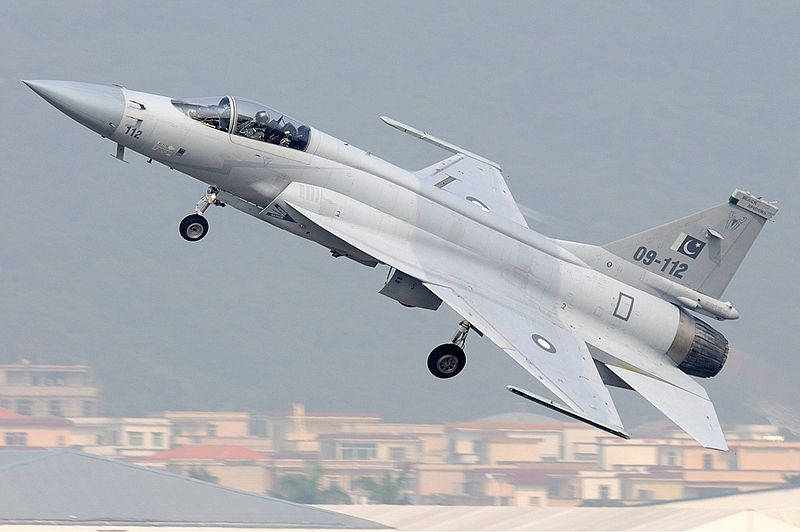
File:Pakistan_Air_Force_Chengdu_JF-17_Gu.jpg · Wikimedia Commons · See Wikimedia Commons
CAC/PAC JF-17 Thunder
Sign in to saveAlso known as Fighter China No.1, FC-1, FC1, Joint Fighter-17 Thunder, JF-17
fighter attack little dragón ( Xiaolong )
In the Vinony graph
Within Vinony's link graph, CAC/PAC JF-17 Thunder is referenced by 296 other articles, and connects out to ASELSAN, unmanned aerial vehicle and General Dynamics F-16 Fighting Falcon.
It is catalogued under topics including 2000s international fighter aircraft, Aircraft first flown in 2003 and Aircraft specs templates using improper note parameter.
Its subject is documented across 40 Wikipedia language editions.
Key facts
- Type
- Multirole Combat Aircraft
- National origin
- Pakistan / China
- Manufacturer
- Pakistan Aeronautical Complex / Chengdu Aircraft Industry Group
- Status
- In service
- Primary users
- Pakistan Air Force Myanmar Air Force Nigerian Air Force Azerbaijani Air Forces
- Number built
- 201 (plus 6 prototypes)
- Manufactured
- In China: June 2007 – present, In Pakistan: January 2008 – present
- Introduction date
- 12 March 2007
- First flight
- 25 August 2003
via Wikipedia infobox
Wikidata facts
- Subclass of
- military aircraft
- Country
- Pakistan
- Operator
- Myanmar Air Force
- Country of origin
- China
- Developer
- Chengdu Aircraft Industry Group
- Manufacturer
- Pakistan Aeronautical Complex
- Image
- Pakistan JF-17 Thunder, Pakistan - Air Force JP7136023.jpg
Show 3 more facts
- first flight
- 2003-08-25
- Commons category
- JF-17 Thunder
- total produced
- 86
Sources (9)
via Wikidata · CC0
~40 min read
Encyclopedic overview
The PAC/CAC JF-17 Thunder, also known as FC-1 Xiaolong, is a Sino-Pakistani single-engine lightweight supersonic multirole combat aircraft developed jointly by the Pakistan Aeronautical Complex (PAC) and the Chengdu Aircraft Corporation (CAC) of China. It is a fourth-generation fighter, designed and developed as a replacement for the third-generation A-5C, F-7P/PG, Mirage III, and Mirage 5 combat aircraft in the Pakistan Air Force (PAF). The JF-17 can be used for multiple roles, including interception, ground attack, anti-ship, and aerial reconnaissance. The Pakistani designation "JF-17" stands for "Joint Fighter-17", with the "Joint Fighter" denoting the joint Pakistani-Chinese development of the aircraft and the "-17" denoting that, in the PAF's vision, it is the successor to the F-16. The Chinese designation "FC-1" stands for "Fighter China-1".
The JF-17 can deploy diverse ordnance, including air-to-air, air-to-surface, and anti-ship missiles; guided and unguided bombs; and a 23-mm GSh-23-2 twin-barrel autocannon. Powered by the Chinese Guizhou WS-13 or Russian Klimov RD-93 (JF-17 Blocks 1 and 2) or Klimov RD-93MA (JF-17 Block 3) afterburning turbofan engine, it has a top speed of Mach 1.6. The JF-17 is the backbone and workhorse of the PAF, complementing the F-16 Fighting Falcon at approximately half the cost, with the Block II variant costing $25 million. The JF-17 was inducted in the PAF in 2007
Excerpted from Wikipedia’s “CAC/PAC JF-17 Thunder” article, available under the CC BY-SA 4.0 licence.