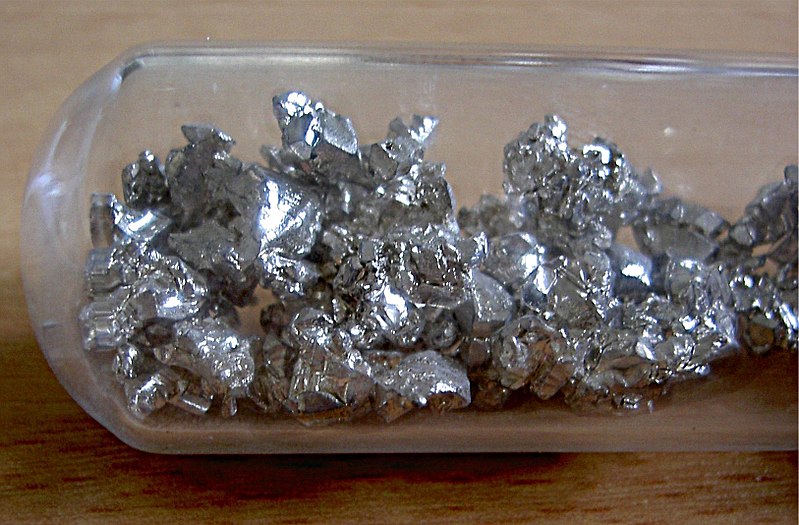
File:Calcium_unter_Argon_Schutzgasatmosphäre.jpg · Wikimedia Commons · See Wikimedia Commons
calcium
Sign in to saveAlso known as Ca, element 20, 20Ca
Calcium is a chemical element; it has symbol Ca and atomic number 20. As an alkaline earth metal, calcium is a reactive metal that forms a dark oxide-nitride layer when exposed to air. Its physical and chemical properties are most similar to its heavier homologues strontium and barium. It is the fifth most abundant element in Earth's crust, and the third most abundant metal, after iron and aluminium. The most common calcium compound on Earth is calcium carbonate, found in limestone and the fossils of early sea life; gypsum, anhydrite, fluorite, and apatite are also sources of calcium. The name
OverviewAI-generated
Calcium is a chemical element with the symbol Ca and atomic number 20. It has an atomic mass of 40.078 and a standard oxidation state of 2. The element was discovered in 1808. Its electron configuration is [Ar] 4s² or 1s² 2s² 2p⁶ 3s² 3p⁶ 4s². The ionic radius is 134, and its electronegativity is 1.00.
Physically, calcium has a melting point of 838.85 and a boiling point of 1483.85. It exhibits an electrical conductivity of 28200000 and a standard molar entropy of 41.6. The canonical SMILES representation is [Ca]. In Unicode, the character is "鈣".
In scientific literature, the term "calcium" appears in 713,024 PubMed records. It is referenced by 4,896 other encyclopedia articles. PubChem lists its weight as 40.08 and its charge as 0. It has zero hydrogen bond donors and acceptors, with a topological polar surface area of 0.
Synthesized by Vinony from 29 facts across 4 sources: Wikidata, PubMed, PubChem, Vinony graph. Generated from structured data (not the Wikipedia text) and checked against those facts — may still contain errors.
Key facts
- Calcium.engvar
- en-GB
via Wikipedia infobox
Chemical data
- Formula
- Ca
- Molecular weight
- 40.08 g/mol
- IUPAC name
- calcium
- SMILES
- [Ca]
- InChIKey
- OYPRJOBELJOOCE-UHFFFAOYSA-N
- Polar surface area
- 0 Ų
- H-bond donors
- 0
- H-bond acceptors
- 0
- Formal charge
- 0
via PubChem
Research
713,024 papers- Calcium Absorption from Food Products: Food Matrix Effects.Nutrients · 2021
- Calcium's Role and Signaling in Aging Muscle, Cellular Senescence, and Mineral Interactions.International journal of molecular sciences · 2023
- Calcium's Role in Orchestrating Cancer Apoptosis: Mitochondrial-Centric Perspective.International journal of molecular sciences · 2023
- Ionized calcium.Clinica chimica acta; international journal of clinical chemistry · 2011
- The Significance of Calcium in Photosynthesis.International journal of molecular sciences · 2019
via PubMed
Wikidata facts
- Subclass of
- alkaline earth metal
- Part of
- alkaline earth metal
- Named after
- lime
- Mass
- 40.078
- Image
- Calcium 1.jpg
- Has use
- essential medicine
Show 20 more facts
- subject has role
- essential medicine
- melting point
- 838.85
- boiling point
- 1483.85
- atomic number
- 20
- Commons category
- Calcium
- topic's main category
- Category:Calcium
- oxidation state
- 2
- element symbol
- Ca
- discoverer or inventor
- Humphry Davy
- Commons gallery
- Calcium
- canonical SMILES
- [Ca]
- chemical formula
- Ca
- time of discovery or invention
- 1808-00-00
- standard molar entropy
- 41.6
- electrical conductivity
- 28200000
- Unicode character
- 鈣
- electronegativity
- 1.00
- electron configuration
- 1s² 2s² 2p⁶ 3s² 3p⁶ 4s²
- ionic radius
- 134
- on focus list of Wikimedia project
- Wikipedia:Vital articles/Level/4
Sources (9)
via Wikidata · CC0
~28 min read
Encyclopedic overview
23 sectionsContents
- Characteristics
- Classification
- Physical properties
- Chemical properties
- Organocalcium compounds
- Isotopes
- History
- Occurrence and production
- Geochemical cycling
- Applications
- Food sources
- Biological and pathological role
- Function
- Binding
- Solubility
- Nutrition
- Hormonal regulation of bone formation and serum levels
- Abnormal serum levels
- Bone disease
- Safety
- Metallic calcium
- References
- Bibliography
Calcium is a chemical element; it has symbol Ca and atomic number 20. As an alkaline earth metal, calcium is a reactive metal that forms a dark oxide-nitride layer when exposed to air. Its physical and chemical properties are most similar to its heavier homologues strontium and barium. It is the fifth most abundant element in Earth's crust, and the third most abundant metal, after iron and aluminium. The most common calcium compound on Earth is calcium carbonate, found in limestone and the fossils of early sea life; gypsum, anhydrite, fluorite, and apatite are also sources of calcium. The name comes from the Latin word calx (meaning "lime"), which was obtained from heating limestone.
Some calcium compounds were known to the ancients, though their chemistry was unknown until the seventeenth century. Pure calcium was isolated in 1808 via electrolysis of its oxide by Humphry Davy, who named the element. Calcium compounds are widely used in many industries: in foods and pharmaceuticals for calcium supplementation, in the paper industry as bleaches, as components in cement and electrical insulators, and in the manufacture of soaps. On the other hand, the metal in pure form has few applications due to its high reactivity; still, in small quantities it is often used as an alloying component in steelmaking, and sometimes, as a calcium–lead alloy, in making automotive batteries.
Excerpted from Wikipedia’s “calcium” article, available under the CC BY-SA 4.0 licence.
Gallery (20)
Available in 179 languages
- Español
- Français
- Deutsch
- 中文
- 日本語
- Русский
- Português
- Italiano
- العربية
- हिन्दी
- abstract
- Afrikaans
- Albanian
- Amharic
- Angika
- Aragonese
- Armenian
- Asturian
Show 160 more
- Awadhi
- azb
- Azerbaijani
- Bahasa Indonesia
- Balinese
- Bangla
- Bashkir
- Basque
- Bavarian
- be_x_old
- Belarusian
- Betawi
- Bhojpuri
- Bikol
- blk
- Bosnian
- Breton
- Bulgarian
- Burmese
- Catalan
- cdo
- Cebuano
- Central Kurdish
- Cherokee
- Chuvash
- Cornish
- Corsican
- Croatian
- Czech
- Danish
- Divehi
- Egyptian Arabic
- Esperanto
- Estonian
- Extremaduran
- Faroese
- Fiji Hindi
- Fijian
- Filipino
- Finnish
- Friulian
- Galician
- Gan Chinese
- Ganda
- Georgian
- Greek
- Guarani
- Gujarati
- Haitian Creole
- Hakka Chinese
- Hawaiian
- Hebrew
- Hungarian
- hyw
- Icelandic
- Ido
- Interlingua
- Irish
- Javanese
- Kalmyk
- Kannada
- Kazakh
- kbp
- Kikuyu
- Komi
- Kurdish
- Kyrgyz
- Lao
- Latin
- Latvian
- Ligurian
- Limburgish
- Lingua Franca Nova
- Lithuanian
- Lojban
- Lombard
- Low German
- Luxembourgish
- Macedonian
- Malagasy
- Malay
- Malayalam
- Manx
- Māori
- Marathi
- Moksha
- Mongolian
- Moroccan Arabic
- nah
- Navajo
- Nederlands
- Nepali
- Newari
- Northern Frisian
- Norwegian
- Norwegian Nynorsk
- Novial
- Occitan
- Odia
- olo
- Oromo
- Ossetic
- Papiamento
- Pashto
- Piedmontese
- Polski
- Punjabi
- Quechua
- roa_rup
- Romanian
- Sanskrit
- Sardinian
- Saterland Frisian
- Scots
- Scottish Gaelic
- Serbian
- Serbian (Latin)
- Shona
- Sicilian
- simple
- Sindhi
- Sinhala
- Slovak
- Slovenian
- Somali
- Standard Moroccan Tamazight
- Sundanese
- Svenska
- Swahili
- Tachelhit
- Tajik
- Tamil
- Tatar
- Telugu
- Tibetan
- Tiếng Việt
- Toki Pona
- Türkçe
- Ukrainian
- Urdu
- Uyghur
- Uzbek
- Veps
- Volapük
- Walloon
- Waray
- Welsh
- Western Mari
- Western Panjabi
- Wu Chinese
- Yakut
- Yiddish
- Yoruba
- zh_classical
- zh_min_nan
- zh_yue
- Zulu
- فارسی
- ไทย
- 한국어
via Wikidata sitelinks · CC0