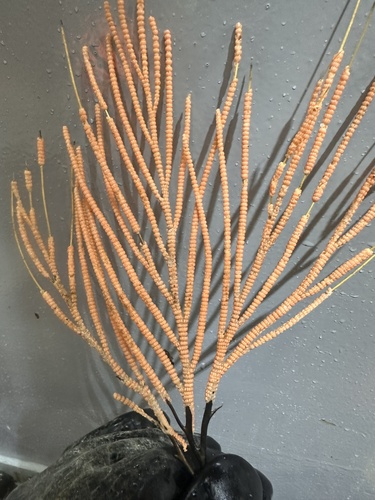
(c) cashearer, some rights reserved (CC BY-NC) · cc-by-nc
Callogorgia
Sign in to saveCallogorgia is a genus of deep sea corals that are ideally suited to be habitats for different organisms. They reproduce both sexually and asexually, clinging to the hard substrate of the ocean during their maturation process. Callogorgia are found at depths ranging from 750-8200 feet in the Gulf of Mexico, Pacific Ocean and the Caribbean Sea. An array of organisms have relationships with Callogorgia, including brittle stars, cat sharks, and copepods. The nature of these relationships are often commensal, with Callogorgia providing a habitat for the organisms.
Species
ウミヒバ属
GENUS
- KingdomAnimalia
- PhylumCnidaria
- ClassAnthozoa
- OrderScleralcyonacea
- FamilyPrimnoidae
via GBIF
Museum specimens
- Specimen records
- 137
- With media
- 30
- Family
- Primnoidae
- Collections
- UWBM, SIO, CAS, USNM, QM, YPM
- Recorded in
- United States, Costa Rica, Philippines, Ecuador, Dominica, Malaysia, Barbados, Australia
~5 min read
Encyclopedic overview
7 sectionsContents
- Description
- Life cycle
- Habitat
- Relationships
- Species
- References
- External links
Callogorgia is a genus of deep sea corals that are ideally suited to be habitats for different organisms. They reproduce both sexually and asexually, clinging to the hard substrate of the ocean during their maturation process. Callogorgia are found at depths ranging from 750-8200 feet in the Gulf of Mexico, Pacific Ocean and the Caribbean Sea. An array of organisms have relationships with Callogorgia, including brittle stars, cat sharks, and copepods. The nature of these relationships are often commensal, with Callogorgia providing a habitat for the organisms.
== Description == Callogorgia is a genus of soft corals in the family Primnoidae. Callogorgia exhibit a fan shaped body structure that often serves as a habitat for other organisms. Callogorgia are a relatively recently researched genus, with most studies occurring in the last 40 years. Due to the recency of the research on this genus, species are still being discovered and researched.
Excerpted from Wikipedia’s “Callogorgia” article, available under the CC BY-SA 4.0 licence.