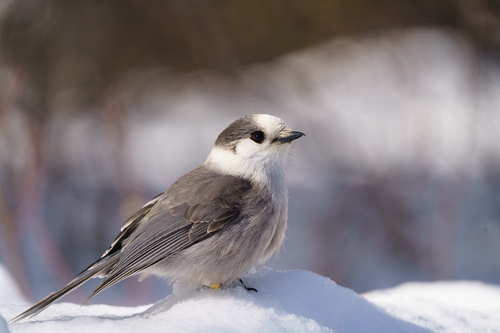
(c) marshallm7, some rights reserved (CC BY-NC) · cc-by-nc
Canada Jay
Sign in to saveAlso known as Perisoreus canadensis, Grey jay, Gray jay, Whiskey jack
species of bird
Species
Least ConcernCanada Jay
species
via IUCN
Wikidata facts
- Image
- Canada jay (53737791802).jpg
Show 6 more facts
- taxon name
- Perisoreus canadensis
- Commons category
- Perisoreus canadensis
- Commons gallery
- Perisoreus canadensis
- litter size
- 4
- short name
- P. canadensis
- taxon common name
- Arrendajo Canadiense
Sources (2)
via Wikidata · CC0
~28 min read
Article
The Canada jay (Perisoreus canadensis), also known as the grey jay, gray jay, camp robber, moose bird, gorby, or whisky jack, is a passerine bird of the family Corvidae. It is found in boreal forests of North America, north to the tree line, and in the Rocky Mountains subalpine zone south to New Mexico and Arizona. A fairly large songbird, the Canada jay has pale grey underparts, darker grey upperparts, and a grey-white head with a darker grey nape. It is one of three members of the genus Perisoreus, a genus more closely related to the magpie genus Cyanopica than to other birds known as jays. The Canada jay itself has nine recognized subspecies.
Canada jays live year-round on permanent territories in coniferous forests, surviving in winter months on food cached throughout their territory in warmer periods. The birds form monogamous mating pairs, with pairs accompanied on their territories by a third juvenile from the previous season. Canada jays adapt to human activity in their territories and are known to approach humans for food, inspiring a list of colloquial names including "lumberjack", "camp robber", and "venison-hawk". The International Union for Conservation of Nature (IUCN) considers the Canada jay a least-concern species, but populations in southern ranges may be affected adversely by global warming.