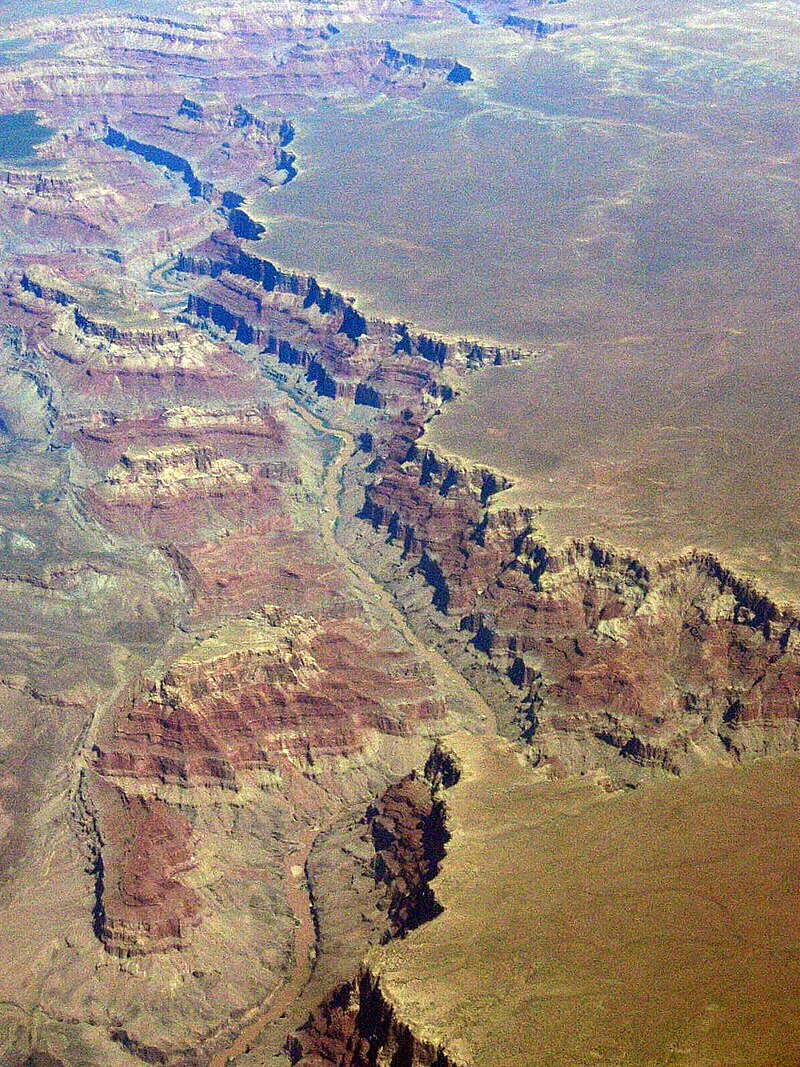
File:Aerial_view_of_canyons.jpg · Wikimedia Commons · See Wikimedia Commons
canyon
Sign in to saveAlso known as gorge, chasm
thumb|Grand Canyon, [[Arizona, at the confluence of the Colorado River and Little Colorado River.]]
A canyon is a deep, narrow valley with steep sides, typically carved out by a river over millions of years. Canyons like the Grand Canyon in Arizona are important natural landmarks that reveal Earth's geological history and attract millions of visitors for their dramatic landscapes.
AI-generated from the Wikipedia summary — may contain errors.
Wikidata facts
- Subclass of
- valley
- Image
- Roca de la Ley, Parque Nacional de Þingvellir, Suðurland, Islandia, 2014-08-16, DD 022.JPG
Show 6 more facts
- OpenStreetMap tag
- natural=canyon
- Commons category
- Canyons
- Commons gallery
- Canyon
- topic's main category
- Category:Canyons and gorges
- on focus list of Wikimedia project
- Wikipedia:Vital articles/Level/4
- exact match
- purl.obolibrary.org/obo/ENVO_00000169
via Wikidata · CC0
~14 min read
Encyclopedic overview
36 sectionsContents
- Etymology
- Formation
- Box canyon
- Largest
- Cultural significance
- Notable examples
- Africa
- Namibia
- South Africa
- Tanzania
- Americas
- Argentina
- Brazil
- Bolivia
- Canada
- Colombia
- Mexico
- Peru
- United States
- Asia
- China
- India
- Indonesia
- Others
- Europe
- United Kingdom
- France
- Ukraine
- Others
- Oceania
- Australia
- New Zealand
- Solar System
- See also
- References
- External links
thumb|Grand Canyon, [[Arizona, at the confluence of the Colorado River and Little Colorado River.]]
A canyon (; archaic British English spelling: cañon), gorge or chasm, is a deep cleft between escarpments or cliffs resulting from weathering and the erosive activity of a river over geologic time scales. Rivers have a natural tendency to cut through underlying surfaces, eventually wearing away rock layers as sediments are removed downstream. A river bed will gradually reach a baseline elevation, which is the same elevation as the body of water into which the river drains. The processes of weathering and erosion will form canyons when the river's headwaters and estuary are at significantly different elevations, particularly through regions where softer rock layers are intermingled with harder layers more resistant to weathering.
Excerpted from Wikipedia’s “canyon” article, available under the CC BY-SA 4.0 licence.
Gallery (48)
Available in 88 languages
- Español
- Français
- Deutsch
- 中文
- 日本語
- Русский
- Português
- Italiano
- العربية
- हिन्दी
- Afrikaans
- Albanian
- Angika
- Armenian
- Asturian
- Azerbaijani
- Bahasa Indonesia
- Bangla
Show 69 more
- Basque
- Betawi
- Bhojpuri
- Bikol
- Bosnian
- Breton
- Bulgarian
- Burmese
- Catalan
- Central Kurdish
- Croatian
- Czech
- Danish
- Esperanto
- Estonian
- Filipino
- Finnish
- Galician
- Georgian
- Greek
- Hebrew
- Hungarian
- Icelandic
- Ido
- Interlingua
- Irish
- Kannada
- Kazakh
- Kyrgyz
- Latin
- Latvian
- Lithuanian
- Macedonian
- Malay
- Mingrelian
- Navajo
- Nederlands
- Newari
- Norwegian
- Norwegian Nynorsk
- Old English
- Oromo
- Polski
- Romanian
- Scottish Gaelic
- Serbian
- Serbian (Latin)
- Sicilian
- simple
- Slovak
- Slovenian
- Svenska
- Swahili
- szy
- Tamil
- Tatar
- Tiếng Việt
- Türkçe
- Ukrainian
- Uzbek
- Walloon
- Welsh
- Western Frisian
- Wu Chinese
- Yakut
- zh_yue
- فارسی
- ไทย
- 한국어
via Wikidata sitelinks · CC0