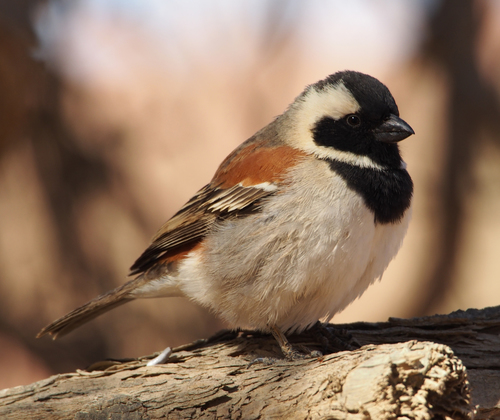
(c) Jenny Donald, some rights reserved (CC BY-NC), uploaded by Jenny Donald · cc-by-nc
Species
Least ConcernCape Sparrow
species
via IUCN
Wikidata facts
Show 10 more facts
- taxon rank
- species
- IUCN conservation status
- Least Concern
- taxon name
- Passer melanurus
- Commons category
- Passer melanurus
- Commons gallery
- Passer melanurus
- taxon common name
- crnolici vrabac
- litter size
- 3.5
- egg incubation period
- 13
- taxon range
- Africa
- taxon author citation
- (Müller, 1776)
Sources (3)
via Wikidata · CC0
~16 min read
Encyclopedic overview
The Cape sparrow (Passer melanurus), or mossie, is a bird of the sparrow family Passeridae found in southern Africa. A medium-sized sparrow at 14–16 centimetres (5.5–6.3 in), it has distinctive plumage, including large pale head stripes in both sexes. Its plumage is mostly grey, brown, and chestnut, and the male has some bold black and white markings on its head and neck. The species inhabits semi-arid savannah, cultivated areas, and towns, and ranges from the central coast of Angola to eastern South Africa and Eswatini. Three subspecies are distinguished in different parts of its range.
Cape sparrows primarily eat seeds, and also eat soft plant parts and insects. They typically breed in colonies, and when not breeding they gather in large nomadic flocks to move around in search of food. The nest can be constructed in a tree, a bush, a cavity, or a disused nest of another species. A typical clutch contains three or four eggs, and both parents are involved in breeding, from nest building to feeding young. The Cape sparrow is common in most of its range and coexists successfully in urban habitats with two of its relatives, the native southern grey-headed sparrow and the house sparrow, an introduced species. The Cape sparrow's population has not been recorded decreasing significantly, and it is not seriously threatened by human activities, so it is assessed as a species of least concern by the International Union for Conservation of Nature (IUCN).
Excerpted from Wikipedia’s “Cape Sparrow” article, available under the CC BY-SA 4.0 licence.