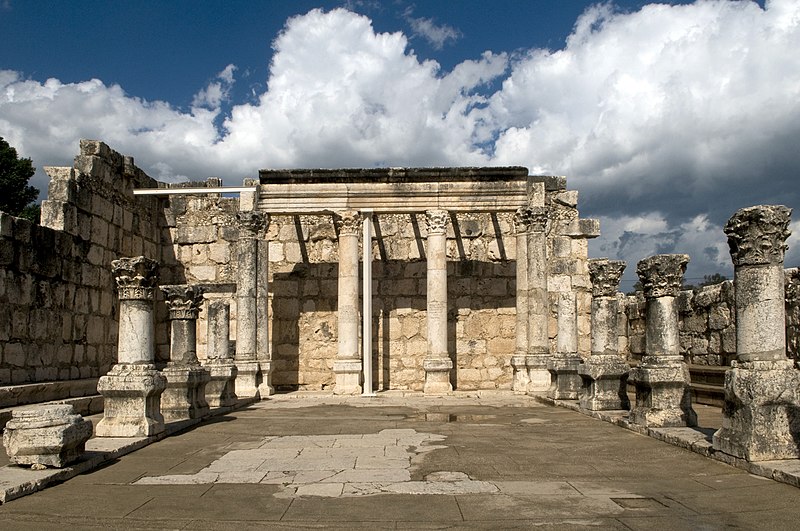
File:Sites_of_Christianity_in_the_Galillee_-_Ruins_of_the_ancient_Great_Synagogue_at_Capernaum_(or_Kfar_Nahum)_on_the_shore_of_the_Lake_of_Galilee,_Northern_Israel.jpg · Wikimedia Commons · See Wikimedia Commons
Capernaum
Sign in to saveAlso known as Kfar Nahum, Kfar Nachum
Capernaum ( ; ; ) was a fishing village established during the time of the Hasmoneans, located on the northern shore of the Sea of Galilee. It had a population of about 1,500 in the 1st century AD. Archaeological excavations have revealed two ancient synagogues built one over the other. A house turned into a church during the Byzantine period is held by Christian tradition to have been the home of Saint Peter. thumb|Capernaum's 4th-century synagogue (detail with columns and benches)
Capernaum was a small fishing village of about 1,500 people on the northern shore of the Sea of Galilee during the 1st century AD, where archaeological digs have uncovered two ancient synagogues built consecutively. The site is significant to Christian tradition as the reputed location of Saint Peter's house, which was later converted into a church during the Byzantine period.
AI-generated from the Wikipedia summary — may contain errors.
Key facts
- Ancient site.name
- Capernaum
- Ancient site.native_name
- (Kǝfar Naḥūm)
- Ancient site.alternate_name
- Kapharnaum, Kepharnōkón, Kafr Nāḥūm, Talḥūm
- Ancient site.image
- Sites of Christianity in the Galillee - Ruins of the ancient Great Synagogue at Capernaum (or Kfar Nahum) on the shore of the Lake of Galilee, Northern Israel.jpg
- Ancient site.caption
- Ruins of the 4th-century Capernaum synagogue
- Ancient site.map_type
- Israel
- Ancient site.map_size
- 250
- Ancient site.location
- Plain of Ginosar, Sea of Galilee, Israel
- Ancient site.region
- Galilee
- Ancient site.type
- Settlement
- Ancient site.epochs
- Hasmonean, Roman, Byzantine, early Islamic periods
- Ancient site.cultures
- Jewish (Second Temple and Talmudic eras), Christian
- Ancient site.excavations
- 1838–present
- Ancient site.archaeologists
- Edward Robinson, Charles William Wilson, Heinrich Kohl, Carl Watzinger, Vendelin von Benden, Gaudenzio Orfali, Virgilio Corbo, Stanislao Loffreda, Vassilios Tzaferis
- Ancient site.condition
- Partially preserved
- Ancient site.public_access
- Yes
- Ancient site.website
- Capernaum – Custody of the Holy Land
via Wikipedia infobox
Wikidata facts
- Instance of
- tourist destination
- Country
- Israel
- Located in
- Northern District
- Area
- 1728
- Time zone
- Israel Standard Time
- Body of water
- Sea of Galilee
- Location
- Tiberias
- Image
- Kafarnaum BW 7.JPG
Show 8 more facts
- P12749
- Mauricio Hochschild
- described by source
- Wikitólica
- Commons category
- Capernaum
- Commons gallery
- Kapernaum
- topic's main category
- Category:Capernaum
- time period
- Second Temple period
- inception
- 0200-00-00
- culture
- culture of ancient Rome
via Wikidata · CC0
~18 min read
Encyclopedic overview
16 sectionsContents
- Toponymy
- New Testament
- History
- Archaeology
- Discovery and excavation
- General description
- Synagogue
- "House of Peter"
- 1st century
- 4th-century transformation
- Octagonal 5th-century church
- Memorial (1990)
- See also
- References
- Further reading
- External links
Capernaum ( ; ; ) was a fishing village established during the time of the Hasmoneans, located on the northern shore of the Sea of Galilee. It had a population of about 1,500 in the 1st century AD. Archaeological excavations have revealed two ancient synagogues built one over the other. A house turned into a church during the Byzantine period is held by Christian tradition to have been the home of Saint Peter. thumb|Capernaum's 4th-century synagogue (detail with columns and benches)
The village was inhabited continuously from the 2nd century BC to the 11th century AD, when it was abandoned sometime before the First Crusade. This includes the re-establishment of the village northeast of the earlier location in , during the Early Islamic period.
Excerpted from Wikipedia’s “Capernaum” article, available under the CC BY-SA 4.0 licence.
Gallery (22)
On the map
3 mapped locations
Available in 60 languages
- Español
- Français
- Deutsch
- 中文
- 日本語
- Русский
- Português
- Italiano
- العربية
- Afrikaans
- Aragonese
- Armenian
- Bahasa Indonesia
- Basque
- Belarusian
- Bishnupriya
- Breton
- Bulgarian
Show 41 more
- Catalan
- Cebuano
- Croatian
- Czech
- Danish
- Esperanto
- Filipino
- Finnish
- Galician
- Greek
- Hebrew
- Hungarian
- Javanese
- Kashubian
- Latvian
- Malagasy
- Malayalam
- Mazanderani
- Nederlands
- Norwegian
- Norwegian Nynorsk
- Occitan
- Polski
- Romanian
- Serbian
- Serbian (Latin)
- Slovenian
- Svenska
- Swahili
- Tamil
- Tiếng Việt
- Türkçe
- Ukrainian
- Urdu
- Venetian
- Waray
- Western Frisian
- Wu Chinese
- فارسی
- ไทย
- 한국어
via Wikidata sitelinks · CC0