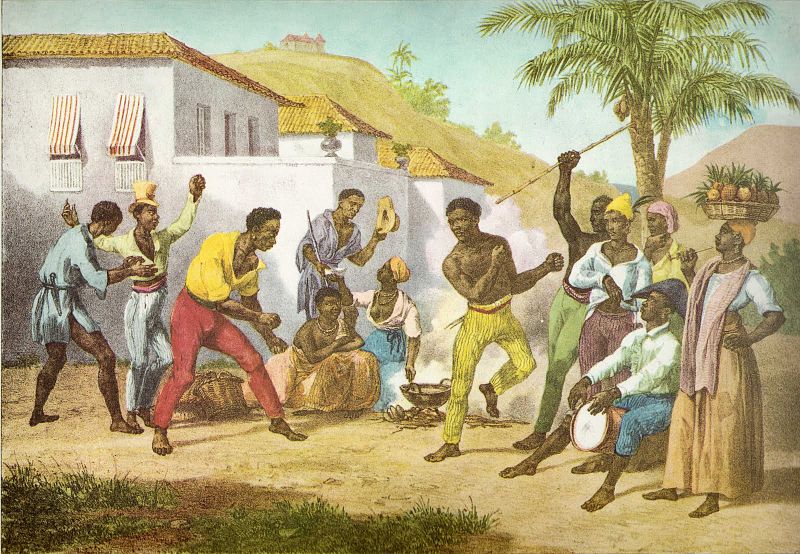
File:Rugendasroda.jpg · Wikimedia Commons · See Wikimedia Commons
capoeira
Sign in to saveCapoeira () is an Afro-Brazilian martial art and game that includes elements of dance, acrobatics, music, and spirituality.
Capoeira is an Afro-Brazilian martial art that blends fighting techniques with dance, acrobatics, music, and spiritual elements into a single practice. It matters as a significant cultural expression that reflects African and Brazilian heritage and remains practiced and valued worldwide today.
AI-generated from the Wikipedia summary — may contain errors.
Key facts
- Martial art.aka
- Jogo de angolaJogo de capoeiraCapoeiragem
- Martial art.formation
- Unknown, first mention in 1789
- Martial art.hardness
- Full-contact
- Martial art.image
- 250px
- Martial art.imagecaption
- Capoeira or the Dance of War by Johann Moritz Rugendas, 1825, published in 1835
- Martial art.name
- Capoeira
- Martial art.focus
- Kicks, evasions, takedowns, handstands, acrobatics
- Martial art.parenthood
- Engolo
- Martial art.ancestor arts
- Engolo, batuque, possibly moraingy and savate
- Martial art.descendant arts
- Capoeira carioca
- Martial art.related arts
- MacuelêDanmyéknocking and kickingBreakdancing
- Martial art.meaning
- Forest clearing
- Martial art.famous_pract
- See notable practitioners
via Wikipedia infobox
Described at

Culture | UNESCO
UNESCO Culture initiatives protect heritage, promote arts, and support creativity, contributing to sustainable development and intercultural dialogue.
unesco.org →Link to a page describing this subject · 11,953 chars · not written by Vinony
Wikidata facts
- Instance of
- type of sport
- Subclass of
- martial arts
- Part of
- Afro-Brazilian culture
- Has part
- capoeira music
- Country
- Brazil
- Country of origin
- Brazil
- Creator
- African Brazilians
- Developer
- Manuel dos Reis Machado
- Image
- Capoeira, Brazils.png
Show 5 more facts
- Commons category
- Capoeira
- topic's main category
- Category:Capoeira
- intangible cultural heritage status
- Representative List of the Intangible Cultural Heritage of Humanity
- inception
- 1600-00-00
- described at URL
- ich.unesco.org/es/RL/00892
via Wikidata · CC0
~48 min read
Encyclopedic overview
52 sectionsContents
- Etymology
- History
- Contemporary global popularity
- Techniques
- Weapons
- As a game
- Roda
- Batizado
- Chamada
- Volta ao mundo
- Music
- Instruments
- Songs
- Philosophy
- ''Malícia'' (malice)
- Malandragem
- Personal Skills Developed
- ''Body''
- Mind
- Spirituality
- Bantu culture
- Inverted worldview
- ''Mandinga'' (magic)
- Styles
- Capoeira Angola
- Capoeira Regional
- Capoeira carioca
- Capoeira Contemporânea
- Ranks
- Brazilian Capoeira Confederation system
- Children's system (3 to 14 years)
- Adult system (above 15)
- Instructors' system
- ABADÁ - Capoeira system
- Adult Graduation System
- Women in Capoeira
- ''Prior to 1970s''
- Inequality in Capoeira, pre-1970s
- Female Capoeiristas, early-to-mid twentieth century
- Culture Changes post-1970s
- Related activities
- Samba de roda
- Maculelê
- Puxada de rede
- Combat capoeira and MMA
- Notable practitioners
- In popular media
- See also
- References
- Bibliography
- Further reading
- External links
Capoeira () is an Afro-Brazilian martial art and game that includes elements of dance, acrobatics, music, and spirituality.
It includes acrobatic and complex manoeuvres, often involving hands on the ground and inverted kicks. It emphasizes flowing movements rather than fixed stances; the ginga, a rocking step, is usually the focal point of the technique. Though often said to be a martial art disguised as a dance, capoeira also serves as a way to maintain spirituality and culture.
Excerpted from Wikipedia’s “capoeira” article, available under the CC BY-SA 4.0 licence.
Gallery (52)
Available in 70 languages
- Español
- Français
- Deutsch
- 中文
- 日本語
- Русский
- Português
- Italiano
- العربية
- Afrikaans
- Armenian
- Asturian
- Azerbaijani
- Bahasa Indonesia
- Bangla
- Basque
- Bosnian
- Breton
Show 51 more
- Bulgarian
- Catalan
- Croatian
- Czech
- Danish
- Egyptian Arabic
- Esperanto
- Estonian
- Finnish
- Galician
- Georgian
- Greek
- Hebrew
- Hungarian
- hyw
- Icelandic
- Interlingua
- Kyrgyz
- Latin
- Latvian
- Lingua Franca Nova
- Lithuanian
- Macedonian
- Malay
- Malayalam
- Mingrelian
- Moroccan Arabic
- Nederlands
- Newari
- Norwegian
- Norwegian Nynorsk
- Occitan
- Polski
- Romanian
- Serbian
- Serbian (Latin)
- simple
- Slovak
- Slovenian
- Svenska
- Swahili
- Tamil
- Tetum
- Tiếng Việt
- Türkçe
- Ukrainian
- Wu Chinese
- zh_yue
- فارسی
- ไทย
- 한국어
via Wikidata sitelinks · CC0