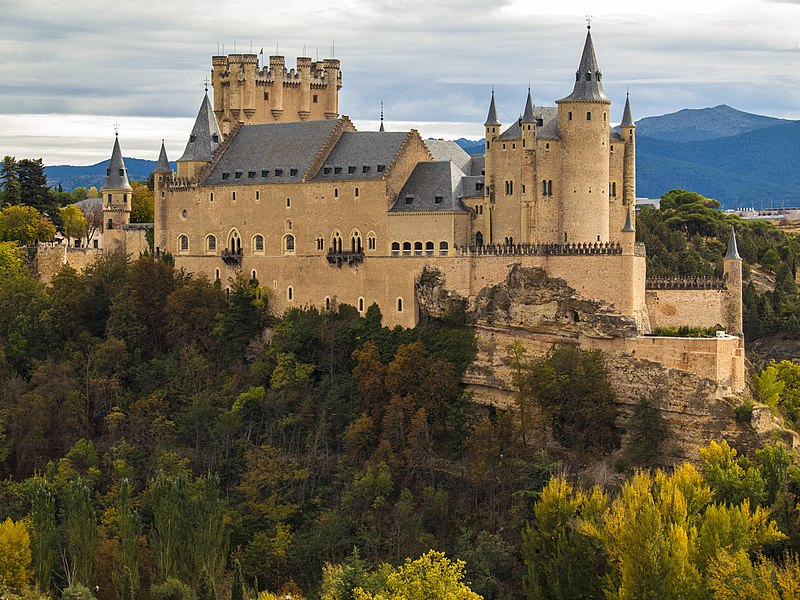
File:Panorámica_Otoño_Alcázar_de_Segovia.jpg · Wikimedia Commons · See Wikimedia Commons
castle
Sign in to saveAlso known as medieval castle, Middle Ages castle
I don't have any context provided to base an overview on. Please provide the context about "castle" that you'd like me to use to write the overview.
AI-generated from the Wikipedia summary — may contain errors.
Wikidata facts
- Image
- Castell Caerffili o'r awyr - aerial (drone) view of Caerphilly Castle - 2023 34.jpg
Show 7 more facts
- Commons gallery
- Castle
- Unicode character
- 🏰
- Commons category
- Castles
- equivalent class
- dbpedia.org/ontology/Castle
- exact match
- wordnet-rdf.princeton.edu/wn31/102974554-n
- OpenStreetMap tag
- historic=castle
- P8168
- Richard Mason
via Wikidata · CC0
~73 min read
Article
33 sectionsContents
- Definition
- Etymology
- Defining characteristics
- Terminology
- Common features
- Motte
- Bailey and enceinte
- Keep
- Curtain wall
- Gatehouse
- Moat
- Battlements
- Arrowslits
- Postern
- Great hall
- History
- Antecedents
- Origins (9th and 10th centuries)
- 11th century
- Innovation and scientific design (12th century)
- 13th to 15th centuries
- Advent of gunpowder
- Bastions and star forts (16th century)
- {{anchor|Revival castles and the castle as a country house}}{{anchor|Revival castle}}{{anchor|Mock castle}}Later use and revival castles
- Construction
- Social centre
- Locations and landscapes
- Warfare
- See also
- Footnotes
- References
- Bibliography
- Further reading
A castle is a type of fortified structure built during the Middle Ages predominantly by the nobility or royalty and by military orders. Scholars usually consider a castle to be the private fortified residence of a lord or noble. This is distinct from a mansion, palace, and villa, whose main purpose was exclusively for pleasance and are not primarily fortresses but may be fortified. Use of the term has varied over time and, sometimes, has also been applied to structures such as hill forts and 19th- and 20th-century homes built to resemble castles. Over the Middle Ages, when genuine castles were built, they took on a great many forms with many different features, although some, such as curtain walls, arrowslits, and portcullises, were commonplace.
European-style castles originated in the 9th and 10th centuries after the fall of the Carolingian Empire, which resulted in its territory being divided among individual lords and princes. These nobles built castles to control the area immediately surrounding them and they were both offensive and defensive structures: they provided a base from which raids could be launched as well as offering protection from enemies. Although their military origins are often emphasised in castle studies, the structures also served as centres of administration and symbols of power. Urban castles were used to control the local populace and important travel routes, and rural castles were often situated near features that were integral to life in the community, such as mills, fertile land, or a water source.
Gallery (52)
Available in 111 languages
- Español
- Français
- Deutsch
- 中文
- 日本語
- Русский
- Português
- Italiano
- العربية
- हिन्दी
- Afrikaans
- Albanian
- Albanian
- Aragonese
- Aramaic
- Armenian
- Arpitan
- Asturian
Show 92 more
- azb
- Azerbaijani
- Bahasa Indonesia
- Bangla
- Bashkir
- Basque
- bat_smg
- Bavarian
- be_x_old
- Belarusian
- Bosnian
- Breton
- Bulgarian
- Buriat
- Burmese
- Catalan
- Central Kurdish
- Chuvash
- Croatian
- Czech
- Danish
- Esperanto
- Estonian
- Finnish
- Galician
- Georgian
- Greek
- Guarani
- Haitian Creole
- Hebrew
- Hungarian
- Icelandic
- Ido
- Ingush
- Interlingua
- Irish
- Javanese
- Latin
- Latvian
- Limburgish
- Lithuanian
- lld
- Lombard
- Luxembourgish
- Macedonian
- Malay
- Manipuri
- Marathi
- Mazanderani
- nds_nl
- Nederlands
- Norwegian
- Norwegian Nynorsk
- nrm
- Occitan
- Piedmontese
- Polski
- Punjabi
- rki
- roa_rup
- Romanian
- rsk
- Scots
- Serbian
- Serbian (Latin)
- Sicilian
- simple
- Slovak
- Slovenian
- Svenska
- Swahili
- Tajik
- Tamil
- Tatar
- Tiếng Việt
- Tigrinya
- Türkçe
- Ukrainian
- Upper Sorbian
- Urdu
- Venetian
- Walloon
- Waray
- Welsh
- Western Frisian
- Western Panjabi
- Wu Chinese
- zh_min_nan
- zh_yue
- فارسی
- ไทย
- 한국어
via Wikidata sitelinks · CC0