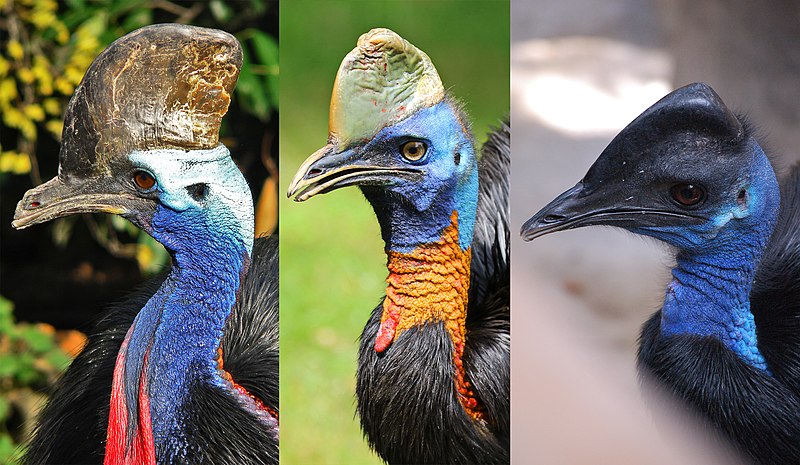
File:Cassowary_Diversity.jpg · Wikimedia Commons · See Wikimedia Commons
Casuarius
Sign in to saveAlso known as cassowary
Cassowaries (; Biak: man suar ; ; Papuan: kasu weri ) are flightless birds of the genus Casuarius, in the order Casuariiformes. They are classified as ratites, flightless birds without a keel on their sternum bones. Cassowaries are native to the tropical forests of New Guinea (Western New Guinea and Papua New Guinea), the Moluccas (Seram and Aru Islands), and northeastern Australia.
OverviewAI-generated
*Casuarius* is a genus of birds within the family Casuariidae, order Casuariiformes, and class Aves. The taxon, described by Brisson in 1760, belongs to the phylum Chordata and kingdom Animalia. It is characterized by bipedal locomotion and has existed for approximately 5 million years. The genus is documented in sources including the *Encyclopædia Britannica* 11th edition and the Brockhaus and Efron Encyclopedic Dictionary.
Specimen records for *Casuarius* are held by institutions such as CUMV, UCMP, ANWC, CHAS, and NHMUK. These records originate from the United States, Papua New Guinea, Australia, the United Kingdom, and Indonesia. The genus has been the subject of 12,343 occurrence records and 160 specific records, including 18 media files. It is referenced by 487 other encyclopedia articles.
Synthesized by Vinony from 27 facts across 5 sources: Wikidata, GBIF, Gbif Occ, iDigBio, Vinony graph. Generated from structured data (not the Wikipedia text) and checked against those facts — may still contain errors.
Species
Casuarius
GENUS
- KingdomAnimalia
- PhylumChordata
- ClassAves
- OrderCasuariiformes
- FamilyCasuariidae
via GBIF
Museum specimens
- Specimen records
- 160
- With media
- 18
- Family
- Casuariidae
- Collections
- CUMV, UCMP, ANWC, CHAS, NHMUK, UAFMC
- Recorded in
- United States, Papua New Guinea, Australia, United Kingdom, Indonesia; Papua, New Guinea, Uruguay, Argentina, Indonesia
Wikidata facts
- Instance of
- taxon
- Parent taxon
- Casuariidae
- Image
- Emu 1 - Tidbinbilla.jpg
Show 9 more facts
- means of locomotion
- bipedalism
- start time
- 5000000-00
- taxon name
- Casuarius
- taxon rank
- genus
- Commons category
- Casuarius
- Commons gallery
- Casuarius
- topic's main category
- Category:Casuarius
- described by source
- Explanatory Dictionary of the Living Great Russian Language
- on focus list of Wikimedia project
- Wikipedia:Vital articles/Level/4
via Wikidata · CC0
~27 min read
Encyclopedic overview
19 sectionsContents
- Taxonomy, systematics, and evolution
- Description
- Behaviour and ecology
- Reproduction
- Diet
- Role in seed dispersal and germination
- Threats
- Distribution and habitat
- Status and conservation
- In captivity
- Relationship with humans
- Role in Papuan cultures and semi-domestication
- Urbanisation of local cassowary population
- Attacks
- References
- Citations
- Cited texts
- Further wording
- External links
Cassowaries (; Biak: man suar ; ; Papuan: kasu weri ) are flightless birds of the genus Casuarius, in the order Casuariiformes. They are classified as ratites, flightless birds without a keel on their sternum bones. Cassowaries are native to the tropical forests of New Guinea (Western New Guinea and Papua New Guinea), the Moluccas (Seram and Aru Islands), and northeastern Australia.
Three cassowary species are extant. The most common, the southern cassowary, is the fourth-tallest and third-heaviest living bird, smaller only than the two species of ostrich and the emu. The other two species of cassowary are the northern cassowary and the dwarf cassowary; the northern cassowary is the most recently discovered and the most threatened. A fourth, extinct, species is the pygmy cassowary.
Excerpted from Wikipedia’s “Casuarius” article, available under the CC BY-SA 4.0 licence.
Gallery (29)
Available in 85 languages
- Español
- Français
- Deutsch
- 中文
- 日本語
- Русский
- Português
- Italiano
- العربية
- Armenian
- Asturian
- Azerbaijani
- Bahasa Indonesia
- Balinese
- Bangla
- Basque
- Belarusian
- Betawi
Show 66 more
- Breton
- Bulgarian
- Burmese
- Catalan
- Cebuano
- Central Kurdish
- Cherokee
- Croatian
- Czech
- Danish
- Egyptian Arabic
- Esperanto
- Estonian
- Filipino
- Finnish
- Galician
- Georgian
- Greek
- Gujarati
- Hebrew
- Hungarian
- Ido
- Interlingua
- Irish
- Javanese
- Kannada
- Kazakh
- Kotava
- Latin
- Latvian
- Macedonian
- Malay
- Malayalam
- Marathi
- Mingrelian
- Navajo
- Nederlands
- Northern Frisian
- Norwegian
- Norwegian Nynorsk
- Pashto
- Polski
- Romanian
- Samoan
- Sanskrit
- Serbian
- simple
- Sinhala
- Slovenian
- Sundanese
- Svenska
- Tajik
- Tamil
- Tiếng Việt
- Tok Pisin
- Türkçe
- Ukrainian
- Urdu
- Waray
- Western Frisian
- Wu Chinese
- Zeelandic
- zh_yue
- فارسی
- ไทย
- 한국어
via Wikidata sitelinks · CC0