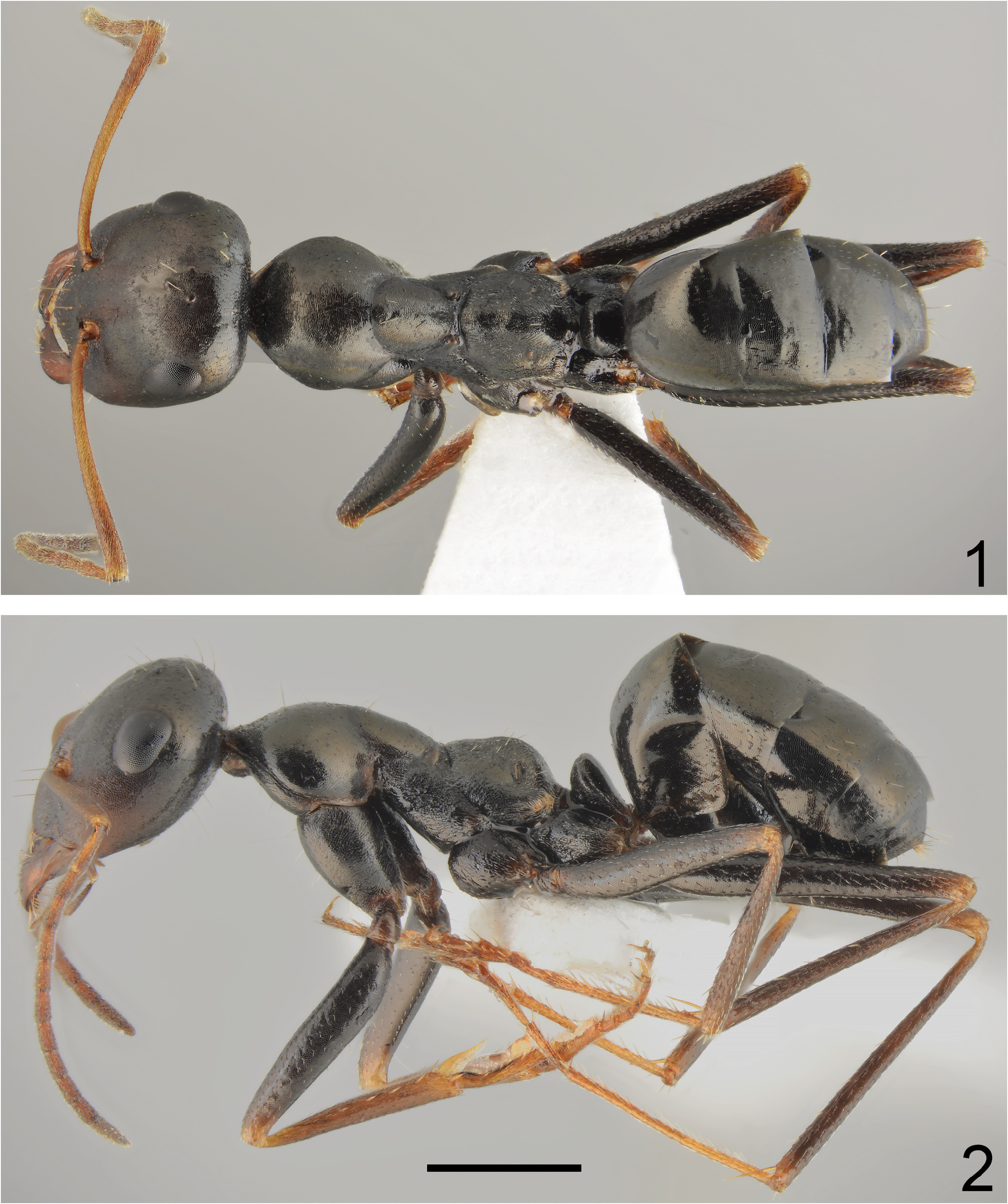
Salata, Sebastian;Demetriou, Jakovos;Georgiadis, Christos;Borowiec, Lech
Cataglyphis
Sign in to saveCataglyphis is a genus of ant, desert ants, in the subfamily Formicinae. Its most famous species is C. bicolor, the Sahara Desert ant, which runs on hot sand to find insects that died of heat exhaustion, and can, like other several other Cataglyphis species, sustain body temperatures up to 50°C. Cataglyphis is also the name of an autonomous rover that won the NASA Sample Return Robot Centennial Challenge inspired by the navigation approaches used by desert ants.
Species
GENUS
- KingdomAnimalia
- PhylumArthropoda
- ClassInsecta
- OrderHymenoptera
- FamilyFormicidae
[male] Lg.3 3/4 lin. Der Kopf ist roth, der Clypeus jedoch- grösstenteils und die Wangen bis zu dem obera Augenrande hin schwarzbraun; die Sculptur höchst fein und dicht runzlig, mit zerstreuten schwachen Pünktchen , überall völlig matt, glanzlos. Die Mandibeln roth, schmal, nicht besonders verlängert , an der Basis völlig glatt, an der Spitze durch einige sehr grobe, etwas zusammenfliessende Punkte schwach runzlig, an: der Spitze zweizaehnig, der äussere Rand ziemlich gross, braungefärbt , der innere sehr klein. Die Maxillartaster sehr lang, die 3 ersten Glieder schwarzbraun, das 3te jedoch etwas heller als die beiden vorhergehenden, das 3te und 4te ungefähr gleich lang, beide bedeutend länger als die übrigen , einzeln genommen; die 3 letzten Glieder derselben roth. Die Lippentaster klein, bräunlich gefärbt . Der Clypeus hat dieselbe Sculptur wie der übrige Theil des Kopfes, in der Mitte ist er schwach höckerig gewölbt , der ganze Vorderrand und die Mitte der Länge nach roth, jedoch erreicht die rothe Farbe in der Mitte nicht ganz das Stirnfeld. Der Vorderrand desselben querüber fast ganz grade abgeschnitten, mit einer Reihe starker, langer, rothgelber Borsten gewimpert, auch die
via GBIF
Museum specimens
- Specimen records
- 64
- With media
- 4
- Family
- Formicidae
- Collections
- CAS, NHMUK, SAM, USNM, BYU, MNHN
- Recorded in
- Bulgaria, Georgia, Burkina Faso, Egypt, Uzbekistan, Spain, Tchad, Israel
Described at
Cataglyphis desert ants: a good model for evolutionary biology in Darwin’s anniversary year—A review AlAin lenoir, 1 Serge Aron, 2 Xim Cerdá, 3 And AbrAhAm hefetz 4 1 IRBI, UMR CNRS 6035, Université François Rabelais, Faculté des Sciences, 37200 Tours, France. E-mail: [email protected] 2 Université Libre de Bruxelles, Service évolution Biologique & écologie, C.P. 160/12 50, av. F.D. Roosevelt, 1050 Bruxelles, Belgique. E-mail: [email protected] 3 Estación Biológica de Doñana, CSIC, Avda. Américo Vespucio s/n, E-41092 Sevilla, Spain. E-mail: [email protected] 4 Department of Zoology, George S. Wise Faculty of Life Sciences, Tel Aviv University, Tel Aviv 69978, Israel. E-mail: [email protected] AbstrAct Cataglyphis ants comprise one of the most characteristic groups of insects in arid regions around the Mediterranean basin and have been intensively stud- ied over the last 30 years. These ants are central-place foragers and scaven- gers, single-prey loaders that have become a model for insect navigation using sophisticated visual orientation, having lost pheromone orientation. They are highly heat-tolerant ants that forage close to their critical thermal limit dur- ing the hottest hours of the day, with their long-chain cuticular hydrocarbons protecting them from desiccation. This is exemplified in two Cataglyphis species, each of which developed different mechanisms for counteracting extreme heat when foraging: polymorphism of workers vs. physiological and behavioral adaptations. Several species in this genus have also become a model for studying nestmate recognition mechanisms. The role of cuticular hydrocarbons and the postpharyngeal gland as a reservoir of hydrocarbons in nestmate recognition was initially discovered mainly in Cataglyphis, includ- ing the first experimental demonstration of the Gestalt model of nestmate recognition. These ants possess very acute discrimination capacities, down to individual recognition. Such fine discrimination is seemingly used by ants that rescue from ant-lion traps only those individuals that are their nestmates. Two main reproductive strategies are exhibited by species of this genus: some reproduce classically, by independent colony foundation following nuptial flight, whereas others reproduce by colony fission. Limited dispersion increases competition for access to resources, and local resource competition This article is dedicated to Professor Jehoshua Kugler (1916–2007), a pioneer of ant studies in Israel, who described a new species of Cataglyphis from this region (Kugler, 1981). has been demonstrated. Multiple mating, which had been considered to be rare in ants, has also been reported in all species studied. Finally, the most important discovery in recent years with regard to reproduction strategies in Cataglyphis is probably the occurrence of thelytokous parthenogenesis in both workers and queens. In Cataglyphis cursor, queens are able to produce new queens by thelytoky, a phenomenon that was later found in four other ant species. This ability does not exist in any other Cataglyphis species, attesting to the great variety of reproductive strategies in this genus. KEYWORDS: Cataglyphis, orientation, reproduction strategies, thelytoky, parthenogenesis, multiple mating, nestmate recognition, hydrocarbons, xe- rophyly introDuction Cataglyphis ants are one of the most characteristic and conspicuous insects of arid regions around the Mediterranean basin and can be seen running very rapidly, up to 20 meters per minute, during the hottest hours of the day. They are called “the thief of the cooking pot” in Arabic, and “thief” in Greek (due to their rapid stealing of food particles) or “Englishmen” (due to their activity in the hot midday sun at siesta time) (Harkness and Wehner, 1977). A century ago, Santschi (1911) observed the sun-assisted orientation skills of Cataglyphis ants in Tunisia (reviewed by Wehner, 1990). During a total eclipse of the sun in June, 1973, in the Sah
Excerpt from a page describing this subject · 40,000 chars · not written by Vinony
Wikidata facts
- Instance of
- taxon
- Parent taxon
- Formicinae
- Image
- Cataglyphis bicolor casent0104612 profile 1.jpg
Show 5 more facts
- taxon rank
- genus
- taxon name
- Cataglyphis
- Commons category
- Cataglyphis
- topic's main category
- Category:Cataglyphis
- described at URL
- digital.csic.es/bitstream/10261/65135/1/israel.pdf#page=23
Sources (1)
via Wikidata · CC0
~8 min read
Encyclopedic overview
9 sectionsContents
- Name
- Description
- Navigational behaviour
- Distribution
- Parthenogenesis
- Species
- References
- Further reading
- External links
Cataglyphis is a genus of ant, desert ants, in the subfamily Formicinae. Its most famous species is C. bicolor, the Sahara Desert ant, which runs on hot sand to find insects that died of heat exhaustion, and can, like other several other Cataglyphis species, sustain body temperatures up to 50°C. Cataglyphis is also the name of an autonomous rover that won the NASA Sample Return Robot Centennial Challenge inspired by the navigation approaches used by desert ants.
==Name== It was named in 1850, with reference to the impressions of its abdomen: "Von χατά und γλυψίς der Einschnitt. Eine Andeutung auf die vielen Einschnitte oder vielmehr Eindrücke de Hinterleibs."
Excerpted from Wikipedia’s “Cataglyphis” article, available under the CC BY-SA 4.0 licence.