Encyclopedia of Life · EOL (see source)
Caulophyllum
Sign in to saveCaulophyllum is a small genus of perennial herbs belonging to the family Berberidaceae and closely related to the Eurasian genera Leontice and Gymnospermium. It is native to eastern Asia and eastern North America. These plants are distinctive spring wildflowers, which grow in moist, rich woodland, it is known for its large triple-compound leaf, and large blue, berry-like fruits. Unlike many spring wildflowers, it is not an ephemeral plant and persists throughout much of the summer. Common names for plants in this genus include blue cohosh, squaw root, and papoose root. As hinted at by its comm
Species
GENUS
- KingdomPlantae
- PhylumTracheophyta
- ClassMagnoliopsida
- OrderRanunculales
- FamilyBerberidaceae
Caulophyllum es un género con tres especies de plantas de la familia Berberidaceae.[1] Taxonomía El género fue descrito por André Michaux y publicado en Flora Boreali-Americana 1: 204–205, pl. 21. 1803.[2] La especie tipo es: Caulophyllum thalictroides. Etimología Caulophyllum: nombre genérico que deriva de las palabras griegas: caulo = "tallo" y phyllum = "hoja". Especies Caulophyllum giganteum Caulophyllum robustum Caulophyllum thalictroides Referencias ↑ Caulophyllum en PlantList ↑ «Caulophyllum». Tropicos.org. Missouri Botanical Garden. Consultado el 24 de mayo de 2013. Datos: Q2671028 Multimedia: Especies: Caulophyllum
via GBIF · Kew POWO
Museum specimens
- Specimen records
- 103
- With media
- 96
- Family
- Berberidaceae
- Collections
- MO, GH, ETSU, CAS, ENCB-IPN, CM
- Recorded in
- United States, Japan
Wikidata facts
- Instance of
- taxon
- Image
- Caulophyllum thalictroides-BB.jpg
Show 7 more facts
- has fruit type
- capsule
- Commons category
- Caulophyllum
- taxon name
- Caulophyllum
- taxon rank
- genus
- topic's main category
- Category:Caulophyllum
- taxon common name
- 红毛七属
Sources (2)
via Wikidata · CC0
~4 min read
Encyclopedic overview
7 sectionsContents
- Description
- Species
- Uses
- Food
- Medicine
- Gallery
- References
Caulophyllum is a small genus of perennial herbs belonging to the family Berberidaceae and closely related to the Eurasian genera Leontice and Gymnospermium. It is native to eastern Asia and eastern North America. These plants are distinctive spring wildflowers, which grow in moist, rich woodland, it is known for its large triple-compound leaf, and large blue, berry-like fruits. Unlike many spring wildflowers, it is not an ephemeral plant and persists throughout much of the summer. Common names for plants in this genus include blue cohosh, squaw root, and papoose root. As hinted at by its common names, this plant is well known as an alternative medicine for inducing childbirth and menstrual flow; it is also considered a poisonous plant.
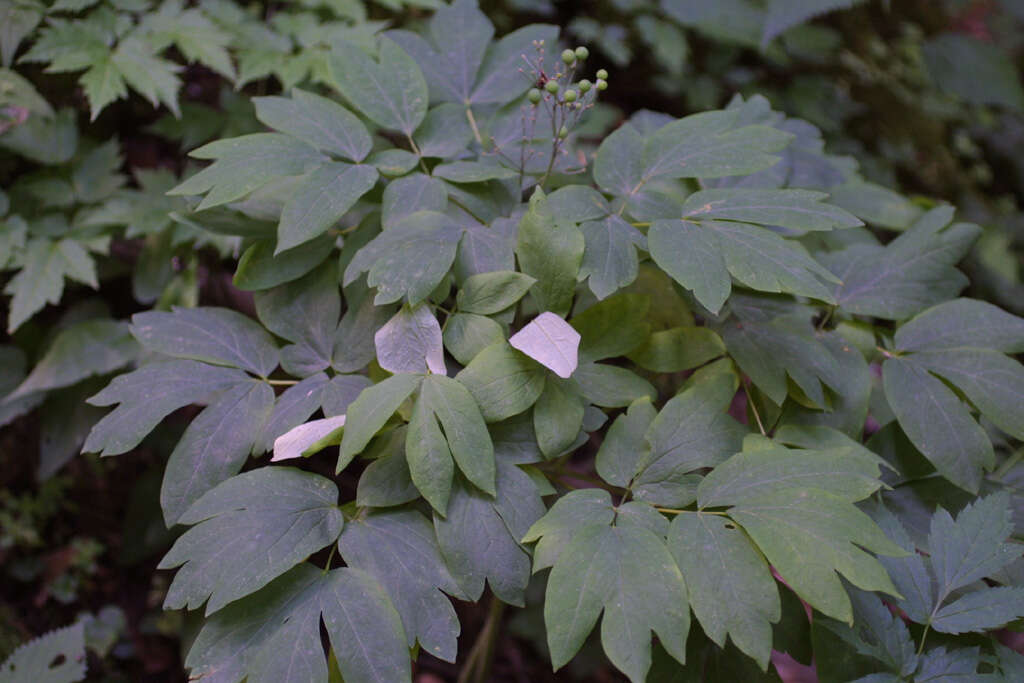
== Description == These large, smooth plants (0.3–0.9 m tall) have a single to few stems with each stem bearing normally one, but on large stems two, large triple-compound leaves which the casual observer might assume to be several smaller leaves arranged on three separate branches. Each leaflet ends in three to five distinct tips. Plants produce underground stems called rhizomes that give rise to the leaves each spring and in the fall when the foliage dies back a scar is left on the rhizome and a new bud is formed that will grow into the foliage next spring. Plants are long lived and can live for more than 50 years. They are found in wooded locations with moisture retentive soils.
Excerpted from Wikipedia’s “Caulophyllum” article, available under the CC BY-SA 4.0 licence.