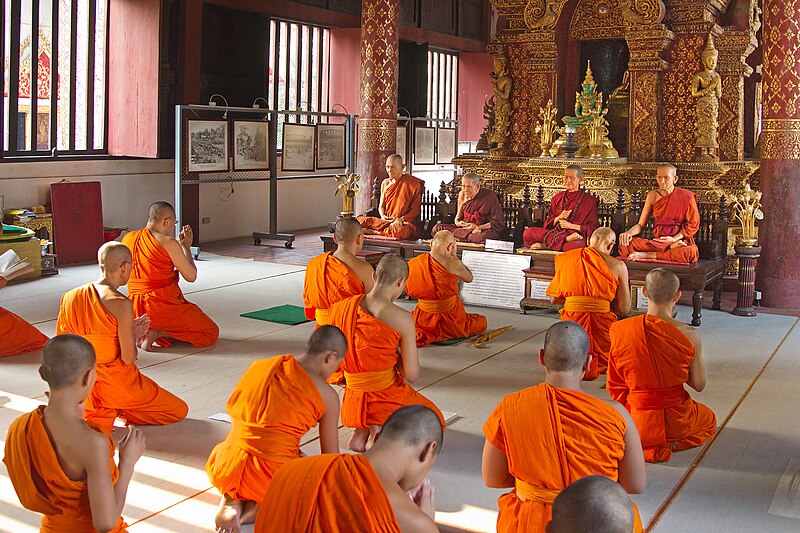
File:Monks_in_Wat_Phra_Singh_-_Chiang_Mai.jpg · Wikimedia Commons · See Wikimedia Commons
celibacy
Sign in to saveCelibacy (from Latin caelibatus) is the state of voluntarily being unmarried, sexually abstinent, or both. It is often in association with the role of a religious official or devotee. In its narrow sense, the term celibacy is applied only to those for whom the unmarried state is the result of a sacred vow, act of renunciation, or religious conviction. In a wider sense, it is commonly understood to only mean abstinence from sexual activity.
Celibacy is a voluntary commitment to remain unmarried, abstain from sexual activity, or both, often taken on by religious figures or devotees as part of their spiritual practice. It matters because it represents a significant personal and sometimes institutional choice that shapes individuals' lives and is central to how many religious traditions organize their communities and spiritual leadership.
AI-generated from the Wikipedia summary — may contain errors.
Wikidata facts
- Subclass of
- condition
- Image
- Conventual Franciscan.JPG
Show 4 more facts
- Commons category
- Celibacy
- topic's main category
- Category:Celibacy
- different from
- involuntary celibacy
- partially coincident with
- sexual abstinence
Sources (3)
via Wikidata · CC0
~28 min read
Encyclopedic overview
20 sectionsContents
- Etymology
- Abstinence and celibacy
- Buddhism
- Christianity
- Desert Fathers
- Augustinian view
- After Augustine
- Catholic Church
- Celibate homosexual Christians
- Hinduism
- Islam
- Zoroastrianism
- Meher Baba
- Ancient Greece and Rome
- The Balkans
- Political contexts
- See also
- References
- Bibliography
- External links
Celibacy (from Latin caelibatus) is the state of voluntarily being unmarried, sexually abstinent, or both. It is often in association with the role of a religious official or devotee. In its narrow sense, the term celibacy is applied only to those for whom the unmarried state is the result of a sacred vow, act of renunciation, or religious conviction. In a wider sense, it is commonly understood to only mean abstinence from sexual activity.
Celibacy has existed in one form or another throughout history, in virtually all the major religions of the world, and views on it have varied. The Hindu concept of brahmacharya encourages celibacy during adolescence, to allow one to focus on learning, and in later years, as a way of attaining spiritual liberation. Jainism, on the other hand, preached complete celibacy even for young monks and considered celibacy to be an essential behavior to attain moksha. Buddhism is similar to Jainism in this respect. There were, however, significant cultural differences in the various areas where Buddhism spread, which affected the local attitudes toward celibacy. A somewhat similar situation existed in Japan, where the Shinto tradition also opposed celibacy. In most native African and Native American religious traditions, celibacy has been viewed negatively as well, although there were exceptions like periodic celibacy practiced by some Mesoamerican warriors.
Excerpted from Wikipedia’s “celibacy” article, available under the CC BY-SA 4.0 licence.