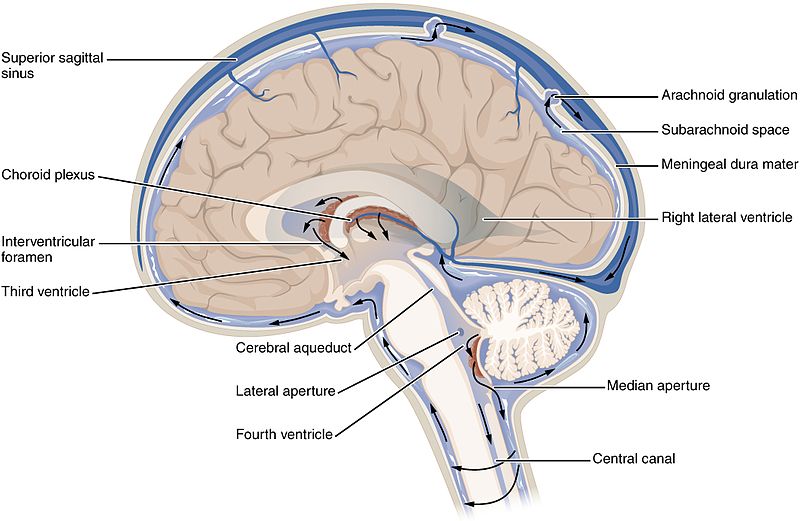
File:1317_CFS_Circulation.jpg · Wikimedia Commons · See Wikimedia Commons
cerebrospinal fluid
Sign in to saveAlso known as CSF
clear colorless bodily fluid found in the brain and spine
Cerebrospinal fluid is a clear, colorless liquid that surrounds and fills spaces in your brain and spinal cord. It helps protect these delicate structures and plays an important role in maintaining proper brain function.
AI-generated from the Wikipedia summary — may contain errors.
Research
152,484 papers- Cerebrospinal fluid.ReviewProgress in neurology and psychiatry · 1967Van der Meulen JPDOI: 10.1016/b978-1-4831-9662-6.50016-0
- Cerebrospinal fluid.ReviewProgress in neurology and psychiatry · 1968Gilland O
- Cerebrospinal fluid analysis.ReviewThe Veterinary clinics of North America. Small animal practice · 1992Chrisman CLDOI: 10.1016/s0195-5616(92)50077-8
- Cerebrospinal fluid: a selective review.ReviewAnnals of neurology · 1982Cutler RW, Spertell RBDOI: 10.1002/ana.410110102
- Cerebrospinal fluid.ReviewProgress in neurology and psychiatry · 1970Gilland O
- Cerebrospinal fluid.ReviewProgress in neurology and psychiatry · 1969Gilland O
- Cerebrospinal fluid: the role of biochemical analysis.ReviewBritish journal of hospital medicine (London, England : 2005) · 2008Srivastava R, Murphy MJ, Jeffery JDOI: 10.12968/hmed.2008.69.4.28977
- Cerebrospinal fluid as a diagnostic body fluid.ReviewThe American journal of medicine · 1983Conly JM, Ronald ARDOI: 10.1016/0002-9343(83)90080-3
via PubMed
Wikidata facts
- Subclass of
- extracellular fluid
- Image
- 4 vials of human cerebrospinal fluid.jpg
Show 4 more facts
- described by source
- Armenian Soviet Encyclopedia
- NCI Thesaurus ID
- C12692
- Commons category
- Cerebrospinal fluid
- exact match
- purl.obolibrary.org/obo/ENVO_02000029
Sources (3)
via Wikidata · CC0
~24 min read
Encyclopedic overview
Cerebrospinal fluid (CSF) is a clear, colorless transcellular body fluid found within the meningeal tissue that surrounds the vertebrate brain and spinal cord, and in the ventricles of the brain.
CSF is mostly produced by the epithelial cells in the choroid plexuses of the ventricles of the brain, and absorbed in the arachnoid granulations. In humans, there is about 125 mL of CSF at any one time, and about 500 mL is generated every day. CSF acts as a shock absorber, cushion or buffer, providing basic mechanical and immunological protection to the brain inside the skull. CSF also serves a vital function in the cerebral autoregulation of cerebral blood flow.
Excerpted from Wikipedia’s “cerebrospinal fluid” article, available under the CC BY-SA 4.0 licence.
Gallery (5)
Available in 61 languages
- Español
- Français
- Deutsch
- 中文
- 日本語
- Русский
- Português
- Italiano
- العربية
- हिन्दी
- Afrikaans
- Armenian
- Bahasa Indonesia
- Bangla
- Basque
- be_x_old
- Belarusian
- Bosnian
Show 42 more
- Breton
- Bulgarian
- Catalan
- Czech
- Danish
- Finnish
- Galician
- Greek
- Hebrew
- Hungarian
- Icelandic
- Irish
- Kazakh
- Latin
- Latvian
- Lithuanian
- Macedonian
- Malay
- Nederlands
- Northern Sami
- Norwegian
- Norwegian Nynorsk
- Odia
- Polski
- Romanian
- Serbian
- Serbian (Latin)
- simple
- Slovenian
- Svenska
- Tamil
- Tiếng Việt
- Türkçe
- Ukrainian
- Urdu
- Uzbek
- Welsh
- Wu Chinese
- zh_yue
- فارسی
- ไทย
- 한국어
via Wikidata sitelinks · CC0