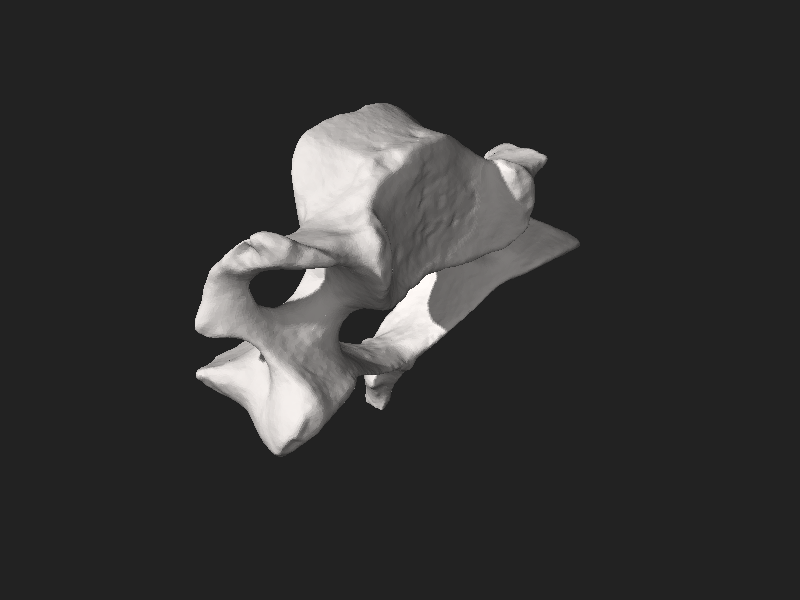
File:Human_cervical_vertebra.stl · Wikimedia Commons · See Wikimedia Commons
In the Vinony graph
Vinony's link graph records 1,108 inbound references to cervical vertebra, and connects out to sacrum, vertebra and rib cage.
Vinony files it under Bones of the head and neck, Bones of the thorax and Bones of the vertebral column.
Vinony links it to 45 Wikipedia language editions.
Key facts
- Latin
- vertebrae cervicales
- Mesh
- D002574
- Ta98
- A02.2.02.001
via Wikipedia infobox
Research
53,581 papers- Upper Cervical Trauma.The Orthopedic clinics of North America · 2021
- An improved version of the cervical vertebral maturation (CVM) method for the assessment of mandibular growth.The Angle orthodontist · 2002
- Atlas and Talus.Journal of anatomy · 2022
- Cervical vertebra morphology in different skeletal classes. A three-dimensional computed tomography evaluation.The Angle orthodontist · 2010
- Morphometric Analysis of Subaxial Cervical Vertebra Pedicles in the Turkish Population.Tomography (Ann Arbor, Mich.) · 2025
via PubMed
Wikidata facts
- Followed by
- thoracic vertebra
- Image
- Cervical vertebrae animation small.gif
Show 3 more facts
- Commons category
- Cervical vertebrae
- NCI Thesaurus ID
- C12693
- tensile modulus of elasticity
- 0.23
via Wikidata · CC0
~12 min read
Encyclopedic overview
In tetrapods, cervical vertebrae (sg.: vertebra) are the vertebrae of the neck, immediately below the skull. Truncal vertebrae (divided into thoracic and lumbar vertebrae in mammals) lie caudal (toward the tail) of cervical vertebrae. In sauropsid species, the cervical vertebrae bear cervical ribs. In lizards and saurischian dinosaurs, the cervical ribs are large; in birds, they are small and completely fused to the vertebrae. The vertebral transverse processes of mammals are homologous to the cervical ribs of other amniotes. Most mammals have seven cervical vertebrae, with the only three known exceptions being the manatee with six, the two-toed sloth with five or six, and the three-toed sloth with nine.
In humans, cervical vertebrae are the smallest of the true vertebrae and can be readily distinguished from those of the thoracic or lumbar regions by the presence of a transverse foramen, an opening in each transverse process, through which the vertebral artery, vertebral veins, and inferior cervical ganglion pass. The remainder of this article focuses on human anatomy.
Excerpted from Wikipedia’s “cervical vertebra” article, available under the CC BY-SA 4.0 licence.