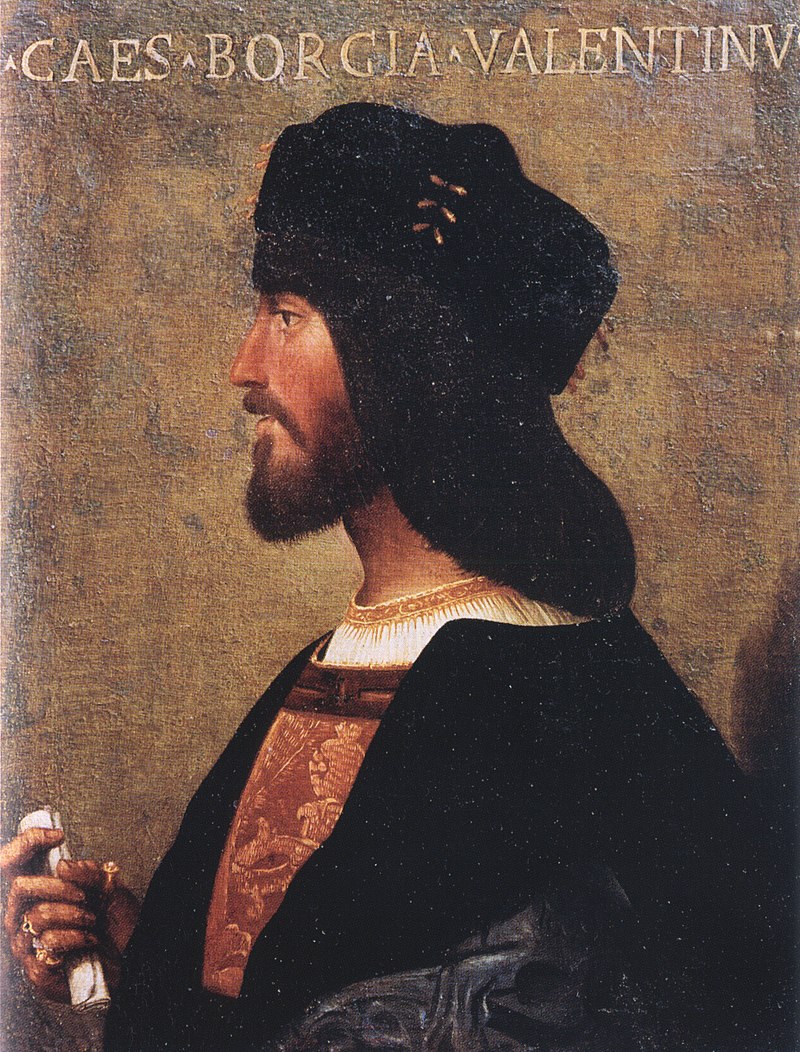
Cesare Borgia
Also known as César de Borja, Cæsar Borgia, Caesar Borgia, Borgia, Cesare, 1476?-1507
Duke of Romagna and former Catholic cardinal
AI overview
Cesare Borgia was an Italian Renaissance nobleman who served as Duke of Romagna and was formerly a cardinal in the Catholic Church, making him a powerful figure at the intersection of religious and political authority. He remains historically significant as a prominent example of Renaissance ambition and power politics, and later became famous as a potential inspiration for Machiavelli's "The Prince."
AI-generated from the Wikipedia summary — may contain errors.
Person · Open Library
- Born
- 1476?
- Died
- 1507
- Works
- 0
via Open Library + Wikidata
Listeners · Last.fm
- Listeners
- 10
- Total plays
- 306
<a href="https://www.last.fm/music/Cesare+Borgia">Read more on Last.fm</a>
Recent publications · Crossref
5 total works indexed
Article
Cesare Borgia (13 September 1475 – 13 March 1507) was an Italian cardinal deacon and later a condottiero, as well as a member of the Spanish House of Borgia. He was the illegitimate son of Pope Alexander VI and sibling to Lucrezia Borgia.
After initially entering the Church and becoming a cardinal on his father's election to the papacy, he resigned his diaconal profession after the death of his brother in 1498. He was employed as a condottiero for King Louis XII of France around 1500, and occupied both Milan and Naples during the Italian Wars. At the same time, he carved out a state for himself in Central Italy, but he was unable to retain power for long after his father's death. His quest for political power was a major inspiration for The Prince by the renowned Florentine historian, Niccolò Machiavelli.