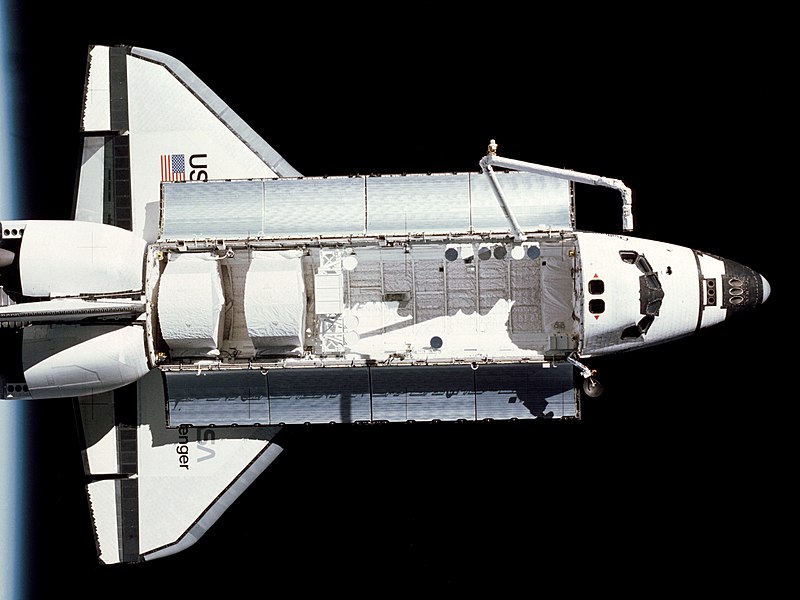
File:S83-35803_(cropped).jpg · Wikimedia Commons · See Wikimedia Commons
Challenger
Sign in to saveAlso known as OV-099, OV099, Orbiter Vehicle 99, Space Shuttle Challenger
American Space Shuttle orbiter
The Challenger was an American Space Shuttle orbiter that was used by NASA for space missions. It is historically significant because it was destroyed in a launch accident on January 28, 1986, killing all seven crew members aboard.
AI-generated from the Wikipedia summary — may contain errors.
Described at
Page Not Found - NASA
nasa.gov →Link to a page describing this subject · 23,582 chars · not written by Vinony
Wikidata facts
- Named after
- HMS Challenger
- Owned by
- NASA
- Operator
- NASA
- Country of origin
- United States
- Duration
- 5385382
- Mass
- 79415
- Manufacturer
- Rockwell International
- Image
- STS007-32-1702.jpg
- Height
- 17.25
- Length
- 37.24
- Significant event
- Space Shuttle Challenger disaster
Show 9 more facts
- Commons category
- Space Shuttle Challenger
- Commons gallery
- Space Shuttle Challenger
- orbits completed
- 995
- event distance
- 41527409.6
- serial number
- OV-099
- wingspan
- 23.79
- first flight
- 1983-04-04
- location of creation
- Air Force Plant 42
Sources (10)
via Wikidata · CC0
~15 min read
Encyclopedic overview
Space Shuttle Challenger (OV-099) was a Space Shuttle orbiter manufactured by Rockwell International and operated by NASA. Named after the commanding ship of a nineteenth-century scientific expedition that traveled the world, Challenger was the second Space Shuttle orbiter to fly into space after Columbia, and launched on its maiden flight in April 1983. It was destroyed in January 1986 soon after launch in a disaster that killed all seven crewmembers aboard.
Initially manufactured as a test article not intended for spaceflight, it was used for ground testing of the Space Shuttle orbiter's structural design. However, after NASA found that their original plan to upgrade Enterprise for spaceflight would be more expensive than upgrading Challenger, the orbiter was pressed into operational service in the Space Shuttle program. Lessons learned from the first orbital flights of Columbia led to Challenger's design possessing fewer thermal protection system tiles and a lighter fuselage and wings. This led to it being 2,200 pounds (1,000 kilograms) lighter than Columbia, though still 5,700 pounds (2,600 kilograms) heavier than Discovery.
Excerpted from Wikipedia’s “Challenger” article, available under the CC BY-SA 4.0 licence.
Gallery (12)
Available in 66 languages
- Español
- Français
- Deutsch
- 中文
- 日本語
- Русский
- Português
- Italiano
- العربية
- Afrikaans
- Albanian
- Asturian
- Azerbaijani
- Bahasa Indonesia
- Basque
- Bikol
- Bulgarian
- Catalan
Show 47 more
- Croatian
- Czech
- Danish
- Egyptian Arabic
- Esperanto
- Estonian
- Finnish
- Galician
- Georgian
- Greek
- Hebrew
- Hungarian
- Ido
- Javanese
- Kashmiri
- Lithuanian
- Luxembourgish
- Macedonian
- Malay
- Maltese
- Marathi
- Nederlands
- Norwegian
- Norwegian Nynorsk
- Polski
- Romanian
- Scots
- Serbian
- simple
- Slovak
- Slovenian
- Svenska
- Tamil
- Tiếng Việt
- Türkçe
- Ukrainian
- Urdu
- Uzbek
- Western Panjabi
- Wu Chinese
- Yiddish
- Yoruba
- zh_min_nan
- zh_yue
- فارسی
- ไทย
- 한국어
via Wikidata sitelinks · CC0