Described at
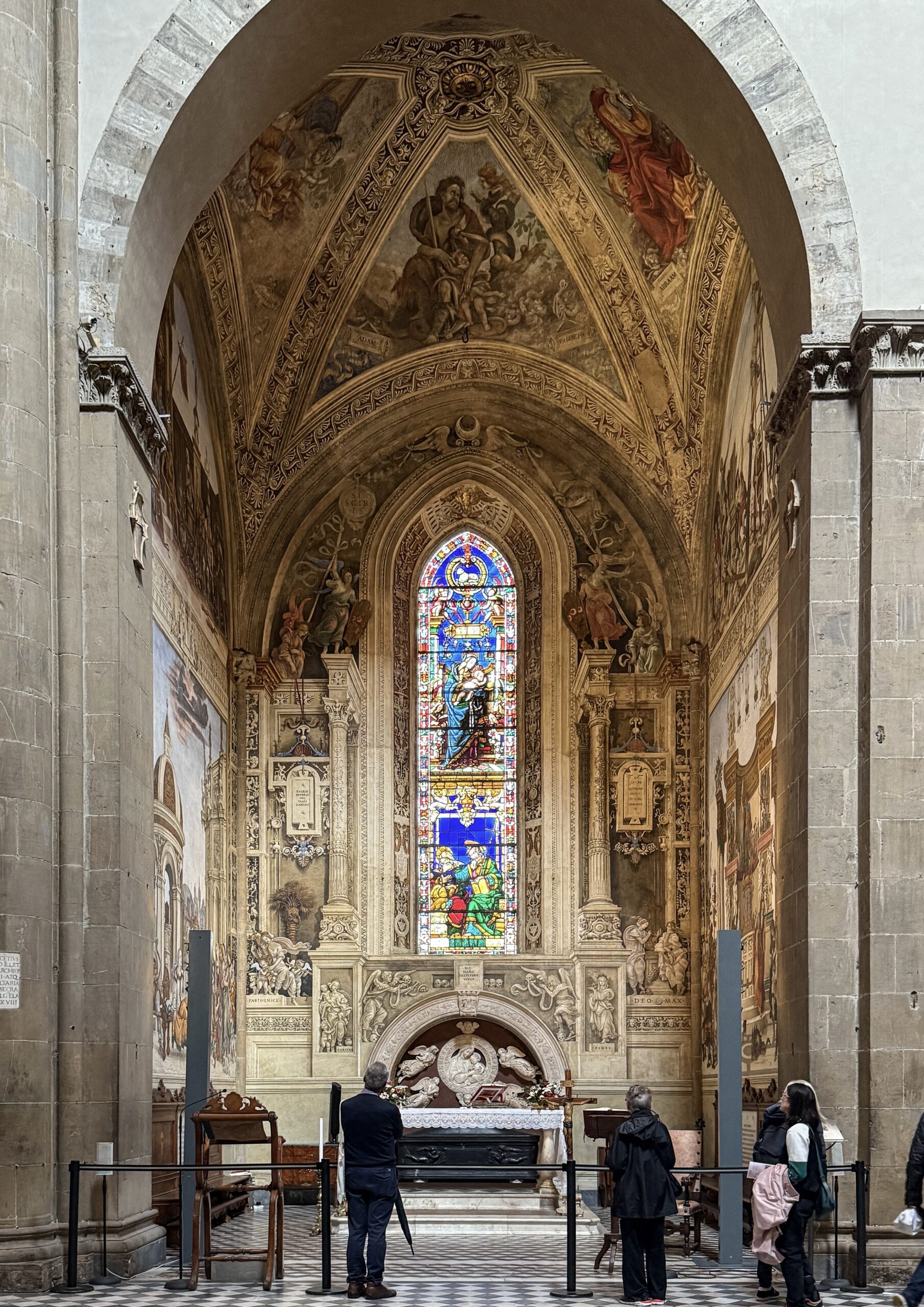
Florenz, Cappella Strozzi, Filippino Lippi
Florenz, Cappella Strozzi: Filippino Lippi schafft in Santa Maria Novella ein Meisterwerk an der Schwelle zur Hochrenaissance.
christianvonholst.de →Florenz, Cappella Strozzi , Filippino Lippi. Die Kapelle befindet sich in Santa Maria Novella rechts von der Cappella Tornabuoni . Filippo Strozzi d. Ä. (1428-1491), der weit gereiste, erfolgreiche Bankier, beauftragt 1487 Filippino Lippi (ca. 1457-1502) mit der Ausmalung der Familienkapelle. Die Ausführung zieht sich wegen Filippinos Arbeiten in Rom bis 1502 hin. Das Grabmal des Auftraggebers in der Mitte der Kapelle wird von Malereien in Grisaille umrahmt. Anders als Ghirlandaio zeigt Filippino keine Zeitgenossen in seinen Bildfeldern. Seine Szenen sind bewegter und dekorativer als die der Hauptchorkapelle. The chapel is located in Santa Maria Novella to the right of the Cappella Tornabuoni. Filippo Strozzi the Elder (1428-1491), the well-traveled, successful banker, commissioned Filippino Lippi (ca. 1457-1502) to paint the family chapel in 1487. Due to Filippino’s work in Rome, the work was not completed until 1502. The patron’s tomb in the center of the chapel is framed by grisaille paintings. Unlike Ghirlandaio, Filippino does not depict any contemporaries in his paintings. His scenes are more animated and decorative than those in the main choir chapel. Gemalte Skulpturen, Reliefs und Architekturelemente bilden wie ein Trompe-l‘œil ein illusionistisches Ensemble gelehrten Inhalts. Oben tragen Engel Schilde mit den drei Mondsicheln der Strozzi. Lateinische Texte und Grotesken ergänzen die figürlichen Szenen. Es zeigt sich die Beschäftigung des Malers mit römischer Kunst der Antike. Das Glasfenster an der Stirnwand entsteht auch nach Filippinos Entwurf. Unten sitzen die Hl. Philipp und Johannes der Evangelist. Darüber eine Madonna mit Kind und zwei Engeln, alles ornamental reich umrandet. Like a trompe-l’œil, painted sculptures, reliefs and architectural elements form an illusionistic ensemble of learned content. Above, angels carry shields with Strozzi’s three crescent moons. Latin texts and grotesques complement the figurative scenes. The painter’s interest in Roman art of antiquity is evident. The stained glass window on the front wall is also based on Filippino’s design. Below are St. Philip and St. John the Evangelist. Above them is a Madonna and Child with two angels, all richly framed with ornamentation. Die Seitenwände zeigen auf Wunsch des Auftraggebers je ein Auferweckungswunder und darüber das Martyrium des Heiligen. Wie in der Legenda Aurea geschildert, holt Johannes der Evangelist, dem die Kapelle geweiht ist, Drusiana ins Leben zurück. At the commissioner’s request, the side walls each show a miracle of resurrection and, above it, the martyrdom of the saint. As described in the Legenda Aurea, John the Evangelist, to whom the chapel is dedicated, brings Drusiana back to life on the left-hand side wall. An der rechten Seitenwand eine weitere Szene nach der Legenda Aurea. Vor einem Tempel des Mars soll der Hl. Philipp ein Opfer bringen. Ein plötzlich erscheinender Drache tötet mit seinem bestialischen Atem einen Jungen. Philipp erweckt ihn wieder zum Leben. An der Stirnwand umrahmen Malereien in Grisaille das Grabmal des Filippo Strozzi. Der Bildhauer und Baumeister Benedetto da Maiano (um 1442-1497), der ab 1489 den berühmten Palazzo Strozzi errichtet, hat es gestaltet. Es befindet sich hinter dem Altar und zeigt darüber im Halbrund fein gearbeitete Reliefs: einen Tondo mit Maria und Kind und vier schwebende Engel, entstanden 1491-1495. On the front wall, paintings in grisaille frame the tomb of Filippo Strozzi. It was designed by the sculptor and master builder Benedetto da Maiano (around 1442-1497), who built the famous Palazzo Strozzi from 1489. It is located behind the altar and features finely crafted reliefs above it in a semicircle: a tondo with Mary and child and four floating angels, created in 1491-1495. Links in der Mitte Caritas mit drei Kindern, die Allegorie der christlichen Liebe. Rechts davon ein rätselhafter männlicher Engel mit einem Totenkopf in der rechten und einem Knochen in de