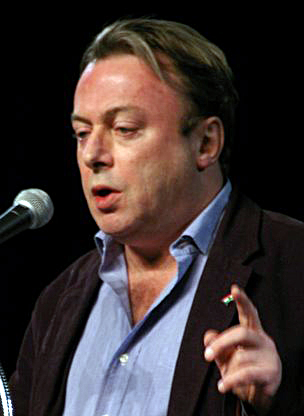
File:Christopher_Hitchens_crop_2.jpg · Wikimedia Commons · See Wikimedia Commons
Christopher Hitchens
Sign in to saveAlso known as Christopher Eric Hitchens
English American author and journalist (1949–2011)
OverviewAI-generated
Christopher Hitchens was a journalist, writer, essayist, and autobiographer born Christopher Eric Hitchens on 13 April 1949 in Portsmouth, Hampshire, England. He held citizenship in the United Kingdom and the United States. Hitchens was educated at the University of Oxford and Balliol College. He resided in Washington, D.C., where he also worked. His notable works include *God Is Not Great*, *The Missionary Position: Mother Teresa in Theory and Practice*, *Mortality*, *Hitch-22*, *Travelling Hopefully*, *The General*, *Dieu n'est pas grand*, *Les crimes de Monsieur Kissinger*, and *The Best American Essays 2010*.
Hitchens was a member of the Socialist Workers Party and the Labour Party. He was influenced by George Orwell, Leon Trotsky, Thomas Paine, and Thomas Jefferson. He received the Richard Dawkins Award. He died on 15 December 2011 in Houston from esophageal cancer and bronchopneumonia, with natural causes listed as the manner of death. He spoke British English and the English language. His sibling was Peter Hitchens.
Synthesized by Vinony from 31 facts across 3 sources: Wikidata, Open Library, TMDb. Generated from structured data (not the Wikipedia text) and checked against those facts — may still contain errors.
Person · Open Library
- Born
- 13 April 1949
- Died
- 15 December 2011
- Works
- 61
Top works
- Travelling Hopefully
- The General
- Dieu n'est pas grand
- Les crimes de Monsieur Kissinger
- The Best American Essays 2010
via Open Library + Wikidata
Film & TV
Portsmouth, Hampshire, England, UK
Christopher Eric Hitchens was an English-American author, columnist, essayist, orator, journalist, and social critic. Hitchens was the author, co-author, editor, or co-editor of over 30 books, including five collections of essays on culture, politics, and literature.
Known for
- Kissinger — Self (archival footage)2025
- Best of Enemies — Self2015
- The Hitch — Self (archive footage)2014
- Phil Ochs: There But for Fortune — Self2011
- Holy Hell — himself2010
- The Bible: A History2010
- In Confidence2010
- Collision — Self2009
- Christopher Hitchens vs John Lennox - Is God Great? Debate2009
- Atheist Alliance International Convention 2007 — Self2008
via TMDB
Wikidata facts
- Instance of
- human
- Given name
- Eric
- Gender
- male
- Citizenship
- United States
- Place of birth
- Portsmouth
- Place of death
- Houston
- Sibling
- Peter Hitchens
- Occupation
- political scientist
- Educated at
- Balliol College
- Political party
- Labour Party
- Languages spoken
- English language
- Native language
- British English
- Notable work
- Hitchens' razor
- Movement
- atheism
- Image
- Christopher Hitchens crop.jpg
- Work location
- Washington, D.C.
- Residence
- Washington, D.C.
Show 12 more facts
- Commons category
- Christopher Hitchens
- cause of death
- bronchopneumonia
- date of birth
- 1949-04-13
- date of death
- 2011-12-15
- topic's main category
- Category:Christopher Hitchens
- manner of death
- natural causes
- influenced by
- Albert Camus
- birth name
- Christopher Eric Hitchens
- writing language
- English language
- has written for
- The Atlantic
- nickname
- Hitch
- name in native language
- Christopher Eric Hitchens
Sources (11)
via Wikidata · CC0
~37 min read
Encyclopedic overview
Christopher Eric Hitchens (13 April 1949 – 15 December 2011) was a British and American author and journalist. Known as one of the "Four Horsemen" of New Atheism (along with Richard Dawkins, Sam Harris, and Daniel Dennett), he gained prominence as a columnist and speaker. His epistemological razor, which states that "what can be asserted without evidence can also be dismissed without evidence", is used in philosophy and law.
Hitchens was born and educated in Britain, graduating in 1970 from the University of Oxford with a degree in philosophy, politics, and economics. In the early 1980s, he emigrated to the United States and wrote for The Nation and Vanity Fair. Hitchens's political views evolved greatly throughout his life. Originally describing himself as a democratic socialist, he was a member of various socialist organisations in his early life, including the Trotskyist International Socialists.
Excerpted from Wikipedia’s “Christopher Hitchens” article, available under the CC BY-SA 4.0 licence.
Gallery (8)
Available in 67 languages
- Español
- Français
- Deutsch
- 中文
- 日本語
- Русский
- Português
- Italiano
- العربية
- हिन्दी
- Afrikaans
- Albanian
- Armenian
- azb
- Bahasa Indonesia
- Bangla
- Basque
- Betawi
Show 48 more
- Breton
- Bulgarian
- Catalan
- Central Kurdish
- Croatian
- Czech
- Danish
- Egyptian Arabic
- Esperanto
- Estonian
- Faroese
- Finnish
- Georgian
- Greek
- Hebrew
- Hungarian
- Irish
- Javanese
- Latvian
- Lithuanian
- Macedonian
- Malayalam
- Minangkabau
- Mingrelian
- Nederlands
- Norwegian
- Norwegian Nynorsk
- Pampanga
- Pashto
- Polski
- Punjabi
- Romanian
- Scots
- Serbian
- Serbian (Latin)
- simple
- Slovak
- Svenska
- Tamil
- Tiếng Việt
- Türkçe
- Ukrainian
- Welsh
- Wu Chinese
- Yiddish
- فارسی
- ไทย
- 한국어
via Wikidata sitelinks · CC0