File:Chromatophores.jpg · Wikimedia Commons · See Wikimedia Commons
chromatophore
Sign in to saveAlso known as chromatophores, pigment cells, chromatocyte, pigment cell
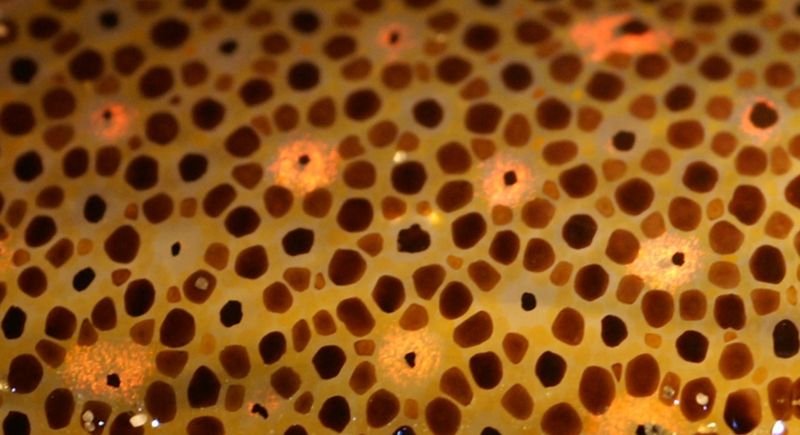
thumb|upright=1.7|Chromatophores in the skin of a squid Chromatophores are cells that produce color, of which many types are pigment-containing cells, or groups of cells, found in a wide range of animals including amphibians, fish, reptiles, crustaceans and cephalopods. Mammals and birds, in contrast, have a class of cells called melanocytes for coloration.
Research
5,299 papers- Chromatophore systems in teleosts and cephalopods: a levels oriented analysis of convergent systems.Brain, behavior and evolution · 1992
- Primary Endosymbiosis: Emergence of the Primary Chloroplast and the Chromatophore, Two Independent Events.Methods in molecular biology (Clifton, N.J.) · 2018
- Paulinella chromatophora.Current biology : CB · 2021
- Piebaldism and chromatophore development in reptiles are linked to the tfec gene.Current biology : CB · 2023
- The dermal chromatophore unit.The Journal of cell biology · 1968
via PubMed
Wikidata facts
Show 3 more facts
- found in taxon
- Crustacea
- Commons category
- Chromatophores
- different from
- chromophore
via Wikidata · CC0
~20 min read
Encyclopedic overview
14 sectionsContents
- Human discovery
- Classification of chromatophore
- Xanthophores and erythrophores
- Iridophores and leucophores
- Melanophores
- Cyanophores
- Pigment translocation
- Background adaptation
- Development
- Practical applications
- Cephalopod chromatophores
- See also
- Notes
- External links
thumb|upright=1.7|Chromatophores in the skin of a squid Chromatophores are cells that produce color, of which many types are pigment-containing cells, or groups of cells, found in a wide range of animals including amphibians, fish, reptiles, crustaceans and cephalopods. Mammals and birds, in contrast, have a class of cells called melanocytes for coloration.
Chromatophores are largely responsible for generating skin and eye colour in ectothermic animals and are generated in the neural crest during embryonic development. Mature chromatophores are grouped into subclasses based on their colour under white light: xanthophores (yellow), erythrophores (red), iridophores (reflective / iridescent), leucophores (white), melanophores (black/brown), and cyanophores (blue). While most chromatophores contain pigments that absorb specific wavelengths of light, the color of leucophores and iridophores is produced by their respective scattering and optical interference properties.
Excerpted from Wikipedia’s “chromatophore” article, available under the CC BY-SA 4.0 licence.