File:Client-server-model.svg · Wikimedia Commons · See Wikimedia Commons
client-server model
Sign in to saveAlso known as client-server relationship, C/S, Online Systems, client–server model, client/server, client–server architecture, client–server
distributed application structure in computing
Research
209 papers- TeraChem protocol buffers (TCPB): Accelerating QM and QM/MM simulations with a client-server model.The Journal of chemical physics · 2023
- The design of Jemboss: a graphical user interface to EMBOSS.Bioinformatics (Oxford, England) · 2003
- GenBank.Nucleic acids research · 1996
- TVGG Dental Implant Identification System.Frontiers in pharmacology · 2022
- A client server model to facilitate creation of a medical image teaching library.Journal of digital imaging · 1999
via PubMed
Wikidata facts
- Subclass of
- software architecture
- Image
- Client-Server Model-ar.svg
- Has parts of class
- server software
Show 4 more facts
- Commons category
- Client-server
- opposite of
- peer-to-peer
- partially coincident with
- centralized computing
- Stack Exchange tag
- stackoverflow.com/tags/client-server
Sources (3)
via Wikidata · CC0
~16 min read
Encyclopedic overview
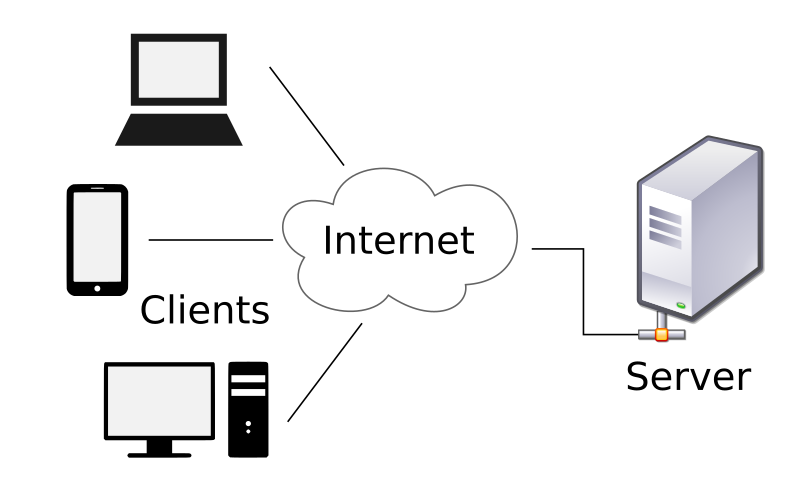
A computer network diagram of clients communicating with a server via the Internet
The client–server model is a form of messaging pattern in a distributed application structure that partitions tasks or workloads between the providers of a resource or service, called servers, and service requesters, called clients. Often clients and servers communicate over a computer network on separate hardware, but both client and server may be on the same device. A server host runs one or more server programs, which share their resources with clients. A client usually does not share its computing resources, but it requests content or service from a server and may share its own content as part of the request. Clients, therefore, initiate communication sessions with servers, which await incoming requests. Examples of computer applications that use the client–server model are email, network printing, and the World Wide Web.
Excerpted from Wikipedia’s “client-server model” article, available under the CC BY-SA 4.0 licence.