File:Nuclear_energy_generation.svg · Wikimedia Commons · See Wikimedia Commons
CNO cycle
Sign in to saveset of fusion reactions by which stars convert hydrogen to helium: 4¹H+2e⁻→⁴He+2e⁺+2e⁻+2νₑ+3γ+24.7 MeV→⁴He+2νₑ+3γ+26.7 MeV
Wikidata facts
- Subclass of
- nuclear fusion
- Named after
- oxygen
- Image
- CNO Cycle.svg
Show 1 more fact
- Commons category
- CNO cycle
Sources (1)
via Wikidata · CC0
~10 min read
Encyclopedic overview
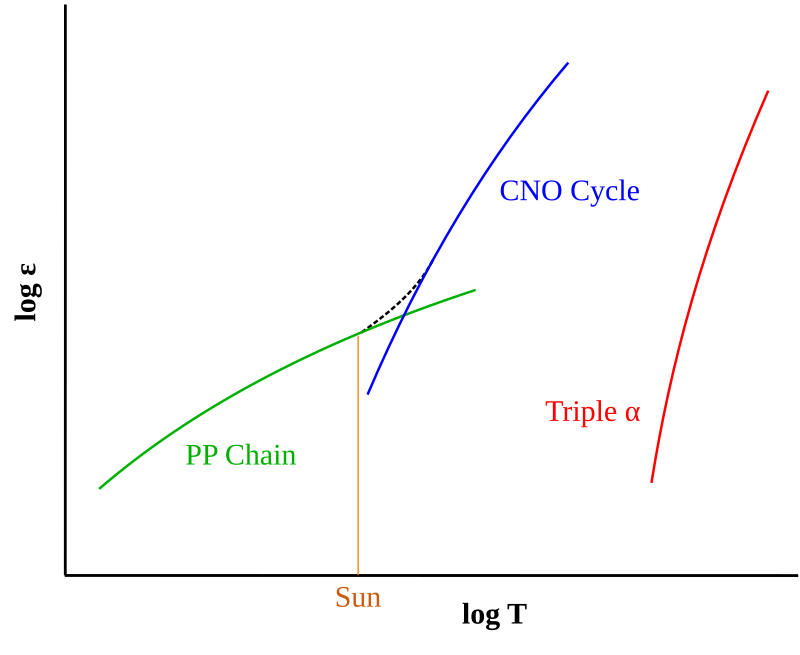
Logarithm of the relative energy output (ε) of proton–proton (p–p), CNO, and triple-α fusion processes at different temperatures (T). The dashed line shows the combined energy generation of the p–p and CNO processes within a star.
In astrophysics, the carbon–nitrogen–oxygen cycle (CNO cycle), sometimes called Bethe–Weizsäcker cycle after Hans Albrecht Bethe and Carl Friedrich von Weizsäcker, is one of the two known sets of fusion reactions by which stars convert hydrogen to helium, the other being the proton–proton chain reaction (p–p cycle), which is more efficient at the Sun's core temperature. The CNO cycle is hypothesized to be dominant in stars that are more than 1.3 times as massive as the Sun.
Excerpted from Wikipedia’s “CNO cycle” article, available under the CC BY-SA 4.0 licence.