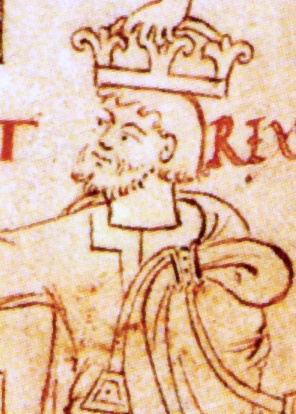
File:Canute_and_Ælfgifu_cropped_(Canute).jpg · Wikimedia Commons · See Wikimedia Commons
Cnut the Great
Sign in to saveAlso known as Canute, Canute II Sveynsson, King of England and Denmark, Cnut, Canute, the Dane, Canute the Dane
Cnut ( ; ; – 12 November 1035), also known as Canute and with the epithet the Great, was King of England from 1016, King of Denmark from 1018, and King of Norway from 1028 until his death in 1035. The three kingdoms united under Cnut's rule are referred to together as the North Sea Empire by historians.
OverviewAI-generated
Cnut, also known as Knud, was a male monarch and writer born in Denmark in 994. He was the son of Sweyn I of Denmark and Gunhild of Wenden, and a member of the House of Knýtlinga. His siblings included Harald II of Denmark, Gyda Svendsdatter, Estrid Svendsdatter, and Olof Skötkonung. Cnut held the noble title of king and served as the monarch of England, Denmark, and Norway. He maintained citizenship in the Danish Realm and the North Sea Empire, working across England, Denmark, and Norway.
He was married to Ælfgifu of Northampton and Emma of Normandy. Their children were Svein Knutsson, Harold Harefoot, Harthacanute, and Gunhilda of Denmark. Cnut spoke, wrote, or signed in Latin. He died of natural causes on 1035-11-12 in Shaftesbury and was buried at Winchester Cathedral. His life and reign are described by sources including The Nuttall Encyclopædia, Brockhaus and Efron Encyclopedic Dictionary, and the Encyclopædia Britannica 11th edition.
Synthesized by Vinony from 23 facts across 2 sources: Wikidata, Europeana Sparql. Generated from structured data (not the Wikipedia text) and checked against those facts — may still contain errors.
Key facts
- Royalty.image
- Canute and Ælfgifu cropped (Canute).jpg
- Royalty.caption
- Contemporary drawing of King Cnutfrom the New Minster Liber Vitae, 1031
- Royalty.succession
- King of England
- Royalty.reign
- 1016–1035
- Royalty.coronation
- 1017 in London
- Royalty.successor
- Harold I
- Royalty.predecessor
- Edmund II
- Royalty.succession1
- King of Denmark
- Royalty.reign1
- 1018–1035
- Royalty.successor1
- Harthacnut
- Royalty.predecessor1
- Harald II
- Royalty.succession2
- King of Norway
- Royalty.reign2
- 1028–1035
- Royalty.successor2
- Magnus the Good
- Royalty.predecessor2
- Saint Olaf
- Royalty.regent2
- Svein Knutsson
- Royalty.reg type2
- Co-king
- Royalty.house
- Knýtlinga
via Wikipedia infobox
Wikidata facts
- Instance of
- human
- Given name
- Knud
- Gender
- male
- Citizenship
- North Sea Empire
- Place of birth
- Denmark
- Place of death
- Shaftesbury
- Spouse
- Emma of Normandy
- Father
- Sweyn I of Denmark
- Mother
- Gunhild of Wenden
- Sibling
- Olof Skötkonung
- Occupation
- writer
- Position held
- Monarch of Norway
- Languages spoken
- Latin
- Religion
- Old Norse religion
- Family
- House of Knýtlinga
- Noble title
- king
- Conflict
- Battle of Helgeå
- Image
- Knut der Große cropped.jpg
- Work location
- Norway
Show 7 more facts
- place of burial
- Winchester Cathedral
- Commons category
- Canute the Great
- topic's main category
- Category:Cnut
- date of death
- 1035-11-12
- date of birth
- 0994-00-00
- manner of death
- natural causes
- name in native language
- Knūtr inn rīki
Sources (3)
via Wikidata · CC0
Works in European collections
36 objects attributed to Cnut the Great, held across European museums, libraries & archives · via Europeana
~44 min read
Encyclopedic overview
27 sectionsContents
- Birth and kingship
- Conquest of England
- Landing in Wessex
- Advance into the North
- Siege of London
- London captured by treaty
- King of England
- Consolidation and Danegeld
- Affairs to the East
- Statesmanship
- King of Denmark
- Journey to Rome
- King of Norway and part of Sweden
- Influence in the western sea-ways
- Relations with the Church
- Death and succession
- Bones at Winchester
- Marriages and children
- Family tree
- Cnut's ''skalds''
- The story of Cnut and the waves
- See also
- Notes
- References
- Sources
- Further reading
- External links
Cnut ( ; ; – 12 November 1035), also known as Canute and with the epithet the Great, was King of England from 1016, King of Denmark from 1018, and King of Norway from 1028 until his death in 1035. The three kingdoms united under Cnut's rule are referred to together as the North Sea Empire by historians.
As a Danish prince, Cnut won the throne of England in 1016 in the wake of centuries of Viking activity in northwestern Europe. His later accession to the Danish throne in 1018 brought the crowns of England and Denmark together. Cnut sought to keep this power base by uniting Danes and English under cultural bonds of wealth and custom. After a decade of conflict with opponents in Scandinavia, Cnut claimed the crown of Norway in Trondheim in 1028. In 1031, Malcolm II of Scotland also submitted to him, though Anglo-Norse influence over Scotland was weak and ultimately did not last by the time of Cnut's death.
Excerpted from Wikipedia’s “Cnut the Great” article, available under the CC BY-SA 4.0 licence.
Gallery (31)
Available in 76 languages
- Español
- Français
- Deutsch
- 中文
- 日本語
- Русский
- Português
- Italiano
- العربية
- Achinese
- Afrikaans
- Albanian
- Armenian
- Asturian
- azb
- Azerbaijani
- Bahasa Indonesia
- Basque
Show 57 more
- be_x_old
- Belarusian
- Bosnian
- Breton
- Bulgarian
- Burmese
- Catalan
- Central Kurdish
- Croatian
- Czech
- Danish
- Egyptian Arabic
- Esperanto
- Estonian
- Finnish
- Galician
- Georgian
- Greek
- Hebrew
- Hungarian
- Icelandic
- Irish
- Kannada
- Kazakh
- Latin
- Latvian
- Lithuanian
- Macedonian
- Malagasy
- Malay
- nds_nl
- Nederlands
- Norwegian
- Norwegian Nynorsk
- Occitan
- Old English
- Polski
- Romanian
- Scots
- Serbian
- Serbian (Latin)
- simple
- Slovak
- Slovenian
- Svenska
- Tiếng Việt
- Türkçe
- Ukrainian
- Urdu
- Waray
- Welsh
- Wu Chinese
- zh_min_nan
- zh_yue
- فارسی
- ไทย
- 한국어
via Wikidata sitelinks · CC0