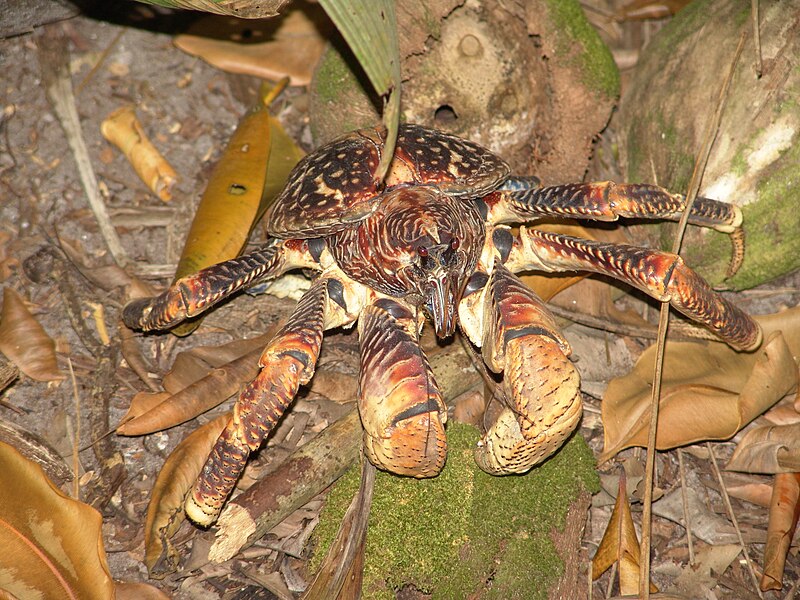
File:Coconut_Crab_Birgus_latro.jpg · Wikimedia Commons · See Wikimedia Commons
Coconut crab
Sign in to saveAlso known as robber crab, palm thief, Birgus latro, mipeyso, tatos
species of crustacean
OverviewAI-generated
The coconut crab, scientifically known as *Birgus latro*, is a species of arthropod described by Linnaeus in 1767. It belongs to the class Malacostraca, order Decapoda, and family Coenobitidae. The taxon has an accepted status and is associated with the Holocene time period. Common names for this organism include "Crabe De Cocotier" and "Palm Thief."
This species inhabits marine environments and has a life expectancy of 60 years. The IUCN Red List assessed its conservation status as Vulnerable in 2020. The species is referenced by 248 other encyclopedia articles.
Synthesized by Vinony from 24 facts across 4 sources: Wikidata, WoRMS, IUCN Red List, Vinony graph. Generated from structured data (not the Wikipedia text) and checked against those facts — may still contain errors.
Species
Vulnerablecoconut crab
Species
- PhylumArthropoda
- ClassMalacostraca
- OrderDecapoda
- FamilyCoenobitidae
via IUCN
Wikidata facts
- Instance of
- taxon
- Image
- Birgus latro.jpg
- Life expectancy
- 60
Show 10 more facts
- taxon rank
- species
- IUCN conservation status
- Vulnerable
- taxon name
- Birgus latro
- Commons category
- Birgus latro
- Commons gallery
- Birgus latro
- taxon common name
- cangrejo de los cocoteros
- taxon author citation
- (Linnaeus, 1767)
- described by source
- Brockhaus and Efron Encyclopedic Dictionary
- short name
- B. latro
- time period
- Holocene
via Wikidata · CC0
~23 min read
Encyclopedic overview
The coconut crab (Birgus latro) is a terrestrial species of giant hermit crab, and is also known as the robber crab or palm thief. It is the largest living terrestrial arthropod, with a weight up to 4.1 kg (9 lb). The distance from the tip of one leg to the tip of another can be as wide as 1 m (3 ft 3 in). It is found on islands across the Indian and Pacific Oceans, as far east as the Gambier Islands, Pitcairn Islands, and Caroline Island, and as far west as Zanzibar. While its range broadly shadows the distribution of the coconut palm, the coconut crab has been extirpated from most areas with a significant human population such as mainland Australia and Madagascar.
The coconut crab is the only species of the genus Birgus, and is related to the other terrestrial hermit crabs of the genus Coenobita. It shows a number of adaptations to life on land. Juvenile coconut crabs use empty gastropod shells for protection like other hermit crabs, but the adults develop a tough exoskeleton on their abdomens and stop carrying a shell. Coconut crabs have organs known as branchiostegal lungs, which they use for breathing instead of their vestigial gills. After the juvenile stage, they will drown if immersed in water for too long. They have an acute sense of smell, which they use to find potential food sources, and which has developed convergently with that of insects.
Excerpted from Wikipedia’s “Coconut crab” article, available under the CC BY-SA 4.0 licence.