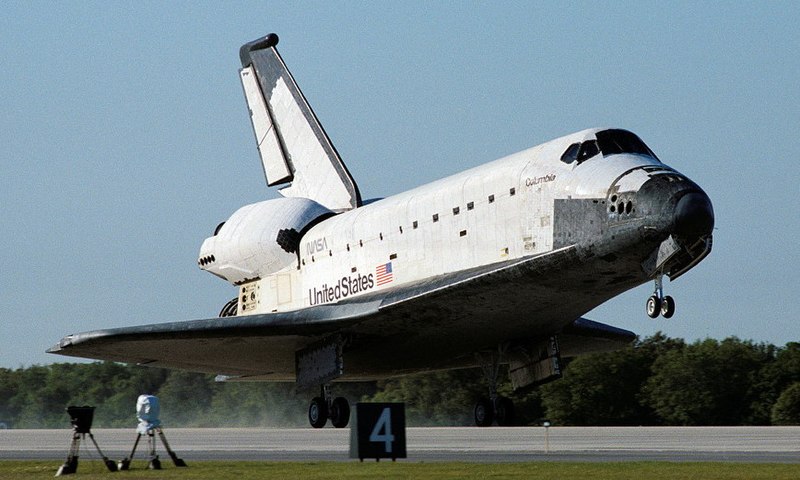
File:Space_Shuttle_Columbia_lands_following_STS-62_on_18_March_1994._(cropped).jpg · Wikimedia Commons · See Wikimedia Commons
Columbia
Sign in to saveAlso known as Space Shuttle Columbia, OV-102, OV102, Orbiter Vehicle 102, STS Columbia OV-102
American Space Shuttle orbiter
Columbia was a spacecraft that NASA used to carry astronauts and cargo into space, launching and landing like an airplane. It was the first Space Shuttle orbiter built and operated by the United States, making it historically significant in the development of reusable spacecraft technology.
AI-generated from the Wikipedia summary — may contain errors.
Described at
Page Not Found - NASA
nasa.gov →Link to a page describing this subject · 23,402 chars · not written by Vinony
Wikidata facts
- Named after
- Columbia Rediviva
- Owned by
- NASA
- Operator
- NASA
- Country of origin
- United States
- Duration
- 25983622
- Mass
- 80739
- Manufacturer
- Rockwell International
- Image
- Space Shuttle Columbia launching.jpg
- Height
- 17.25
- Length
- 37.24
- Significant event
- Space Shuttle Columbia disaster
Show 8 more facts
- first flight
- 1981-04-12
- event distance
- 201497772
- orbits completed
- 4808
- serial number
- OV-102
- Commons category
- Space Shuttle Columbia
- wingspan
- 23.79
- location of creation
- Air Force Plant 42
Sources (9)
via Wikidata · CC0
~29 min read
Encyclopedic overview
Space Shuttle Columbia (OV-102) was a Space Shuttle orbiter manufactured by Rockwell International and operated by NASA. Named after the first American ship to circumnavigate the globe, and the female personification of the United States, Columbia was the first of five Space Shuttle orbiters to fly in space, debuting the Space Shuttle launch vehicle on its maiden flight on April 12, 1981 and becoming the first spacecraft to be re-used after its first flight when it launched on STS-2 on November 12, 1981. As only the second full-scale orbiter to be manufactured after the Approach and Landing Test vehicle Enterprise, Columbia retained unique external and internal features compared with later orbiters, such as test instrumentation and distinctive black chines. In addition to a heavier aft fuselage and the retention of an internal airlock throughout its lifetime, these made Columbia the heaviest of the five spacefaring orbiters: around 1,000 kilograms (2,200 pounds) heavier than Challenger and 3,600 kilograms (7,900 pounds) heavier than Endeavour when originally constructed. Columbia also carried ejection seats based on those from the SR-71 during its first six flights until 1983, and from 1986 onwards carried an imaging pod on its vertical stabilizer.
During its 22 years of operation, Columbia was flown on 28 missions in the Space Shuttle program, spending over 300 days in space and completing over 4,000 orbits around Earth. NASA's flagship orbiter, Columbia often flew flights dedicated to scientific research in orbit following the loss of Challenger in 1986. Columbia was used for eleven of the fifteen flights of Spacelab laboratories, all four United States Microgravity Payload missions, and the only flight of Spacehab's Research Double Module. Columbia flew many of the longest duration space shuttle missions, all dedicated to scientific research. The only space shuttle that could rival Columbia's long missions was Endeavour, which flew the STS-67 mission that lasted for nearly 17 days. In 1992, NASA modified Columbia to be able to fly some of the longest missions in the Shuttle Program history using the Extended Duration Orbiter pallet. The orbiter used the pallet in thirteen of the pallet's fourteen flights, which aided lengthy stays in orbit for scientific and technological research missions. The longest duration flight of the Shuttle Program, STS-80, was flown with Columbia in 1996, at over 17 days in orbit. Columbia was also used to deploy the first ever satellites into orbit by the Shuttle on STS-5, retrieve the Long Duration Exposure Facility and deploy the Chandra observatory, which was the heaviest payload ever carried by the Space Shuttle. Columbia also carried into space the first female commander of an American spaceflight mission, the first ESA astronaut, the first female astronaut of Indian origin, and the first Israeli astronaut.
Excerpted from Wikipedia’s “Columbia” article, available under the CC BY-SA 4.0 licence.