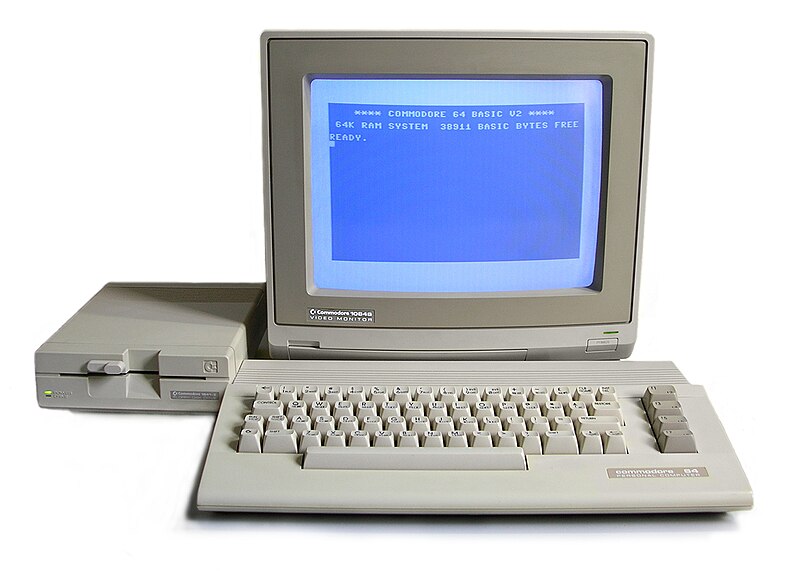
File:C64c_system.jpg · Wikimedia Commons · See Wikimedia Commons
Commodore 64
Sign in to saveAlso known as CBM 64, C64, C=64, VIC-64
8-bit home computer introduced in 1982
The Commodore 64 was a home computer released in 1982 that used 8-bit technology. It became one of the most popular personal computers of its era and played a significant role in bringing computing into households during the 1980s.
AI-generated from the Wikipedia summary — may contain errors.
Key facts
- Manufacturer
- Commodore Business Machines (CBM)
- Type
- Home computer
- Released
- August 1982 ; 43 years ago ( 1982-08 )
- Introductory price
- US$595 (equivalent to $1,990 in 2025)
- Discontinued
- April 1994 ; 32 years ago ( 1994-04 )
- Units sold
- 12.5 – 17 million
- Operating system
- Commodore KERNAL / BASIC 2.0 GEOS (optionally)
- Cpu
- MOS Technology 6510 / 8500 @ 1.023 MHz ( NTSC version) @ 0.985 MHz ( PAL version)
- Memory
- 64 KB RAM + 20 KB ROM
- Graphics
- VIC-II ( 320×200 , 16 colors , sprites , raster interrupt )
- Sound
- SID 6581/8580 ( 3× osc , 4× wave , filter , ADSR , ring )
- Connectivity
- 2× CIA 6526 ( joystick , GPIO / RS-232 /keyboard) Power (+5V DC & 9V AC) ROM cartridge Video/audio ( RF / A/V ) Serial IEEE 488 bus ( floppy disk / printer ) Digital tape
- Predecessor
- VIC-20 MAX Machine
- Successor
- Commodore 128 Amiga
via Wikipedia infobox
Wikidata facts
- Subclass of
- home computer
- Has part
- MOS Technology CIA
- Follows
- Commodore VIC-20
- Developer
- Commodore International
- Manufacturer
- Commodore International
- Image
- Commodore-64-Computer-FL.jpg
- Significant event
- economic production
Show 9 more facts
- Commons category
- Commodore 64
- topic's main category
- Category:Commodore 64
- Commons gallery
- Commodore 64
- Stack Exchange tag
- stackoverflow.com/tags/c64
- start time
- 1982-08-00
- discontinuation date
- 1994-05-00
- units sold
- 17000000
- storage capacity
- 20
Sources (9)
via Wikidata · CC0
~40 min read
Encyclopedic overview
The Commodore 64, also known as the C64, is an 8-bit home computer introduced in January 1982 by Commodore International (first shown at the Consumer Electronics Show, January 7–10, 1982, in Las Vegas). It has been listed in the Guinness World Records as the best-selling desktop computer model of all time, with independent estimates placing the number sold between 12.5 and 17 million units. Volume production started in early 1982, marketing in August for US$595 (equivalent to $1,990 in 2025). Preceded by the VIC-20 and Commodore PET, the C64 took its name from its 64 kibibytes (65,536 bytes) of RAM. With support for multicolor sprites and a custom chip for waveform generation, the C64 could create superior visuals and audio compared to systems without such custom hardware.
The C64 dominated the low-end computer market (except in the UK, France and Japan, lasting only about six months in Japan) for most of the later years of the 1980s. For a substantial period (1983–1986), the C64 had between 30% and 40% share of the US market and two million units sold per year, outselling IBM PC compatibles, the Apple II, and Atari 8-bit computers. Sam Tramiel, a later Atari president and the son of Commodore's founder, said in a 1989 interview, "When I was at Commodore we were building 400,000 C64s a month for a couple of years." In the UK market, the C64 faced competition from the BBC Micro, the ZX Spectrum, and later the Amstrad CPC 464, but the C64 was still the second-most-popular computer in the UK after the ZX Spectrum. The Commodore 64 failed to make any impact in Japan, as their market was dominated by Japanese computers, such as the NEC PC-8801, Sharp X1, Fujitsu FM-7 and MSX, and in France, where the ZX Spectrum, Thomson MO5 and TO7, and Amstrad CPC 464 dominated the market.
Excerpted from Wikipedia’s “Commodore 64” article, available under the CC BY-SA 4.0 licence.