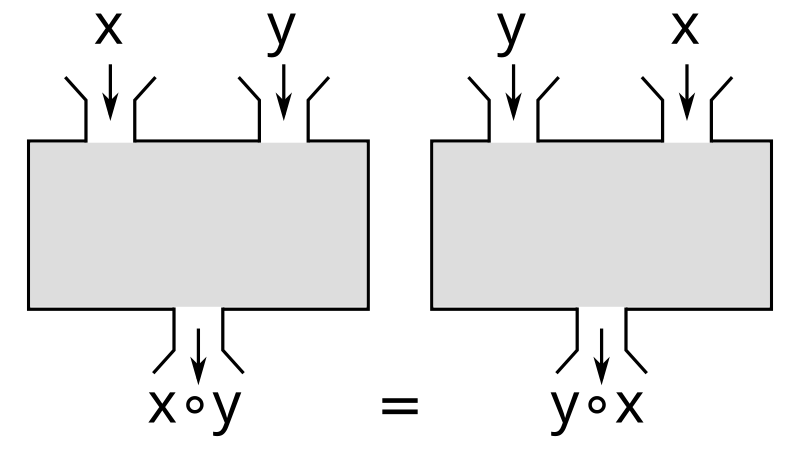
File:Commutativity_of_binary_operations_(without_question_mark).svg · Wikimedia Commons · See Wikimedia Commons
commutative property
Sign in to saveAlso known as commutative operation, commutativity
property of binary operations, for which changing the order of the operands does not change the result
The commutative property is a rule in mathematics that says you can switch the order of two numbers in an operation and still get the same answer—for example, 3 + 5 equals 5 + 3. This matters because it simplifies calculations and helps us understand that certain operations are flexible, allowing us to rearrange problems in whatever way is easiest or most convenient to solve.
AI-generated from the Wikipedia summary — may contain errors.
Described at

What Is Commutative Property? Definition, Formula, Examples
Commutative property states that changing the order of numbers in an addition/multiplication operation does not alter the sum/the product. Let's learn in detail.
splashlearn.com →Explore 2,000+ definitions with examples and more - all in one place. The commutative property states that the numbers on which we operate can be moved or swapped from their position without making any difference to the answer. The property holds for Addition and Multiplication, but not for subtraction and division. Let’s see. The above examples clearly show that the commutative property holds true for addition and multiplication but not for subtraction and division . So, if we swap the position of numbers in subtraction or division statements, it changes the entire problem. 2. Sara buys 3 packs of buns. Each pack has 4 buns. Mila buys 4 packs of buns and each pack has 3 buns. Who bought more buns?
Excerpt from a page describing this subject · 40,000 chars · not written by Vinony
Wikidata facts
- Instance of
- mathematical property
- Image
- Commutativity of binary operations (without question mark).svg
Show 5 more facts
- used by
- multiplication
- Commons category
- Commutativity
- on focus list of Wikimedia project
- Wikipedia:Vital articles/Level/4
- maintained by WikiProject
- WikiProject Mathematics
Sources (3)
via Wikidata · CC0
~6 min read
Encyclopedic overview
In mathematics, a binary operation is commutative if changing the order of the operands does not change the result. It is a fundamental property of many binary operations, and many mathematical proofs depend on it. Perhaps most familiar as a property of arithmetic, e.g. "3 + 4 = 4 + 3" or "2 × 5 = 5 × 2", the property can also be used in more advanced settings. The name is needed because there are operations, such as division and subtraction, that do not have it (for example, "3 − 5 ≠ 5 − 3"); such operations are not commutative, and so are referred to as noncommutative operations.
The idea that simple operations, such as the multiplication and addition of numbers, are commutative was for many centuries implicitly assumed. Thus, this property was not named until the 19th century, when new algebraic structures started to be studied.
Excerpted from Wikipedia’s “commutative property” article, available under the CC BY-SA 4.0 licence.
Gallery (4)
Available in 71 languages
- Español
- Français
- Deutsch
- 中文
- 日本語
- Русский
- Português
- Italiano
- العربية
- हिन्दी
- Afrikaans
- Albanian
- Armenian
- Asturian
- Azerbaijani
- Bahasa Indonesia
- Bangla
- Bashkir
Show 52 more
- Basque
- Belarusian
- Bosnian
- Bulgarian
- Catalan
- Central Kurdish
- Chuvash
- Croatian
- Czech
- Danish
- Esperanto
- Estonian
- Finnish
- Galician
- Greek
- Hebrew
- Hungarian
- Icelandic
- Interlingua
- Irish
- Kazakh
- Latin
- Latvian
- Lithuanian
- Macedonian
- Malay
- Malayalam
- Nederlands
- Northern Frisian
- Norwegian
- Norwegian Nynorsk
- Polski
- Romanian
- Scottish Gaelic
- Serbian
- Serbian (Latin)
- simple
- Sinhala
- Slovak
- Slovenian
- Svenska
- Tamil
- Tatar
- Tiếng Việt
- Türkçe
- Ukrainian
- Venetian
- Wu Chinese
- zh_yue
- فارسی
- ไทย
- 한국어
via Wikidata sitelinks · CC0