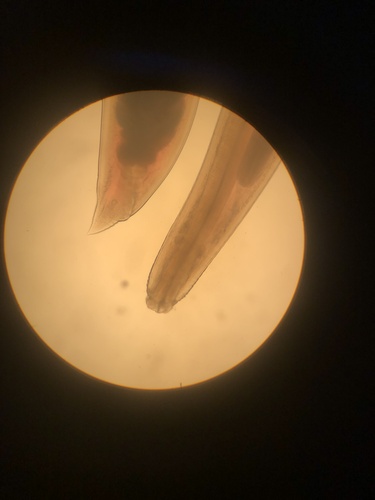
(c) Mark, some rights reserved (CC BY-NC), uploaded by Mark · cc-by-nc
Contracaecum
Sign in to saveContracaecum is a genus of parasitic nematodes from the family Anisakidae. These nematodes are parasites of warm-blooded, fish eating animals, i.e. mammals and birds, as sexually mature adults. The eggs and the successive stages of their larvae use invertebrates and increasing size classes of fishes as intermediate hosts. It is the only genus in the family Anisakidae which can infect terrestrial, marine and freshwater animals.
Species
GENUS
- KingdomAnimalia
- PhylumNematoda
- ClassChromadorea
- OrderRhabditida
- FamilyAnisakidae
Chile Central
via GBIF
Museum specimens
- Specimen records
- 1,314
- With media
- 19
- Family
- Anisakidae
- Collections
- CIAD, CINVESTAV-IPN
- Recorded in
- Mexico
Wikidata facts
- Instance of
- taxon
- Parent taxon
- Anisakidae
- Image
- Bulletin - United States National Museum (1927) (20480520866).jpg
Show 2 more facts
- taxon name
- Contracaecum
- taxon rank
- genus
Sources (1)
via Wikidata · CC0
~4 min read
Encyclopedic overview
5 sectionsContents
- Life cycle
- Distribution
- Effects on human health
- Species
- References
Contracaecum is a genus of parasitic nematodes from the family Anisakidae. These nematodes are parasites of warm-blooded, fish eating animals, i.e. mammals and birds, as sexually mature adults. The eggs and the successive stages of their larvae use invertebrates and increasing size classes of fishes as intermediate hosts. It is the only genus in the family Anisakidae which can infect terrestrial, marine and freshwater animals.
==Life cycle== The adults live as parasites in the stomachs of piscivorous birds and mammals. As third stage larvae they attach to the stomach of the species of fish which are preyed on by their definitive host. When the intermediate host fish is eaten and reached the warm stomach of its predator the larvae of Contracaecum moult twice into adult males and females, producing eggs which are expelled into water in the faeces of the host. Where the water is shallow the eggs or larvae descend to the sea bed. Here they may be consumed by invertebrates while those that float in the water column are ingested by various zooplankton. The small invertebrates and zooplankton are then eaten by larger organisms moving up the food chain until a fish suitable as a transport host consumes the larvae with the previous host. In this fish host, the larvae penetrate the wall of the intestinal tract into the organs and body cavity. The immune system of the fish reacts by producing a capsule of connective tissue around the larva, this capsule retains the larvae for the fish's life. Once an infected fish or the discarded guts of a cleaned fish are eaten by another fish, the capsule around the larvae are digested, freeing the larvae to restart this stage of its life cycle. In larger and older specimens of predatory fish there may be hundreds, possibly thousands of the larvae-containing capsules of connective tissue, these are all third-stage larvae and they are characterised by having and tooth-like structure on their head which is used to bore through the host's tissues. They have no reproductive organs at this stage.
Excerpted from Wikipedia’s “Contracaecum” article, available under the CC BY-SA 4.0 licence.