File:Comparison_convolution_correlation.svg · Wikimedia Commons · See Wikimedia Commons
convolution
Sign in to saveAlso known as convolution operation
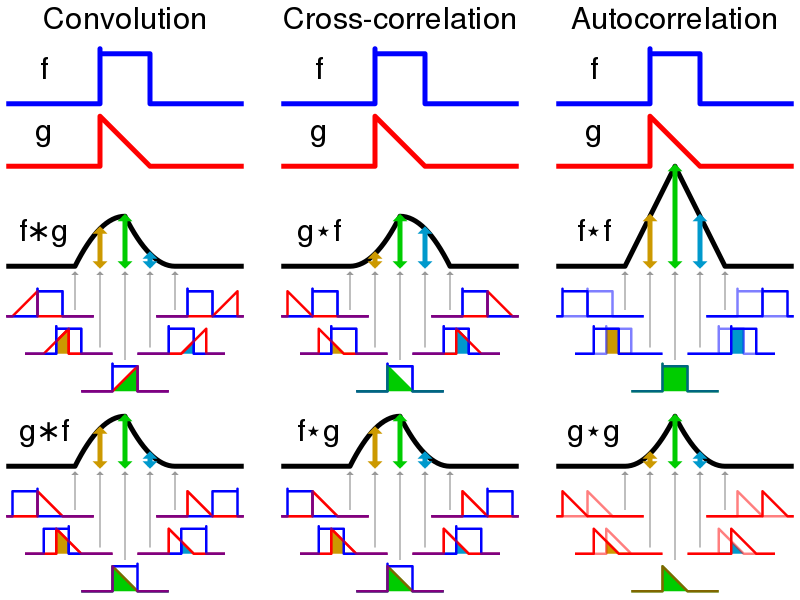
thumb|400px|class=skin-invert-image|Visual comparison of convolution, cross-correlation, and [[autocorrelation. For the operations involving function f, and assuming the height of f is 1.0, the value of the result at 5 different points is indicated by the shaded area below each point. The symmetry of f is the reason f \star g and g*f are identical in this example. ]]
Wikidata facts
- Instance of
- integral transform
- Subclass of
- mathematical operation
- Part of
- harmonic analysis
- Image
- Convolution with stride=3.svg
Show 5 more facts
- Commons category
- Convolution
- Stack Exchange tag
- stackoverflow.com/tags/convolution
- opposite of
- deconvolution
- maintained by WikiProject
- WikiProject Mathematics
- class of object(s) of occurrence
- function
Sources (1)
via Wikidata · CC0
~37 min read
Encyclopedic overview
33 sectionsContents
- Definition
- Notation
- Relations with other transforms
- Visual explanation
- Historical developments
- Circular convolution
- Discrete convolution
- Circular discrete convolution
- Fast convolution algorithms
- Domain of definition
- Compactly supported functions
- Integrable functions
- Functions of rapid decay
- Distributions
- Measures
- Properties
- Algebraic properties
- Integration
- Differentiation
- Convolution theorem
- Convolution in other types of transformations
- Convolution on matrices
- Translational equivariance
- Convolutions on groups
- Convolution of measures
- Infimal convolution
- Bialgebras
- Applications
- See also
- Notes
- References
- Further reading
- External links
thumb|400px|class=skin-invert-image|Visual comparison of convolution, cross-correlation, and [[autocorrelation. For the operations involving function f, and assuming the height of f is 1.0, the value of the result at 5 different points is indicated by the shaded area below each point. The symmetry of f is the reason f \star g and g*f are identical in this example. ]]
In mathematics (in particular, functional analysis), convolution is a mathematical operation on two functions f and g that produces a third function f*g, as the integral of the product of the two functions after one is reflected about the y-axis and shifted. The term convolution refers to both the resulting function and to the process of computing it. The integral is evaluated for all values of shift, producing the convolution function. The choice of which function is reflected and shifted before the integral does not change the integral result (see commutativity). Graphically, it expresses how the 'shape' of one function is modified by the other.
Excerpted from Wikipedia’s “convolution” article, available under the CC BY-SA 4.0 licence.