
Image by Alexas_Fotos on Pixabay · Pixabay License
Cornplanter
Sign in to saveAlso known as John Abeel, Kaintwakon, Gaiänt'wakê, Gyantwachia, Kaiiontwa'kon, Chief Cornplanter, Charles, Earl Cornplanter, John Abeel III
John Abeel III (–February 18, 1836) known as '''Gaiänt'wakê' (Gyantwachia – "the planter") or 'Kaiiontwa'kon' (Kaintwakon'' – "By What One Plants") in the Seneca language and thus generally known as Cornplanter, was a Seneca chief and diplomat. As a war chief, Cornplanter fought in the American Revolutionary War on the side of the British. After the war Cornplanter led negotiations with the United States and was a signatory of the Treaty of Fort Stanwix (1784), the Treaty of Canandaigua (1794), and other treaties. He helped ensure Seneca neutrality during the Northwest Indian War.
Person · Open Library
- Works
- 5
Top works
- Legends of the Longhouse, told to Sah-Nee-Weh, the white sister
- Legends of the Longhouse. Told to Sah-Hee-Weh, the White Sister. With an Introduction By Carl Cormer. Illustrated By the Author.
- Iroquois Indian games and dances
- Iroquis Indian games and dances
- Legends of the Longhouse
via Open Library + Wikidata
Key facts
- American Indian chief.name
- Cornplanter
- American Indian chief.image
- Cornplanter.jpg
- American Indian chief.image_size
- 220
- American Indian chief.caption
- Chief Cornplanter, portrait by Frederick Bartoli, 1796
- American Indian chief.tribe
- Seneca
- American Indian chief.birth_place
- Canawaugus (now part of Caledonia, Livingston, New York
- American Indian chief.death_date
- February 18, 1836
- American Indian chief.death_place
- Cornplanter Tract, Warren, Pennsylvania
- American Indian chief.successor
- Edward Cornplanter
- American Indian chief.native_name
- Gaiänt'wakê, Kaintwakon
- American Indian chief.nicknames
- John Abeel, John O'Bail, John O'Beale
- American Indian chief.known_for
- War chief of the Seneca during the American Revolutionary War
- American Indian chief.resting_place
- Elk Township, Warren County, Pennsylvania
- American Indian chief.children
- Henry O'Bail, Charles O'Bail, Polly O'Bail, William O'Bail, Esther O'Bail, Ja-wa-a-joh
- American Indian chief.parents
- Gah-hon-no-neh (Seneca), Johannes Abeel (Dutch)
- American Indian chief.relations
- Handsome Lake (half-brother) Guyasutha (uncle).Chainbreaker (nephew)
via Wikipedia infobox
Described at
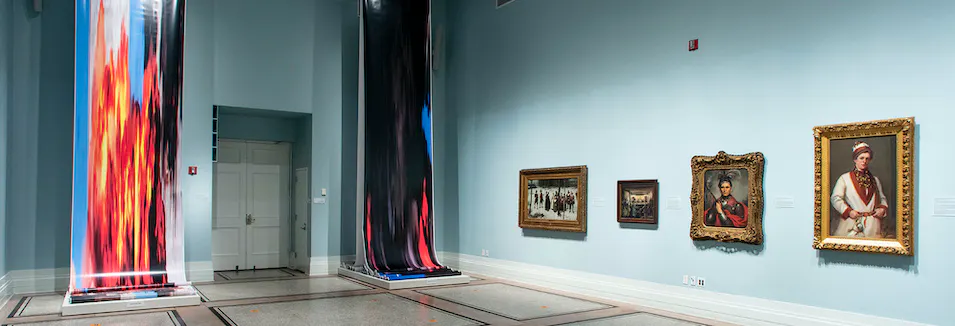
Gayë́twahgeh (also known as Cornplanter, 1732/40–1836). F. Bartoli. 1796. Oil on canvas. Gift of Thomas Jefferson Bryan Gayë́twahgeh came to New-York Historical in 1867 as part of the collection of Thomas Jefferson Bryan, one of the major art collectors of the 19th century. It’s become a familiar image to frequent New-York Historical visitors, appearing in several exhibitions over the years and more recently, even serving as a reminder to mask up during COVID-19 times. But in truth, we know very little about the painting—the artist, for instance, is a complete mystery, even down to their full first name. The painting was known as Cornplanter for decades until a recent movement by Dreaming Together ‘s curator Wendy N.E. Ikemoto to reassert Gayë́twahgeh’s proper Indigenous name. Most of what we do know about the work is from the time period of its creation and a close read of the details in the painting itself. It’s on display as part of the “People” section of Dreaming Together and grouped most immediately with Jay Yao’s 2013 photograph Untitled (St. Mary Magdalene Church, Kawit, Cavite) and Louise Lyons Heustis’ 1899 portrait of Annie R. Tinker. The exhibition makes a close study of the clothes Gayë́twahgeh wears in the portrait, a hybrid style that includes Indigenous elements as well as Euro-American ones, like the blanket that’s been adapted to an Indigenous style or the peace metal around his neck that evokes both medieval armor and Indigenous shell necklaces. The look is reflective of a time period and a moment in early American history that was surprisingly international, when Indigenous tribes were courted by various vying political powers, including the young United States. This is reflected in Gayë́twahgeh’s life story: the son of a Dutch fur trader and an Indigenous mother, he led the Seneca on the side of the British in the Revolutionary War before pushing for diplomacy with the new nation. “This is an Indigenous America that was part of an international world,” says Ikemoto. “North America at this time was not incipiently American, nor was it British—it was multinational. The territory was grounds for all of these competing powers, which included the Indigenous powers and the Indigenous nations.” For all the power and the heroism the portrait evokes, the later years of Gayë́twahgeh’s life were marked by a familiar history of disillusionment and loss. Stung by the betrayals of the American government, he reportedly withdrew from the white world. In the 1790s, he was granted a tract of land in northwestern Pennsylvania as reward for his support of the new United States. (He died there in 1836.) The Cornplanter Grant or Tract, as it was known, became a center of Seneca life and culture for generations. But in the 1960s, it fell victim to another broken promise when large portions of the land were flooded for the creation of the Kinzua Dam. You asked, and our curators answered! For AskaMuseumDay last month, we gathered the questions our social media followers. To celebrate the arrival of the historic Fred W. McDarrah Archive at The New York Historical, we are excited to share some of the stories behind McDarrah’s iconic photos of the 1975 Pride March in honor of its fiftieth anniversary.
Excerpt from a page describing this subject · 9,254 chars · not written by Vinony
Wikidata facts
- Instance of
- human
- Given name
- Charles
- Gender
- male
- Citizenship
- United States
- Sibling
- Handsome Lake
- Occupation
- politician
- Position held
- traditional leader or chief
- Image
- Cornplanter.jpg
- Significant event
- Treaty of Fort Stanwix
Show 7 more facts
- date of death
- 1836-02-18
- Commons category
- Cornplanter
- place of burial
- Corydon Township
- relative
- Jesse Cornplanter
- ethnic group
- Seneca
- described at URL
- www.nyhistory.org/blogs/gayetwahgeh-in-dreaming-together
- date of birth
- 1732-00-00
via Wikidata · CC0
~17 min read
Encyclopedic overview
11 sectionsContents
- Early life
- War chief
- Post-Revolutionary War years
- Family
- Cornplanter Tract
- Cornplanter Monument
- Relocation of Cornplanter's grave
- Legacy
- Further reading
- References
- External links
John Abeel III (–February 18, 1836) known as '''Gaiänt'wakê' (Gyantwachia – "the planter") or 'Kaiiontwa'kon' (Kaintwakon'' – "By What One Plants") in the Seneca language and thus generally known as Cornplanter, was a Seneca chief and diplomat. As a war chief, Cornplanter fought in the American Revolutionary War on the side of the British. After the war Cornplanter led negotiations with the United States and was a signatory of the Treaty of Fort Stanwix (1784), the Treaty of Canandaigua (1794), and other treaties. He helped ensure Seneca neutrality during the Northwest Indian War.
In the postwar years, Cornplanter endeavoured to learn more about Euro-American culture and invited Quakers to establish schools in Seneca territory. After the War of 1812 he became disillusioned by his people's poor reaction to Euro-American society. He had the schools closed and embraced his half-brother Handsome Lake's movement to return to traditional Seneca ways and religion.
Excerpted from Wikipedia’s “Cornplanter” article, available under the CC BY-SA 4.0 licence.