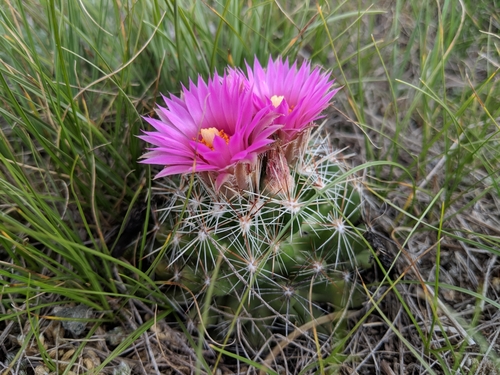
(c) Kyla Rushton, some rights reserved (CC BY-NC), uploaded by Kyla Rushton · cc-by-nc
Coryphantha
Sign in to saveCoryphantha (from Greek, "flowering on the top"), or beehive cactus, is a genus of small to middle-sized, globose or columnar cacti. The genus is native to arid parts of Central America, Mexico, through Arizona, New Mexico, and western Texas and north into southwestern, central, and southeastern Montana. With its two subgenera, 57 species and 20 subspecies, it is one of the largest genera of cactus.
Species
Spinystar
GENUS
- KingdomPlantae
- PhylumTracheophyta
- ClassMagnoliopsida
- OrderCaryophyllales
- FamilyCactaceae
Coryphantha pycnacantha Coryphantha cornifera Coryphantha delicata Корифанта живородящая (Coryphantha vivipara)
via GBIF · Kew POWO
Museum specimens
- Specimen records
- 161
- With media
- 78
- Family
- Cactaceae
- Collections
- IEA-UAT, INECOL, FC-UNAM, SD, FESI-UNAM, RSA
- Recorded in
- Mexico, United States
Wikidata facts
Show 6 more facts
- taxon rank
- genus
- Commons category
- Coryphantha
- taxon name
- Coryphantha
- topic's main category
- Category:Coryphantha
- taxon common name
- krooncactus
Sources (1)
via Wikidata · CC0
~6 min read
Encyclopedic overview
8 sectionsContents
- Description
- Name
- Species
- Synonymy
- Related genera
- Gallery
- References
- External links
Coryphantha (from Greek, "flowering on the top"), or beehive cactus, is a genus of small to middle-sized, globose or columnar cacti. The genus is native to arid parts of Central America, Mexico, through Arizona, New Mexico, and western Texas and north into southwestern, central, and southeastern Montana. With its two subgenera, 57 species and 20 subspecies, it is one of the largest genera of cactus.
==Description== There are four characteristics that distinguish Coryphantha from other cacti. Their bodies do not have ribs, just tubercles. The flowers form at the top of the plant (the apex or growing end of the stem). The tip (podarium) of each flowering tubercle has three parts, the spiny areole, the groove and the axil. Without the groove it is not a Coryphantha. The seed coat (or testa) has a net-like pattern (reticulate). More than many other cacti, the Coryphantha change in their appearance over their lifespan. The presence or absence of a central spine is not indicative of the genus, even in fully adult plants.
Excerpted from Wikipedia’s “Coryphantha” article, available under the CC BY-SA 4.0 licence.