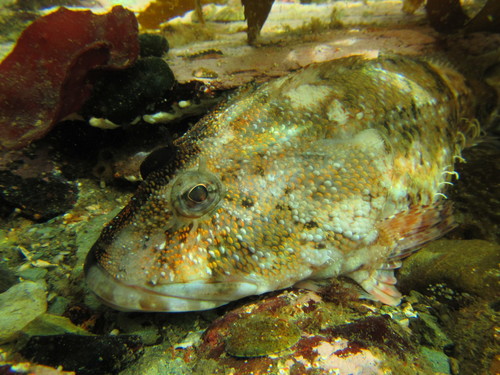
(c) Mariano Rodriguez, all rights reserved, uploaded by Mariano Rodriguez
Cottoperca
Sign in to saveCottoperca is a genus of marine ray-finned fishes belonging to the family Bovichtidae, the temperate icefishes or thornfishes. They are found in the southeastern Pacific, southwestern Atlantic and northern Southern Oceans off southern South America.
Species
Mimic Bull Blenny
GENUS
- KingdomAnimalia
- PhylumChordata
- ClassTeleostei
- OrderPerciformes
- FamilyBovichtidae
via GBIF
Wikidata facts
- Instance of
- taxon
- Parent taxon
- Bovichtidae
- Image
- Cottoperca gobio.jpg
Show 4 more facts
- Commons category
- Cottoperca
- taxon name
- Cottoperca
- taxon rank
- genus
- topic's main category
- Category:Cottoperca
Sources (1)
via Wikidata · CC0
~3 min read
Encyclopedic overview
7 sectionsContents
- Taxonomy
- Species
- Characteristics
- Distribution and habitat
- Biology
- Fisheries and conservation
- References
Cottoperca is a genus of marine ray-finned fishes belonging to the family Bovichtidae, the temperate icefishes or thornfishes. They are found in the southeastern Pacific, southwestern Atlantic and northern Southern Oceans off southern South America.
==Taxonomy== Cottoperca was first formally described as a genus in 1875 by the Austrian ichthyologist Franz Steindachner with Cottoperca rosenbergii which Steindachner described as its only species. C. rosenbergii was later found to be a synonym of Batrachus trigloides which had been described by the German naturalist Johann Reinhold Forster in 1801. Some taxonomic authorities consider that Cottoperca is monotypic and that the only valid species is C. gobio, while others state the only valid species is C. trigloides, although this is not the position taken by the 5th edition of Fishes of the World, World Register of Marine Species, FishBase or the Catalog of Fishes, which all give the genus 2 species. The genus name is made up from cottus, meaning "sculpin" and perca which means "perch", an allusion Steindachner did not explain but which is probably a reference to the sculpin like shape of C. rosenbergii.
Excerpted from Wikipedia’s “Cottoperca” article, available under the CC BY-SA 4.0 licence.