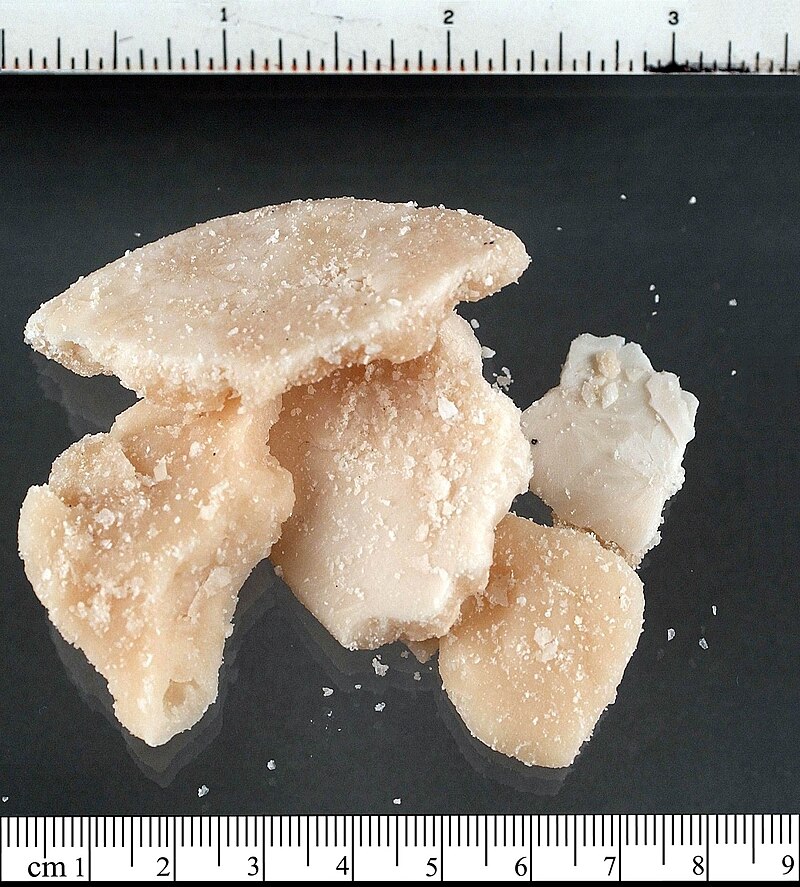
File:Rocks_of_crack_cocaine.jpg · Wikimedia Commons · See Wikimedia Commons
Key facts
- Dependence liability
- High
- Addiction liability
- High
- Routes of administration
- Smoking , intravenous
- Drug class
- Stimulant
- Legal status
- Illegal in most countries
- Metabolism
- Liver
- Excretion
- Kidney
via Wikipedia infobox
Research
35,908 papers- Crack.Nursing times · 1991
- Neurotoxicity of crack cocaine exposure: evidence from a systematic review of in vitro and in vivo studies.Archives of toxicology · 2024
- Crack cocaine and cocaine hydrochloride. Are the differences myth or reality?JAMA · 1996
- Crack cocaine inhalation increases seizure susceptibility by reducing acetylcholinesterase activity.Epilepsy & behavior : E&B · 2024
- Behavioral and neurobiological alterations induced by chronic use of crack cocaine.Reviews in the neurosciences · 2019
via PubMed
Wikidata facts
Show 2 more facts
- Commons category
- Crack cocaine
- has active ingredient
- cocaine
via Wikidata · CC0
~25 min read
Encyclopedic overview
Two grams of crack cocaine Crack cocaine, commonly known simply as crack, and also known as rock, is a free base form of the stimulant cocaine that can be smoked. Crack offers a short, intense high to smokers. The Manual of Adolescent Substance Abuse Treatment calls it the most addictive form of cocaine.
Crack cocaine first saw widespread use as a recreational drug in primarily impoverished neighborhoods in New York City, Philadelphia, Baltimore, Washington, D.C., Los Angeles, San Francisco and Miami in late 1984 and 1985. This rapid increase in use and availability was named the "crack epidemic", which began to wane in the 1990s.
Excerpted from Wikipedia’s “crack” article, available under the CC BY-SA 4.0 licence.