
crawler-transporter
Sign in to saveAlso known as Missile Crawler Transporter Facility, Hans, Franz, Missile Crawler Transporter Facilities, crawler transporter
The crawler-transporters, formally known as the Missile Crawler Transporter Facilities, are a pair of tracked vehicles used to transport launch vehicles from NASA's Vehicle Assembly Building (VAB) along the Crawlerway to Launch Complex 39. They were originally used to transport the Saturn IB and Saturn V rockets during the Apollo, Skylab and Apollo–Soyuz programs. They were then used to transport Space Shuttles from 1981 to 2011. The crawler-transporters carry vehicles on the mobile launcher platforms (MLPs) used by NASA, and after each launch return to the pad to take the platform back to the
Key facts
- Automobile.name
- Crawler-transporter
- Automobile.image
- Crawler-Transporter.jpg
- Automobile.image_size
- 275px
- Automobile.aka
- Missile Crawler Transporter Facilities
- Automobile.manufacturer
- Marion Power Shovel Company
- Automobile.model_years
- 1965
- Automobile.transmission
- 16 × traction motors, 4 per corner
- Automobile.height
- Adjustable,
- Automobile.sp
- us
- NRHP.embed
- yes
- NRHP.name
- Missile Crawler Transporter Facilities
- NRHP.nrhp_type
- nrhp
- NRHP.location
- Kennedy Space Center, Florida
- NRHP.added
- January 21, 2000
- NRHP.refnum
- 99001643
- NRHP.mpsub
- John F. Kennedy Space Center MPS
via Wikipedia infobox
Described at
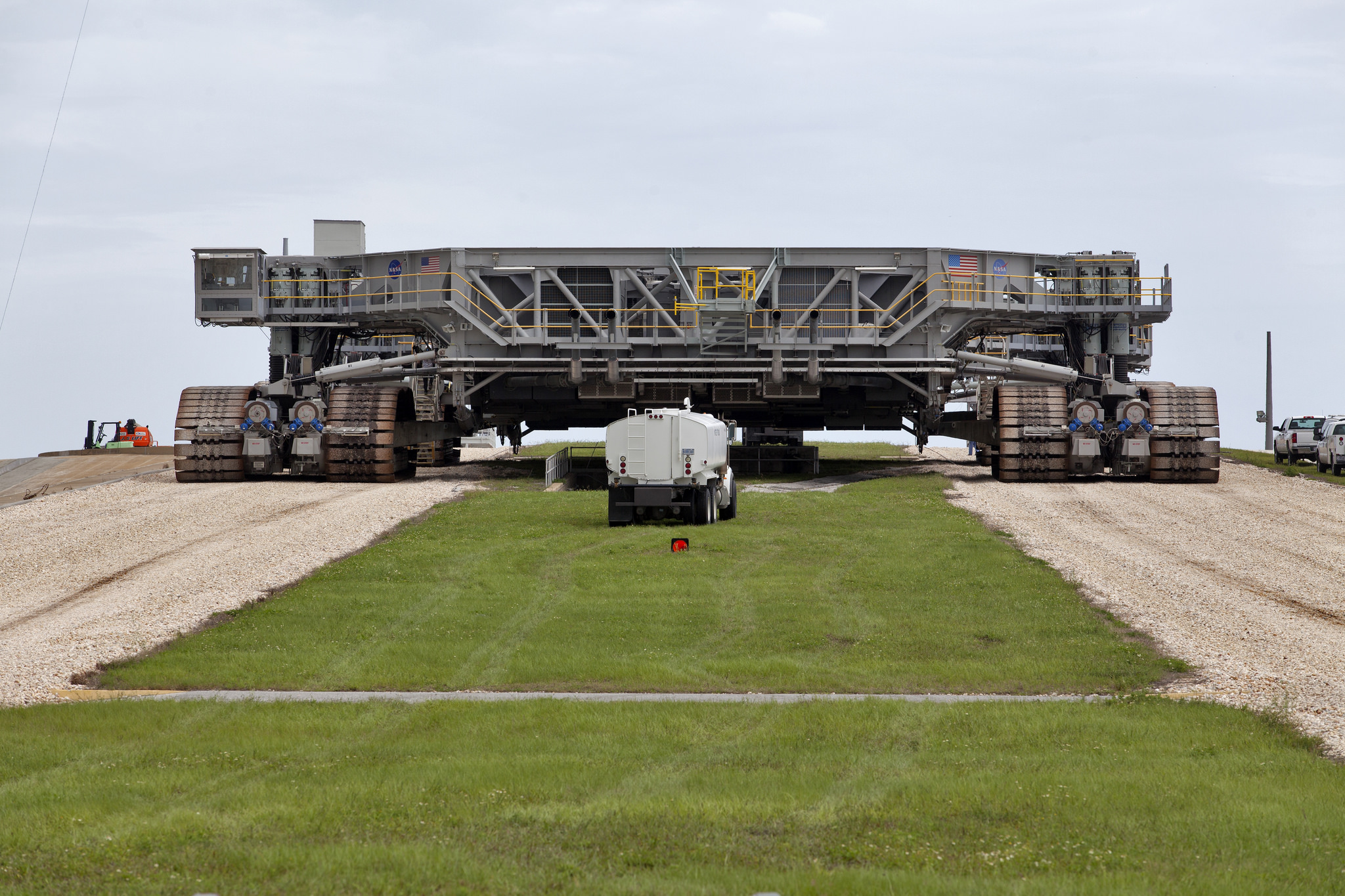
The Crawlers - NASA
A pair of behemoth machines called crawler-transporters have carried the load of taking rockets and spacecraft to the launch pad for more than 50 years at
nasa.gov →A pair of behemoth machines called crawler-transporters have carried the load of taking rockets and spacecraft to the launch pad for more than 50 years at NASA’s Kennedy Space Center in Florida. Each the size of a baseball infield and powered by locomotive and large electrical power generator engines, the crawler-transporters stand ready to keep up the work for the next generation of launch vehicles to lift astronauts into space. The crawlers are unique in the world, having been built in 1965 to move the massive Saturn V rocket from Kennedy’s Vehicle Assembly Building to Launch Complex 39. After the Moon landing and Skylab programs ended, the crawlers continued their work, taking space shuttles to their launch pads for 30 years. With the shuttle fleet retired in 2011, the crawlers are envisioned as critical elements of future launch operations at Kennedy. Crawler-transporter 2 (CT-2) is integral to the Artemis missions. May 1, 1979 – A crawler transported space shuttle Enterprise, with external tank and two inert solid rocket boosters, to Launch Pad A for fit check. Nov. 16, 2011 – Moved Space Launch System’s (SLS) mobile launcher from the park site beside the Vehicle Assembly Building (VAB) to Launch Pad 39B. June 28, 2019 – CT-2 carried the mobile launcher from the VAB along the crawlerway to Launch Pad 39B for Verification and Validation (V&V) testing of ML and pad systems. March 17 – April 26, 2022 – CT-2 carried the SLS with the Orion spacecraft atop on the mobile launcher from the VAB to Pad 39B for the Artemis I wet dress rehearsal tests ahead of launch. Nov. 3 – Dec. 9, 2022 – CT-2 carried SLS with the Orion spacecraft atop on the mobile launcher from the VAB to Pad 39B for the launch of Artemis I, which took place on Nov. 16. CT-2 carried the mobile launcher back to the VAB and later on to a parking location at Kennedy, where modifications and upgrades are being made on both ahead of the Artemis II crewed mission. March 29, 2023 – Guinness World Records presented a certificate to teams with EGS and Kennedy leadership, officially designating CT-2 as “the heaviest self-powered vehicle.” Learn more and access additional quick facts about NASA's crawler-transporter and crawler-transporter 2. Learn about NASA’s crawler-transporters at Kennedy Space Center through this video infographic. The crawler-transporter will carry the agency’s Orion spacecraft atop the Space Launch System rocket to Launch Pad 39B for Artemis I.
Excerpt from a page describing this subject · 27,549 chars · not written by Vinony
Wikidata facts
- Subclass of
- oversize load
- Country
- United States
- Located in
- Brevard County
- Owned by
- NASA
- Operator
- NASA
- Country of origin
- United States
- Mass
- 2850000
- Manufacturer
- Marion Power Shovel Company
- Image
- Crawler Transporter Maintenance Building with the two CTs (KSC-98PC-1044).jpg
- Height
- 7.9
- Width
- 114
- Length
- 40
- Speed
- 1.6
Show 6 more facts
- Commons category
- Crawler-transporters
- designed to carry
- Mobile Launcher Platform
- capital cost
- 14000000
- inception
- 1965-00-00
- described at URL
- www.nasa.gov/sites/default/files/atoms/files/combined_crawler-transporters_fact_sheet_final.pdf
- total produced
- 2
Sources (14)
via Wikidata · CC0
~8 min read
Encyclopedic overview
9 sectionsContents
- Specifications
- Future use
- Crawler-Transporter 2
- Crawler-Transporter 1
- Appearances in popular culture
- Gallery
- See also
- References
- External links
The crawler-transporters, formally known as the Missile Crawler Transporter Facilities, are a pair of tracked vehicles used to transport launch vehicles from NASA's Vehicle Assembly Building (VAB) along the Crawlerway to Launch Complex 39. They were originally used to transport the Saturn IB and Saturn V rockets during the Apollo, Skylab and Apollo–Soyuz programs. They were then used to transport Space Shuttles from 1981 to 2011. The crawler-transporters carry vehicles on the mobile launcher platforms (MLPs) used by NASA, and after each launch return to the pad to take the platform back to the VAB.
The two crawler-transporters were designed and built by Marion Power Shovel Company using some components designed and built by Rockwell International at a cost of ( in 2022) each. Upon its construction, the crawler-transporter became the largest self-powered land vehicle in the world. While other vehicles such as bucket-wheel excavators like Bagger 288, dragline excavators like Big Muskie and power shovels like The Captain are significantly larger, they are powered by external sources.
Excerpted from Wikipedia’s “crawler-transporter” article, available under the CC BY-SA 4.0 licence.
Gallery (6)
On the map
3 mapped locations