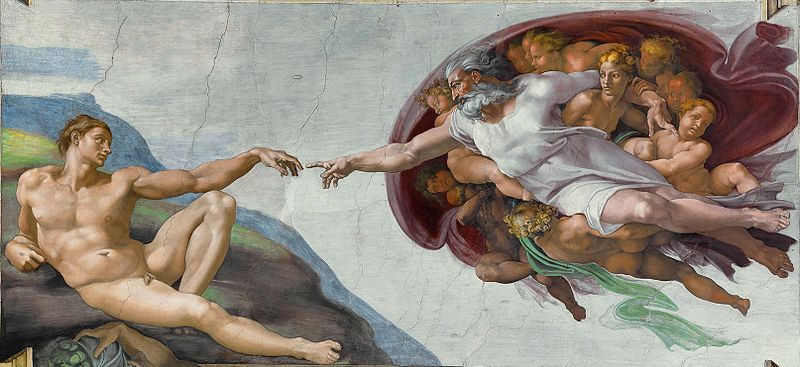
File:The_Creation_of_Adam.jpg · Wikimedia Commons · See Wikimedia Commons
creationism
Sign in to saveAlso known as biological creationism
Creationism is the religious belief that nature, and aspects such as the universe, Earth, life, and humans, originated with supernatural acts of divine creation, and is often pseudoscientific. In its broadest sense, creationism includes various religious views, which differ in their acceptance or rejection of modern scientific concepts, such as evolution, that describe the origin and development of natural phenomena.
Creationism is the religious belief that the universe, Earth, life, and humans were created by divine supernatural acts rather than through natural processes. It matters because creationists hold varying views on how much they accept or reject scientific explanations like evolution, which shapes debates about education, science, and religion in society.
AI-generated from the Wikipedia summary — may contain errors.
Wikidata facts
- Instance of
- cosmogony
- Subclass of
- religious belief
- Part of
- creationist cosmologies
- Image
- Michelangelo - Creation of Adam (cropped).jpg
Show 9 more facts
- different from
- creationism
- topic has template
- Template:Creationism2
- opposite of
- evolution
- Commons category
- Creationism
- topic's main category
- Category:Creationism
- Commons gallery
- Creationism
- facet of
- origin of life
- P8168
- Guo Xi
- studied by
- Protology
Sources (3)
via Wikidata · CC0
~59 min read
Encyclopedic overview
43 sectionsContents
- Biblical basis
- Diversity among creationists
- Young Earth creationism
- Old Earth creationism
- Gap creationism
- Day-age creationism
- Progressive creationism
- Philosophic and scientific creationism
- Creation science
- Neo-creationism
- Intelligent design
- Geocentrism
- Omphalos hypothesis
- Theistic evolution
- By religion
- Bahá'í Faith
- Buddhism
- Christianity
- Hinduism
- Islam
- Judaism
- Native American
- Prevalence
- Australia
- Brazil
- Canada
- Europe
- South Africa
- South Korea
- United States
- Education controversies
- Criticism
- Christian criticism
- Teaching of creationism
- Scientific criticism
- Organizations
- See also
- Notes
- References
- Citations
- Works cited
- Further reading
- External links
Creationism is the religious belief that nature, and aspects such as the universe, Earth, life, and humans, originated with supernatural acts of divine creation, and is often pseudoscientific. In its broadest sense, creationism includes various religious views, which differ in their acceptance or rejection of modern scientific concepts, such as evolution, that describe the origin and development of natural phenomena.
The term creationism most often refers to belief in special creation: the claim that the universe and lifeforms were created as they exist today by divine action, and that the only true explanations are those which are compatible with a Christian fundamentalist literal interpretation of the creation myth found in the Bible's Genesis creation narrative. Since the 1970s, the most common form of this has been Young Earth creationism which posits special creation of the universe and lifeforms within the last 10,000 years on the basis of flood geology, and promotes pseudoscientific creation science. From the 18th century onward, Old Earth creationism accepted geological time harmonized with Genesis through gap or day-age theory, while supporting anti-evolution. Modern old-Earth creationists support progressive creationism and continue to reject evolutionary explanations. Following political controversy, creation science was reformulated as intelligent design and neo-creationism.
Excerpted from Wikipedia’s “creationism” article, available under the CC BY-SA 4.0 licence.
Gallery (26)
Available in 78 languages
- Español
- Français
- Deutsch
- 中文
- 日本語
- Русский
- Português
- Italiano
- العربية
- हिन्दी
- Afrikaans
- Armenian
- Azerbaijani
- Bahasa Indonesia
- Bangla
- Basque
- be_x_old
- Belarusian
Show 59 more
- Bulgarian
- Catalan
- Croatian
- Czech
- Danish
- Egyptian Arabic
- Esperanto
- Estonian
- Faroese
- Filipino
- Finnish
- Galician
- Georgian
- Greek
- Hebrew
- Hungarian
- Irish
- Kazakh
- Kyrgyz
- Lao
- Latin
- Latvian
- Limburgish
- Lingua Franca Nova
- Lithuanian
- Luxembourgish
- Macedonian
- Malay
- Mongolian
- Nederlands
- Norwegian
- Norwegian Nynorsk
- Occitan
- Pashto
- Polski
- Romanian
- Saterland Frisian
- Serbian
- Serbian (Latin)
- simple
- Sinhala
- Slovak
- Slovenian
- Svenska
- Tamil
- Telugu
- Tiếng Việt
- Türkçe
- Ukrainian
- Uzbek
- Waray
- Welsh
- Wu Chinese
- Yiddish
- zh_min_nan
- zh_yue
- فارسی
- ไทย
- 한국어
via Wikidata sitelinks · CC0