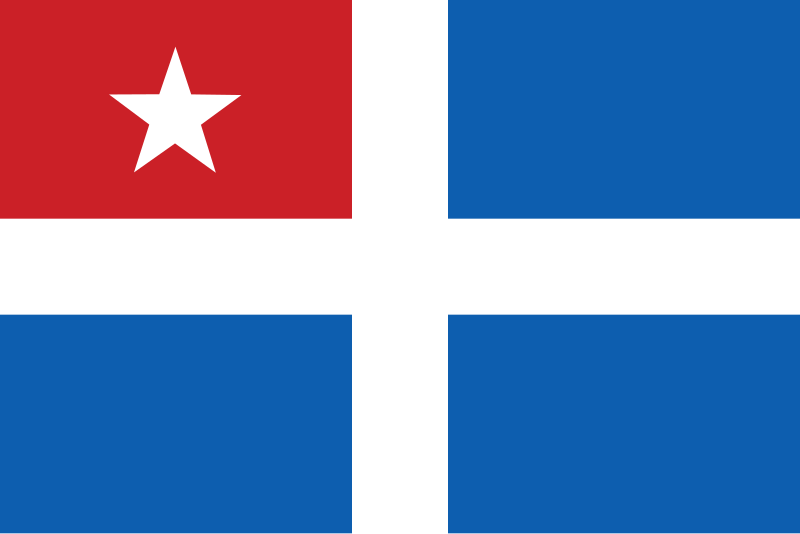
File:Flag_of_Cretan_State.svg · Wikimedia Commons · See Wikimedia Commons
Cretan State
Sign in to savestate on Crete between 1898-1913
Key facts
- 1910
- Eleftherios Venizelos
- Status
- Autonomous state of the Ottoman Empire
- Capital
- Chania
- Largest city
- Heraklion
- Common languages
- Greek (official), Ottoman Turkish (recognised)
- Religion
- Greek Orthodox (prevailing religion), Sunni Islam (recognised), Judaism
- Demonym
- Cretian
- 1898 1906
- Prince George
- 1906 1911
- Alexandros Zaimis
- Legislature
- Assembly
- Proclamation
- 9 December 1898
- Theriso revolt
- 23 March 1905
- Unilateral union with greece
- 7 October 1908
- Treaty of london
- 30 May 1913
- Union with greece
- 1 December 1913
- 1911 estimate
- 336,151
- Currency
- Cretan drachma
via Wikipedia infobox
Wikidata facts
- Instance of
- historical country
- Continent
- Europe
- Capital
- Chania
- Official language
- Greek
- Area
- 8336
Show 9 more facts
- topic's main category
- Category:Cretan State
- inception
- 1898-01-01
- dissolved, abolished or demolished date
- 1913-00-00
- replaces
- Crete vilayet
- Commons category
- Cretan State
- language used
- Greek
- official religion
- Greek Orthodoxy
- native label
- Κρητική Πολιτεία
- merged into
- Greece
Sources (3)
via Wikidata · CC0
~12 min read
Encyclopedic overview
Today part of Greece
The Cretan State (Greek: Κρητική Πολιτεία, romanized: Kritiki Politeia; Ottoman Turkish: كرید دولتی, romanized: Girid Devleti) was an autonomous state governing the island of Crete from 1898 to 1913, under de jure suzerainty of the Ottoman Empire but with de facto independence secured by European Great Powers. In 1897, the Cretan Revolt led the Ottoman Empire to declare war on Greece, which led the United Kingdom, France, Italy and Russia to intervene on the grounds that the Ottoman Empire could no longer maintain control. The Cretan State was the prelude to the island's final annexation to the Kingdom of Greece, which occurred de facto in 1908 and de jure in 1913 after the First Balkan War.
Excerpted from Wikipedia’s “Cretan State” article, available under the CC BY-SA 4.0 licence.