Cricket
Sign in to saveCricket is a bat-and-ball game that is played between two teams of eleven players on a field, at the centre of which is a pitch with a wicket at each end, each comprising two bails (small sticks) balanced on three stumps. Two players from the batting team, the striker and nonstriker, stand in front of either wicket holding bats, while one player from the fielding team, the bowler, bowls the ball toward the striker's wicket from the opposite end of the pitch. The striker's goal is to hit the bowled ball with the bat and then switch places with the nonstriker, with the batting team scoring one r
Cricket is a bat-and-ball sport played between two teams of eleven players, where batters attempt to hit a bowled ball and score runs by switching positions with a teammate, while fielders try to prevent scoring. The game centers on a pitch with wickets (sets of sticks called stumps and bails) at each end, where a bowler delivers the ball to a striker who defends their wicket.
AI-generated from the Wikipedia summary — may contain errors.
Wikipedia views (30d)
180,497 totalvia Wikimedia Pageviews API
Key facts
- Sport.name
- Cricket
- Sport.image
- Pollock to Hussey.jpg
- Sport.nickname
- ''The Gentlemen's Game''
- Sport.imagesize
- 300 px
- Sport.union
- International Cricket Council
- Sport.first
- 16th century; South East England
- Sport.contact
- No
- Sport.team
- 11 players per side (substitutes permitted in some circumstances)
- Sport.mgender
- No, separate competitions
- Sport.type
- Team sport, Bat-and-Ball
- Sport.ball
- Cricket ball, Cricket bat, Wicket (Stumps, Bails), Protective equipment
- Sport.venue
- Cricket field
- Sport.glossary
- Glossary of cricket terms
- Sport.region
- Worldwide (most popular in the Commonwealth)
- Sport.olympic
- 1900, 2028
via Wikipedia infobox
Research
6,199 papers- Cricket: The third domesticated insect.Current topics in developmental biology · 2022Mito T, Ishimaru Y, Watanabe T et al.DOI: 10.1016/bs.ctdb.2022.02.003
- Lipidome of cricket species used as food.Food chemistry · 2021Tzompa-Sosa DA, Dewettinck K, Provijn P et al.DOI: 10.1016/j.foodchem.2021.129077
- A novel cricket morph has diverged in song and wing morphology across island populations.Journal of evolutionary biology · 2023Gallagher JH, Zonana DM, Broder ED et al.DOI: 10.1111/jeb.14235
- The Cricket Gryllus bimaculatus: Techniques for Quantitative and Functional Genetic Analyses of Cricket Biology.ReviewResults and problems in cell differentiation · 2019Kulkarni A, Extavour CGDOI: 10.1007/978-3-030-23459-1_8
- Studies on Neotropical crickets: Aclodes paz n. sp. a new phalangopsid cricket (Orthoptera: Phalangopsidae) from the Santander caves, Colombia.ReviewZootaxa · 2022Cadena-Castaeda OJ, Quintana-Arias RF, Rodrguez DMT et al.DOI: 10.11646/zootaxa.5141.6.3
- The genome assembly and annotation of the cricket Gryllus longicercus.Scientific data · 2024Szrajer S, Gray D, Ylla GDOI: 10.1038/s41597-024-03554-z
- Challenges with effective nutrient supplementation for amphibians: A review of cricket studies.ReviewZoo biology · 2014Livingston S, Lavin SR, Sullivan K et al.DOI: 10.1002/zoo.21177
- DeepLabCut-based daily behavioural and posture analysis in a cricket.Biology open · 2024Hayakawa S, Kataoka K, Yamamoto M et al.DOI: 10.1242/bio.060237
via PubMed
Official website

Home | ICC Women's T20 World Cup, 2026 | ICC
Official ICC Women's T20 World Cup, 2026 Cricket website - live matches, scores, news, highlights, commentary, rankings, videos and fixtures from the International Cricket Council.
icc-cricket.com →Link to the official site · 14,583 chars · not written by Vinony
~40 min read
Encyclopedic overview
45 sectionsContents
- History
- Origins
- Growth of amateur and professional cricket in England
- English cricket in the 18th and 19th centuries
- Cricket becomes an international sport
- Cricket in the 20th century
- Cricket in the 21st century
- Laws and gameplay
- Playing area
- Match structure
- Clothing and equipment
- Bat and ball
- Player roles
- Basic gameplay: bowler to batter
- Overs
- Fielding
- <span class="anchor" id="Batting, runs, and extras"></span>Batting and scoring
- Dismissals
- Bowling
- Specialist roles
- Match closure
- Innings
- Umpires and scorers
- Spirit of the Game
- Women's cricket
- Governance
- Forms of cricket
- Competitions
- International competitions
- National competitions
- First-class
- Limited overs
- Other
- Club and school cricket
- Rivalries
- Culture
- Influence on everyday life
- In the arts and popular culture
- Influence on other sports
- See also
- Footnotes
- Citations
- Sources
- Further reading
- External links
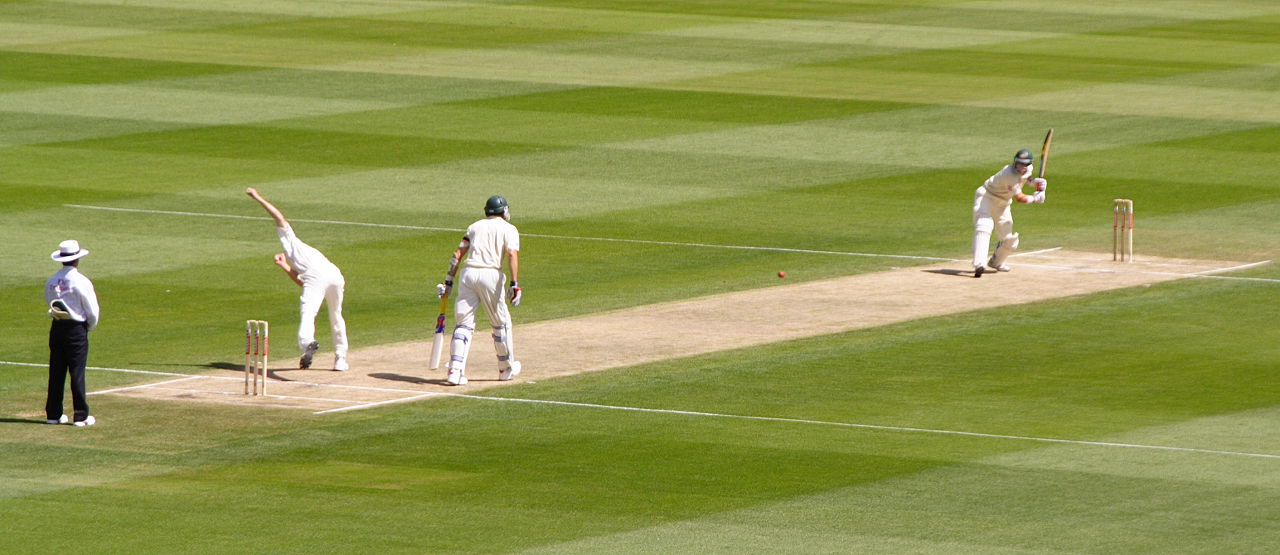
Cricket is a bat-and-ball game that is played between two teams of eleven players on a field, at the centre of which is a 22-yard (20-metre; 66-foot) pitch with a wicket at each end, each comprising two bails (small sticks) balanced on three stumps. Two players from the batting team, the striker and nonstriker, stand in front of either wicket holding bats, while one player from the fielding team, the bowler, bowls the ball toward the striker's wicket from the opposite end of the pitch. The striker's goal is to hit the bowled ball with the bat and then switch places with the nonstriker, with the batting team scoring one run for each of these swaps. Runs are also scored when the ball reaches the boundary of the field or when the ball is bowled illegally.
The fielding team aims to prevent runs by dismissing batters (so they are "out"). Dismissal can occur in various ways, including being bowled (when the ball hits the striker's wicket and dislodges the bails), and by the fielding side either catching the ball after it is hit by the bat but before it hits the ground, or hitting a wicket with the ball before a batter can cross the crease line in front of the wicket. When ten batters have been dismissed, the innings (playing phase) ends and the teams swap roles. Forms of cricket range from traditional Test matches played over five days to the newer Twenty20 format (also known as T20), in which each team bats for a single innings of 20 overs (each "over" being a set of 6 fair opportunities for the batting team to score) and the game generally lasts three to four hours.
Excerpted from Wikipedia’s “Cricket” article, available under the CC BY-SA 4.0 licence.
Gallery (35)
Available in 147 languages
- Español
- Français
- Deutsch
- 中文
- 日本語
- Русский
- Português
- Italiano
- العربية
- हिन्दी
- abstract
- Afrikaans
- Albanian
- Albanian
- Angika
- Aragonese
- Armenian
- Assamese
Show 128 more
- Asturian
- Awadhi
- azb
- Azerbaijani
- Bahasa Indonesia
- Bangla
- Bashkir
- Basque
- bat_smg
- Bavarian
- be_x_old
- Belarusian
- Bhojpuri
- Bosnian
- Breton
- Bulgarian
- Buriat
- Burmese
- Catalan
- Central Kurdish
- Chechen
- Croatian
- Czech
- Danish
- dty
- Egyptian Arabic
- Esperanto
- Estonian
- Extremaduran
- Fiji Hindi
- Filipino
- Finnish
- Galician
- Gan Chinese
- gcr
- Georgian
- Greek
- Guarani
- Gujarati
- Haitian Creole
- Hausa
- Hebrew
- Hungarian
- Icelandic
- Ido
- Iloko
- Interlingua
- Irish
- Jamaican Creole English
- Javanese
- Kannada
- Kashmiri
- Kazakh
- kbp
- Kyrgyz
- Latin
- Latvian
- Limburgish
- Lingua Franca Nova
- Lithuanian
- Low German
- Luxembourgish
- Macedonian
- Maithili
- Malay
- Malayalam
- Marathi
- Mazanderani
- Mingrelian
- Mongolian
- Moroccan Arabic
- Neapolitan
- Nederlands
- Nepali
- Newari
- Norwegian
- Norwegian Nynorsk
- nrm
- Occitan
- Odia
- Old English
- Pashto
- Piedmontese
- Polski
- Punjabi
- Quechua
- Romanian
- Samoan
- Sanskrit
- Santali
- Scots
- Scottish Gaelic
- Serbian
- Serbian (Latin)
- Sicilian
- simple
- Sindhi
- Sinhala
- skr
- Slovak
- Slovenian
- Sundanese
- Svenska
- Swahili
- syl
- Talysh
- Tamil
- Telugu
- Tiếng Việt
- Toki Pona
- Tulu
- Türkçe
- Ukrainian
- Urdu
- Uzbek
- Waray
- Welsh
- Western Frisian
- Western Panjabi
- Wu Chinese
- Xhosa
- Yiddish
- zh_min_nan
- zh_yue
- Zulu
- فارسی
- ไทย
- 한국어
via Wikidata sitelinks · CC0