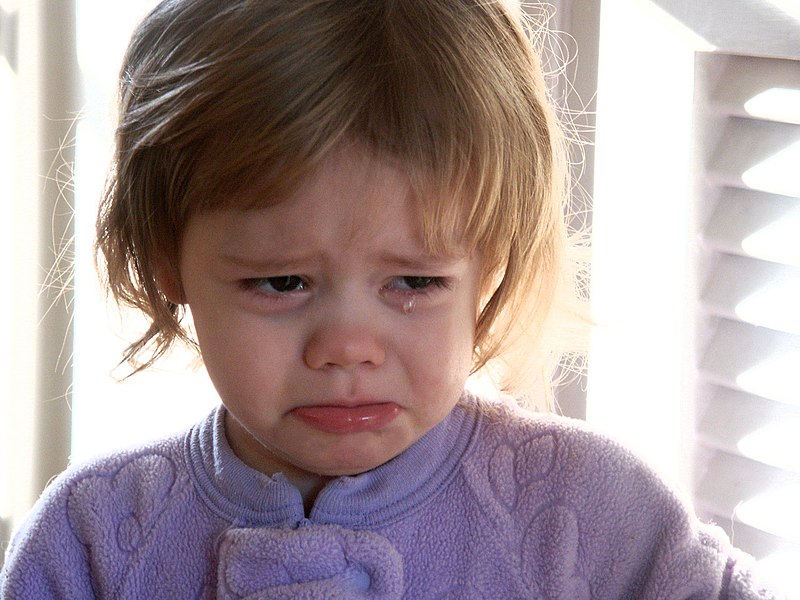
File:Crying-girl.jpg · Wikimedia Commons · See Wikimedia Commons
crying
Sign in to saveAlso known as sobbing, weeping, bawling, wailing, 😭, cry, sob, wail
thumb|A young child crying |alt=a young child in a pink sweater crying and looking sad
Crying is the release of tears from the eyes, often accompanied by facial expressions and sounds that show sadness or other strong emotions. It matters because it's a natural way humans express their feelings and can be a sign that someone needs comfort or support.
AI-generated from the Wikipedia summary — may contain errors.
Wikidata facts
- Subclass of
- mood
- Image
- Crying-girl.jpg
Show 9 more facts
- uses
- tear
- maintained by WikiProject
- WikiProject Psychology
- described at URL
- neal.fun/earth-reviews/crying
- on focus list of Wikimedia project
- Wikipedia:Vital articles/Level/4
- Commons category
- Crying
- Unicode character
- 😭
- topic's main category
- Category:Crying
- opposite of
- laughter
- NCI Thesaurus ID
- C77963
via Wikidata · CC0
~16 min read
Encyclopedic overview
14 sectionsContents
- Function
- Biological response
- Globus sensation
- Frequency
- In infants
- Categorizing dimensions
- Religious views
- Christianity
- Islam
- Types of tears
- Related disorders
- References
- Further reading
- External links
thumb|A young child crying |alt=a young child in a pink sweater crying and looking sad
Crying is the dropping of tears (or welling of tears in the eyes) in response to an emotional state or physical pain. Emotions that can lead to crying include sadness, anger, joy, and fear. Crying can also be caused by relief from a period of stress or anxiety, or as an empathetic response. The act of crying has been defined as "a complex secretomotor phenomenon characterized by the shedding of tears from the lacrimal apparatus, without any irritation of the ocular structures", instead, giving a relief which protects from conjunctivitis. A related medical term is lacrimation, which also refers to the non-emotional shedding of tears. Various forms of crying are known as sobbing, weeping, wailing, whimpering, bawling, and blubbering.
Excerpted from Wikipedia’s “crying” article, available under the CC BY-SA 4.0 licence.
Gallery (17)
Available in 72 languages
- Español
- Français
- Deutsch
- 中文
- 日本語
- Русский
- Português
- Italiano
- العربية
- Afrikaans
- Albanian
- Armenian
- Asturian
- Bahasa Indonesia
- Basque
- Bikol
- Bulgarian
- Catalan
Show 53 more
- cdo
- Central Dusun
- Colognian
- Croatian
- Czech
- Esperanto
- Estonian
- Filipino
- Finnish
- Galician
- Greek
- Hakka Chinese
- Hausa
- Hebrew
- hyw
- Javanese
- Kannada
- Kashmiri
- Latin
- Latvian
- Malay
- Malayalam
- Nederlands
- Nepali
- Norwegian
- Norwegian Nynorsk
- Odia
- Pashto
- Polski
- Quechua
- Romanian
- Rusyn
- Serbian
- Sicilian
- Silesian
- simple
- Sindhi
- Slovak
- Sundanese
- Svenska
- Tamil
- Tiếng Việt
- Türkçe
- Tyap
- Ukrainian
- Urdu
- Walloon
- Wu Chinese
- zh_min_nan
- zh_yue
- Zhuang
- فارسی
- 한국어
via Wikidata sitelinks · CC0